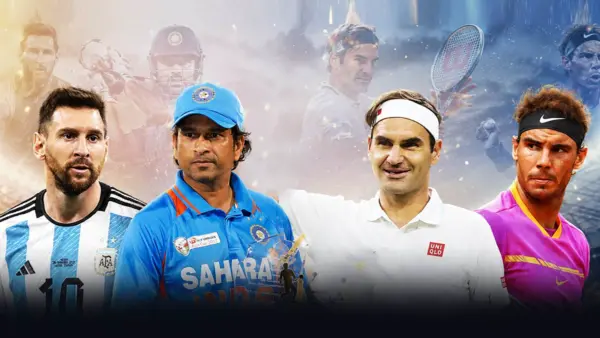
Messi, Tendulkar, Federer, Nadal—and the hardest decision in a great career: knowing when enough is enough
The hardest moment in a great career is not proving that you can still win.
It is deciding that you no longer need to.
That is what makes the retirement of a legend so strangely moving. The world expects failure to end a career. But the greatest often leave before failure forces them to.
They walk away while there is still applause left. While the body can still produce a few more performances. While the crowd is still asking for an encore.
Lionel Messi’s decision to step away from Argentina Football team is one of those moments.
At 39, he is not leaving because football has rejected him. Quite the opposite. He won the World Cup in 2022, took Argentina to another final in 2026 and scored eight goals in the tournament. He leaves international football as Argentina’s most-capped player and leading scorer, with 207 appearances and 125 goals. His club career continues.
And yet, Messi has decided that the Argentina chapter should end here. His words are revealing: the decision hurts him deeply, but he believes this is the right time.
That phrase—the right time—is far more difficult than it sounds. Because when you are still capable of doing more, how do you know when you have done enough?
Perhaps that is the real test of greatness.
Not knowing how long you can continue, but knowing when continuing would add less to your story than leaving would.
Sachin Tendulkar faced that moment too.
After 24 years and 200 Tests, he walked away from the game he had lived since childhood. There was no dramatic collapse, no humiliation, no one forcing him out. There was simply the realisation that a journey that had begun with an 11-year-old boy had reached its natural destination.
For Sachin, retirement was not the end of a profession.
It was the separation of a man from the identity he had carried almost all his life.
Roger Federer heard a different message. His body had been warning him for years—through injuries, surgeries and increasingly difficult recoveries. At 41, he finally accepted what the greatest athletes eventually must:
The mind can remain young long after the body has started keeping score.
Rafael Nadal’s battle was more prolonged still. At 38, after years of fighting injuries, he accepted that the body could no longer sustain the demands of the sport.
Federer listened to his body.
Nadal listened to time.
Sachin listened to his heart.
Messi, perhaps, listened to completion.
Four legends. Four endings. Four different reasons to stop. Yet none waited for the world to tell them that they were finished.
They recognized the moment themselves.
And that is where sport suddenly becomes life. Most of us will never play a World Cup final. We will never hear 70,000 people chant our name.
But many of us will eventually face a quieter version of the same question.
When should I stop?
For a professional in his or her fifties, that question can be more unsettling than any performance review.
For three decades, the profession has been part of the identity: I am a journalist. I am a doctor. I am an officer. I am a businessman. Etc…
Then one day, the designation disappears. The visiting card changes. The chair gets another occupant. And suddenly, the question is no longer about the job.
It is about the self.
Who am I when I am no longer what I used to do?
That may be the real anxiety of retirement—not losing the salary or even the status, but losing the version of yourself that existed because of the job.
Which is why some people never really retire. Even when they can afford to. Even when they no longer need the money.
Because they have spent so many years being important that they have forgotten how to simply be. And perhaps this is where the legends teach us something the rest of us often learn too late:
Being indispensable is not the same as being valuable.
Every organisation survives its leaders. Every team finds another captain. Every generation eventually makes room for the next.
The difficult part is accepting that you are replaceable without believing that you are worthless.
Once you do, something liberating happens. You stop protecting your position. You start passing on your experience.
The player becomes the coach.
The boss becomes the mentor.
The expert becomes the teacher.
The person who once competed for space begins creating space for others. I guess, that is the real privilege of age.
Not being the most important person in the room, but being secure enough to make someone else important.
The Bhagavad Gita offers an unexpectedly relevant thought here: ‘Karmanye vadhikaraste, ma phaleshu kadachana.‘
We usually read it as a lesson in detachment from the fruits of our actions. Perhaps, later in life, it offers another lesson: Your worth cannot depend forever on the scoreboard.
For much of our working lives, we count the score—promotions, money, awards, titles, influence. Then comes a point when the more important question is no longer What did I achieve?
It is: What will I do with everything I have learned?
That is when a career can become a legacy. And perhaps that is also how we know when the first innings is nearing its end.
Not when someone tells us we are finished. But when we no longer feel compelled to prove that we are still at our peak.
When we can watch someone younger take our place without feeling that we have lost ours. When we can leave a position without feeling that we have left ourselves behind.
That is not retirement. That is evolution.
The second innings, after all, should not begin the day after retirement. It should begin while the first one is still being played.
Make room for the friend you have postponed. The book you never read. The journey you kept delaying. The skill you always wanted to learn. The family that knew your designation better than your dreams.
Because there is a peculiar tragedy in modern life: We spend decades preparing financially for retirement, while postponing the life we hope to live after it.
•Messi has not left football.
•Tendulkar left international cricket, not his understanding of it.
•Federer left competitive tennis, not his relationship with the game.
•Nadal left the court, not the sport that shaped him.
Perhaps that is what a great retirement really looks like. You leave the stage. You do not leave the story.
Most of us will never get a World Cup final, a 200th Test or a farewell Grand Slam. Our last day may be much quieter—a desk cleared, an Access card deactivated, an email sent, a door closed.
No cameras. No applause. But the question will be the same.
Will we wait until someone tells us we are finished—or will we have the wisdom to recognise when our best contribution lies somewhere else?
Because perhaps the true mark of a legend is not how long he stays in the game.
It is knowing when the game has given him everything— and when it is time to give something back.