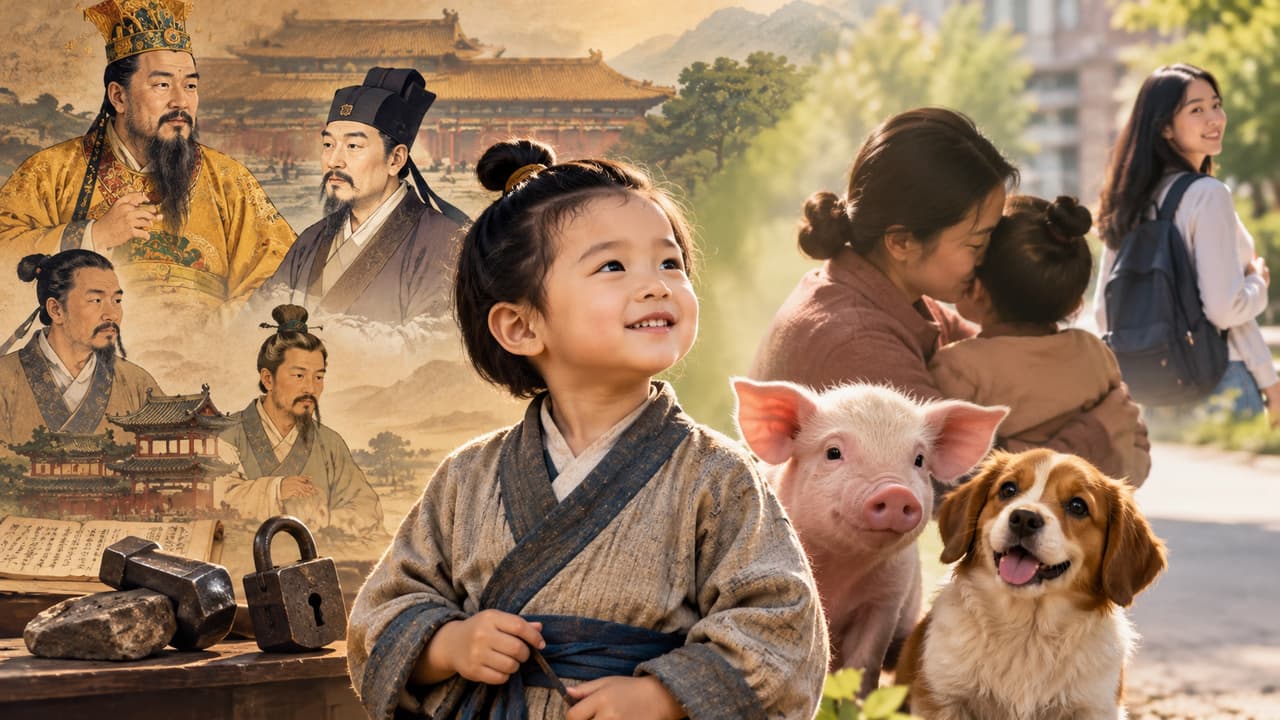
Some traditional Chinese nicknames can leave outsiders astonished, with names meaning “Dog”, “Pig”, “Brick” or even “Dog Faeces”.
While people across the world often have nicknames alongside their official names, some traditional Chinese nicknames can leave outsiders astonished, with names meaning “Dog”, “Pig”, “Brick” or even “Dog Faeces”. Surprisingly, these seemingly insulting names were once rooted in parental love, superstition and a desperate desire to protect children from illness and misfortune.
The unusual tradition dates back to ancient China, when medical facilities were limited and life expectancy was considerably lower. Parents believed that giving their children humble, unflattering or even vulgar nicknames could help them grow up healthy and escape the attention of evil spirits.
For many families, the more ordinary or unattractive a nickname sounded, the better. Some parents even named their children after animals such as dogs and pigs, hoping they would inherit the creatures’ perceived strength, vitality and resilience.
According to Ouyang Xiu, a celebrated literary figure of the Northern Song dynasty (960–1127), families who wanted their children to survive and grow up safely often deliberately chose humble names. In his book Dao Shan Qing Hua, he recorded examples such as gou sheng (food left over by dogs), gou dan (dog and egg), gou shi (dog faeces) and zhu wa (piglet).
Others preferred names inspired by hard and durable objects, including stones, iron hammers, iron pillars and locks. Such names reflected parents’ hopes that their children would develop the toughness to withstand diseases, hardships and other misfortunes.
Rustic and inconspicuous names were also popular, as some families believed that avoiding impressive or attractive names would prevent evil spirits from noticing their children.
Even emperors and celebrated writers had unusual nicknames
The practice was not confined to ordinary households. Historical records suggest that even emperors, celebrated writers and prominent military figures were given nicknames that would sound bizarre by modern standards.
Emperor Wu of the Western Han dynasty (202 BC–9) reportedly had the nickname zhi, meaning “pig” in ancient Chinese. Sima Xiangru, a renowned writer and diplomat of the same dynasty, was known as quan zi, meaning “dog’s child”.
Fan Ye, a historian from the Southern dynasties (420–589), was nicknamed zhuan er, meaning “brick”. Meanwhile, Xin Qiji, the celebrated poet and general of the Southern Song dynasty (1127–1279), gave his son the nickname tie zhu, meaning “iron pillar”, according to one of his poems.
Zhu Yuanzhang, the founding emperor of the Ming dynasty (1368–1644), was nicknamed chong ba, meaning “the eighth”, because he was the eighth child in his family.
From protective blessings to embarrassing childhood memories
With advances in medicine and changing social attitudes, the tradition has gradually faded. Few Chinese families continue to give their children such humble nicknames today, although the practice reportedly survives in some rural communities.
Yet, for those who grew up with these names, the memories can be both affectionate and embarrassing.
A woman born in the 1980s in northwestern China’s Shaanxi province shared her experience on social media, revealing that her nickname was gou dan (dog and egg). The name became particularly embarrassing when her mother visited her at university and called her by it in front of her roommates, who burst into laughter.
“How embarrassed I was at the time! But my mother is used to calling me that. Afterwards, I asked her not to use the name outside the home,” said the woman, identified by her surname, Zhang.
Zhang explained that her parents had insisted on using the nickname because she had nearly died from an illness when she was only a few months old. For them, the name was not an insult but a symbol of their hope that their daughter would survive and grow up healthy.
A TV series brings the centuries-old tradition back into the spotlight
The age-old custom returned to public conversation in 2024 with the release of the comic television series Gou Sheng Running Quickly. The show follows the story of an orphan named gou sheng (food left over by dogs) as he grows up, bringing renewed attention to the cultural significance of humble nicknames.
The series sparked heated online discussions, with some people viewing the practice as an outdated superstition while others defended it as a heartfelt expression of parental affection.
“These humble nicknames carry parents’ heartfelt blessings. I think this tradition should be preserved,” one person commented.
Another user shared a striking family anecdote: “I have an uncle in his 70s whose nickname is ye hu (chamber pot). Everyone in my family calls him that, and I don’t even know his real name.”
Though names such as “Dog”, “Piglet” and “Iron Pillar” might sound strange or even offensive today, their origins reveal a different story. Behind these unconventional nicknames lay the fears, hopes and affection of parents who wanted nothing more than to see their children survive and thrive.