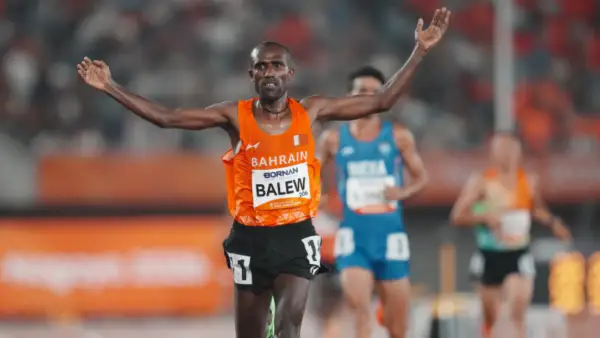
The African presence has stamped its class in track and field at the Asian Games.
In three races (Women’s 10,000m, Men’s 10,000m, and Mixed 4x400m relay), African athletes who switched nationalities, stormed to the podium and in two of them pipped Indians to the gold medal.
This is not the first time that African born athletes are participating in the Asiads. But not only has the number of medals won by them increased (from 14 in 2014 to 16 in 2018), so has the number of countries they represent. For India, it’s a challenge because track and field, especially middle distance events, is the strongest suit for the country. Indian athletes have to dig deeper to finish on the podium.
In men’s 10000m, Gulveer Singh won a silver after Ethiopia-born Birhanu Balew of Bahrain won the gold. Gulveer, one of the best Asian long distance runners at the moment, was in the lead throughout his race. He looked destined for a great finish given his devastating last kick but it was Balew who produced the tremendous last kick, opening a big lead over the Indian and finishing 1.87 seconds ahead of the Indian.
It not only impacts the podium at the Asian Games but also the record books. For example, the all time Asian top 10 list of men’s 5000m, has eight African-born athletes and two native Asians- Moukhled Al Outaibi of Saudi Arabia and Gulveer.
Similarly, in the women’s 3000m Steeplechase, Parul Chaudhary is the only native Asian in the top five of all time top list with the other four being African athletes switching to represent Bahrain and Kazakhstan.
It has also cost India sprint medals specially at the 2018 edition when Dutee Chand in 100m and 200m and Hima Das in 400m lost to Nigeria-born sprinters Edidong Odiong and Salwa Naser.
Not a new trend
African athletes, specially from Ethiopia, Kenya, Nigeria, and Sudan, have completely changed the medal tally of Athletics at the Asian Games. Gulf countries, specially Qatar and Bahrain, have benefitted mostly from these transfers while the likes of Kazakhstan have been the recent benefactors.
Qatar was one of the earliest adopters of the practice when Somalia-born Mohamed Suleiman in the 1500m discipline became their first Olympic medallist at the 1992 Barcelona Olympics.
It started mainly at the 2006 Doha Asian Games where Kenya-born runners won the men’s 800m, 1500m, 5,000m, 10,000m, 3000m steeplechase and marathon for Qatar and Bahrain. The practice increased after 2006 and was at peak during the period of 2012 to 2016 where Bahrain got 18 athletes from Kenya, 17 from Ethiopia, 5 from Morocco and 2 from Nigeria.
It coincided with the improvement in medal tally as Bahrain went from nine athletics medals in 2010 Asian Games to 19 (9 gold) in 2014 Incheon edition, 26 (12 gold) in 2018 Jakarta edition, and 16 (10 gold) in 2023 Hangzhou edition.
The uber rich Gulf countries tended to negotiate with the family of these athletes giving them a good lifestyle and a chance to compete at the top level. Like in the case of Balew, whose family is taken well care of and keeps switching between Bahrain and Ethiopia.
“Life has changed for me after I started competing for Bahrain. I drive a Corolla and have a new home. I train in Ethiopia mostly year round. I love Bahrain, my family keeps switching between Bahrain and Ethiopia,” Balew told the media after his 2026 Asian Games gold medal.
However, the bulk transfers in the period based purely on financial arrangements, resulted in World Athletics freezing the transfer of allegiance from February 2017 to July 2018. It was resumed only after new reforms were announced in 2018.
Hamad Kalkaba Malboum, IAAF Council representative for Africa, condemned the system and called it “a wholesale market for African talent open to the highest bidder.” Under the new laws, there was a new waiting period of three years and an age limit of 20 for athletes to be eligible for transfer.
Despite the stringent laws, WA recently blocked a move of 11 athletes including 2024 Paris Olympic discus gold medalist Rojé Stona (Jamaica), former marathon world record-holder Brigid Kosgei (Kenya), shot putter Rajindra Campbell (Jamaica), long jumper Wayne Pinnock (Jamaica), and sprinter Favour Ofili (Nigeria) transferring to Turkiye terming it a “coordinated recruitment strategy led by the Turkish government.”
The increasing trend of African-born athletes competing at Asian Games has two sides to it, one is the rising competition and the other is denying medals to the genuine Asian talent.
The situation can be debated about the right and the wrong but at the moment it remains the reality for the native Asian athletes.