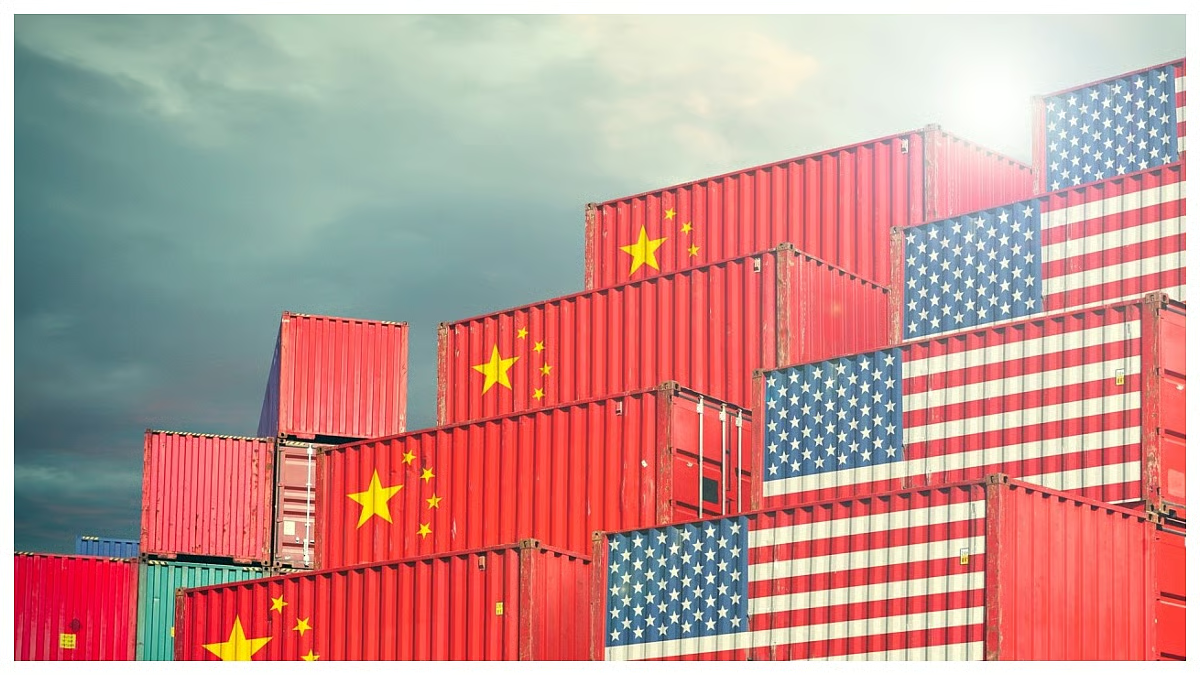
India has been included in Tier 1 of a new White House report examining countries that could potentially be used to reroute Chinese goods and evade US tariffs.
The 25-page report, The Great Transshipment Scam, identifies more than 40 countries with elevated transshipment risks and places India alongside Canada, the European Union, Japan, South Korea, Taiwan, Mexico and Israel under the category “Diversified Scale Leaders.”
Importantly, the assessment does not announce any new tariff on Indian exports. Nor does Tier 1 imply that most goods exported from India violate US customs rules.
Instead, the category covers large industrial economies that process significant volumes of China-linked products while serving as major export platforms for the American market.
The White House argues that transshipment risks are embedded within otherwise legitimate trade flows. However, it uses strong language to describe India as a significant “enabler” of China-linked transshipment, alleging that limited assembly, repackaging, relabelling or documentation changes can sometimes be used to alter a product’s declared country of origin.
Origin rules in focus
The report specifically highlights the Pune-Gujarat-Chennai manufacturing corridor as a potential channel for pumps and compressors classified under HS codes 8413 and 8414.
It compares this corridor with competing manufacturing regions in the United States but stops short of naming any Indian company or quantifying allegedly suspect shipments.
The report clarifies that routing goods through a third country is not illegal by itself. A violation occurs only when exporters falsely claim a new country of origin despite the product undergoing insufficient processing, often referred to as “substantial transformation.”
It cites so-called “screwdriver factories” as examples of facilities carrying out minimal assembly primarily to support a different origin claim.
The findings come as India and the US work towards finalising an interim bilateral trade agreement. The framework announced earlier this year already includes rules of origin designed to ensure that trade benefits accrue primarily to products genuinely manufactured in India or the US.
As a result, Indian exporters using Chinese components may face increased documentation requirements to prove adequate value addition. While the White House report raises compliance concerns, it does not alter existing tariff rates or impose India-specific trade penalties.