The terms “pickup” and “utility truck” are often used interchangeably, even though they aren’t always supposed to be. Sure, there’s an overlap here and there, but the two handle very different jobs.
The pickup is the more common term, so let’s start there. defines a pickup truck as “a light truck having an enclosed cab and an open body with low sides and tailgate.” In other words, what typifies a pickup is that open cargo bed at the back. This bed is typically left open to the sky, unless you opt for a tonneau cover, a truck cap, or a camper shell. There’s plenty of other stuff that can change from one truck to the next, like the size, but the bed stays put.
The word itself actually traces back to Henry Ford and a special version of the 1925 Model T Roadster with a bed on the rear, which he coined the term “pickup” for. The goal with that vehicle was to provide farmers with something they could put to work. Roughly 135,000 units were sold throughout its life — and the term eventually caught on as well.
Meanwhile, the other term, “utility truck,” has had a fuzzier start. One of the earliest mentions was with the WWII Willys Jeep, which was billed by AM General as the country’s first four-wheel-drive tactical utility truck. Eventually, it settled onto other purpose-built pickups that power, water, and telecom crews drive.
The overarching meaning is a pickup truck built for a specific task, rather than being multipurpose. The defines a utility vehicle, also called a utility truck, as “a truck with low sides designed for carrying small loads.” That sounds generalized, but when an American says utility truck, they usually mean a work rig and aren’t thinking of a consumer pickup at all.
How to tell one apart from the other
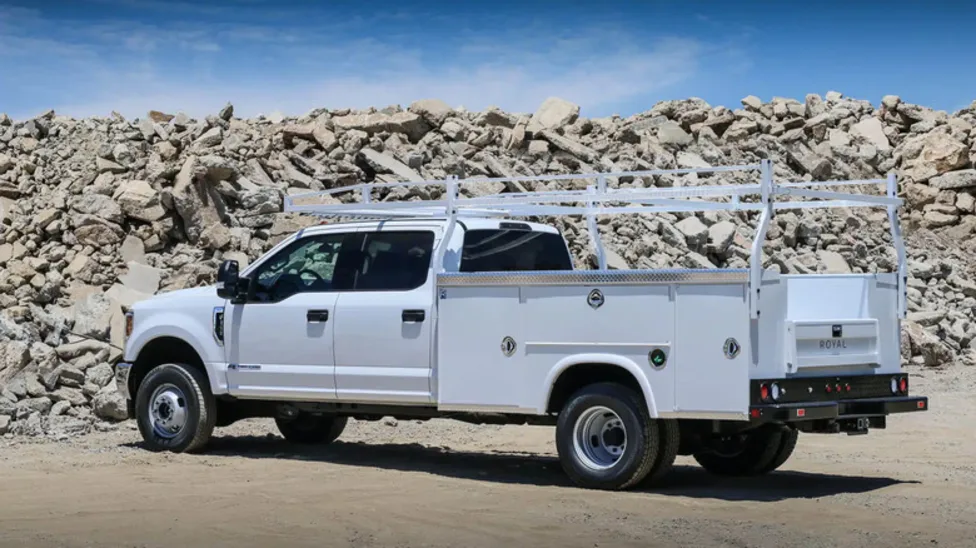
The easiest way to tell a utility truck from a plain pickup truck, though, is that bed around the back. In utility trucks, you typically get a more specialized setup on the rear. This may include a crane for hoisting heavy parts if the truck is intended for construction, or towing equipment like a tilt tray if it’s a tow truck. Besides this, the bed may feature lockable compartments, drawers, and shelves for tools. Obviously, none of this is stock.
Common pickup models that get such treatment are the Ford F-250 and F-350 Super Duty. The bare XL trim often leaves the lot as a plain pickup. From there, it heads straight to an upfitter, who takes the open bed out and replaces it with a service body. These upfitters are often third-party makers like Knapheide and .
So is one a subcategory of the other? Sort of, though even that depends. If the truck started life as a pickup, then yes, the utility truck is just that pickup with a work body. But the term often stretches wider than that and covers just about any specially equipped vehicle. And those vehicles may not always be pickup trucks. Some barely belong on a road at all, which we’ll get to.
Utes and how not every utility vehicle is a truck
But first, also worth mentioning here is the term’s shorthand, “ute,” commonly used in Australia and New Zealand. It points to a distinct design that’s big there, where .The thing is, a ute is a utility truck in name only. In function it sits much closer to a pickup, which makes it more of a subcategory of that. This goes to show how the two classifications bleed together, sometimes one way, sometimes the other.
Also worth mentioning here is the much smaller utility vehicle that’s neither a truck nor a ute. It’s known as a UTV (utility task vehicle), and you may have seen it buzzing around a golf course, a college campus, or a city park. A common example of these is the .Their whole point is that they do a specific job that a full-size truck would be simply too bulky or expensive for. Indeed, a small 4×4 from this category costs between just $12,500 and $20,000, which is half the starting price of $30,000 you’d need for a pickup. What makes them especially shine is how little room they need to turn around. Where a utility truck would never squeeze down places like a warehouse aisle or between livestock pens, these manage perfectly fine.
Ultimately, the word “utility” can refer to both vehicles, as long as they’re built for specific tasks. Where one spends its days off the road on grounds and trails, the other is the full-size work truck.