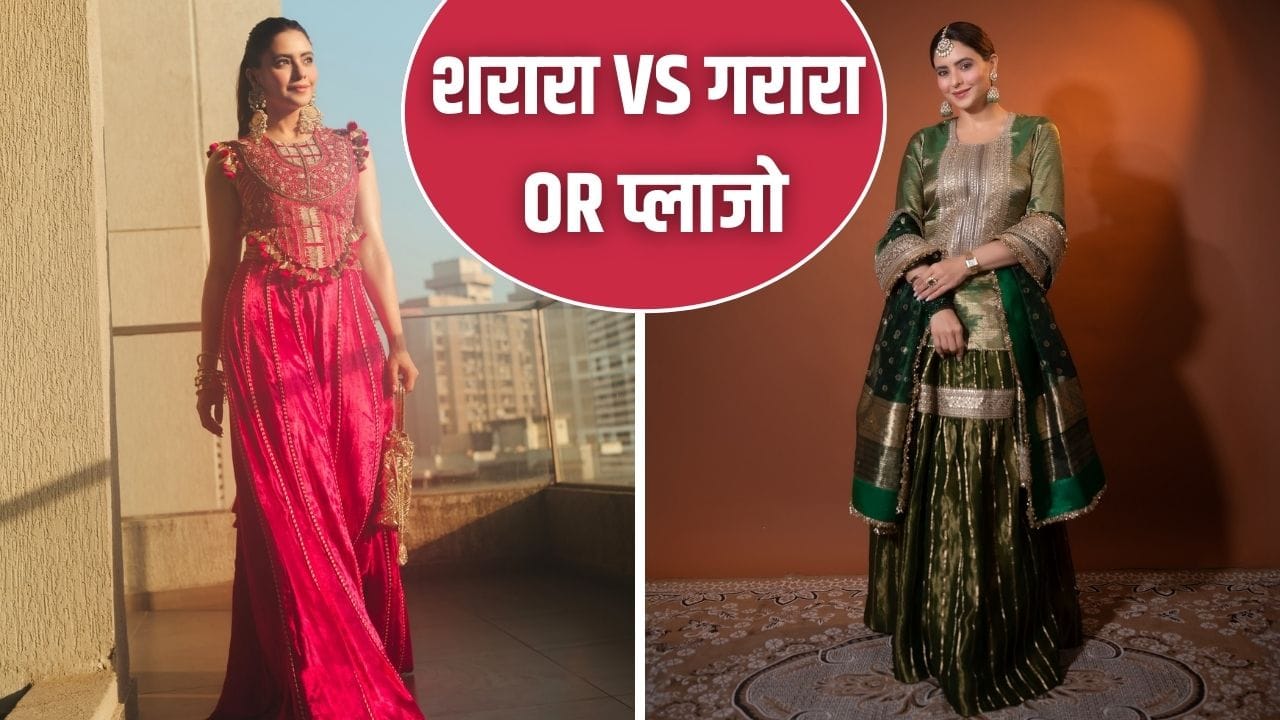
Difference between Sharara, Garara and Palazzo
Changes keep coming in fashion, but it is often seen that old outfit designs are presented in a new way. The traditional attire worn in India has also undergone many changes with time. Talking about outfits like slacks, shorts and pants, the most popular attire styles are Sharara, Garara and Palazzo. At first glance, these three trousers look similar, but there is a lot of difference between them. Which includes overall cutting, stitching. Flare detailing etc. While doing online shopping, many times people get a little confused in differentiating between Sharara, Garara and Palazzo. In such a situation, let us know how you can differentiate between these three trousers.
If you are also planning to go shopping for a special occasion and want to buy a set based on Sharara, Garara or palazzo, then this article can be useful for you, because in this all three types of bottoms have been differentiated on the basis of design. With this you will be able to easily differentiate between Gharara and Sharara as well as palazzo suit. So let us know.
Sharara detailing
When you wear Sharara, it looks exactly like a skirt, but it is actually a trouser. Actually Sharara is a flared wide bottom pant, which is fitting at the waist and flares in A line near the glutes. This gives it a ghagra like look.
Flared Pattern: The specialty of Sharara is that it is made of a single cloth i.e. there is no cut in the middle and the flare pattern in its cutting extends continuously forward from wherever it starts i.e. in A line.
Fabric used: Fabrics like georgette, chiffon, satin or crepe are generally used to make sharara so that its flare remains open and gives a flowy look.
Ways to wear: Sharara is often carried with long kurti. However, sometimes it is also worn with knee length kurti and peplum top.
Garra detailing
Garara became quite popular during the Mughal period and even today it is liked among Indians. Garara is especially carried in functions etc. It is also flared, but it has fitting till the knees and after that it is flared. Most of the Garara is cut into 2 pieces. The flare i.e. the gher is created with pleated detailing in the upper knee part and then in the lower part.
Difference in stitching: In Sharara, once the flare starts and runs in A line, whereas in Garara, the upper part is fitted and extends from the knee.
Heavy Look: Zari work, Gota Patti work etc. are often used on Garara and it gives a more heavy look, hence it is worn more on occasions like weddings.
This is how to carry: Garara is often worn with short kurti, whose length is up to half thigh. Apart from this, women also carry Garara with short frock and Angrakha Kurti.
Palazzo looks like this
If we talk about palazzo, it is made from a combination of both sharara and gharara, that is, it is a modern design of both these bottoms. This is a kind of velvet pant which is very comfortable to wear and can be carried in traditional as well as fusion style.
Difference in cutting: Palazzo is similar to Sharara, but instead of being very flared, the cutting is a little straight instead of A line.
Fabric: Apart from cotton, palazzo is made from rayon, linen or mixed fabric. It has been designed according to comfort.
Modern Look: Palazzo pants are inspired by modern fashion. These can be styled on casual occasions, as they either have very little or no embroidery.
Fusion Look: Most people create a fusion look in palazzo instead of pure ethnic. Matching crop tops to long shrugs are carried with it like a co-ord set.
Also read: Syara actress Aneet Padda is very glamorous, see her amazing looks here