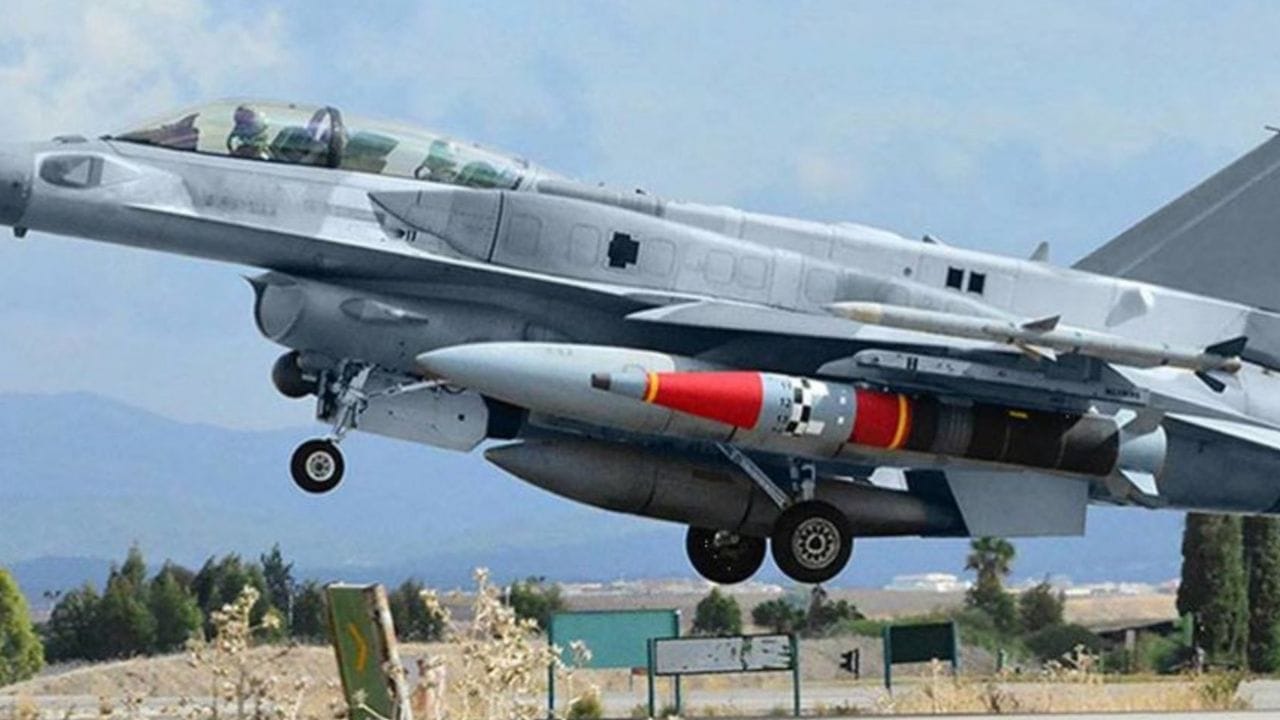
New Delhi: Israel has reportedly offered India the Golden Horizon air-launched ballistic missile (ALBM), a deep-strike system designed to be deployed from fighter aircraft.
According to open-source defence reporting, the Golden Horizon is designed for launch from the IAF’s Sukhoi Su-30MKI fleet and would allow Indian strike aircraft to engage high-value targets deep inside adversary territory without entering heavily defended airspace.
While there has been no official confirmation from New Delhi over the proposal, defence assessments shows that the missile may have an estimated range between 800 kilometre and 2,000 kilometre, depending on configuration. The system is believed to be derived from Israel’s Silver Sparrow target missile. It was earlier used in missile defence trials to simulate ballistic threats and then adapted into an operational air-launched weapon.
Capabilities of ALBM
Unlike cruise missiles, which fly at low altitude along sustained trajectories, ballistic missiles follow a high-arc flight path before descending at extremely high speed. According to defence analysts, the Golden Horizon’s terminal velocity could approach hypersonic levels, above Mach 5, complicating interception by conventional air defence systems. The high-speed impact is also expected to expand its ability to penetrate hardened and underground targets.
The system would represent a distinct category of capability compared to tactical missiles already in Indian service. Israel has earlier supplied India with systems such as the LORA, with a reported range of around 400 kilometre, and the Rampage missile, which has an approximate range of 250 kilometre. These systems are primarily designed to target battlefield assets such as radar installations, air defence batteries and ammunition depots.
By contrast, the Golden Horizon is believed to be tailored for fortified and deeply buried facilities, including underground command centres, reinforced military infrastructure and potentially nuclear-related installations.
India and Israel prepare to deepen defence cooperation
The offer comes as India and Israel prepare to deepen defence cooperation ahead of Prime Minister Narendra Modi’s scheduled visit later this month. Discussions are expected to focus on areas including anti-ballistic missile defence, laser systems, long-range stand-off weapons and unmanned platforms. Although a memorandum of understanding on security cooperation is likely, no major defence contract is expected to be formally announced during the visit.
Open-source defence analysts added that an air-launched ballistic missile would enable the IAF to strike adversary airbases, command nodes and logistics hubs from beyond the reach of long-range surface-to-air missile systems and beyond-visual-range fighter aircraft.
Analysts have also raised the possibility of India pursuing parallel indigenous development under the Aatmanirbhar Bharat framework. India has ongoing programmes in areas such as air-launched BrahMos variants, hypersonic research and miniaturised ballistic systems. However, the development and certification of a fully indigenous ALBM could take several years.