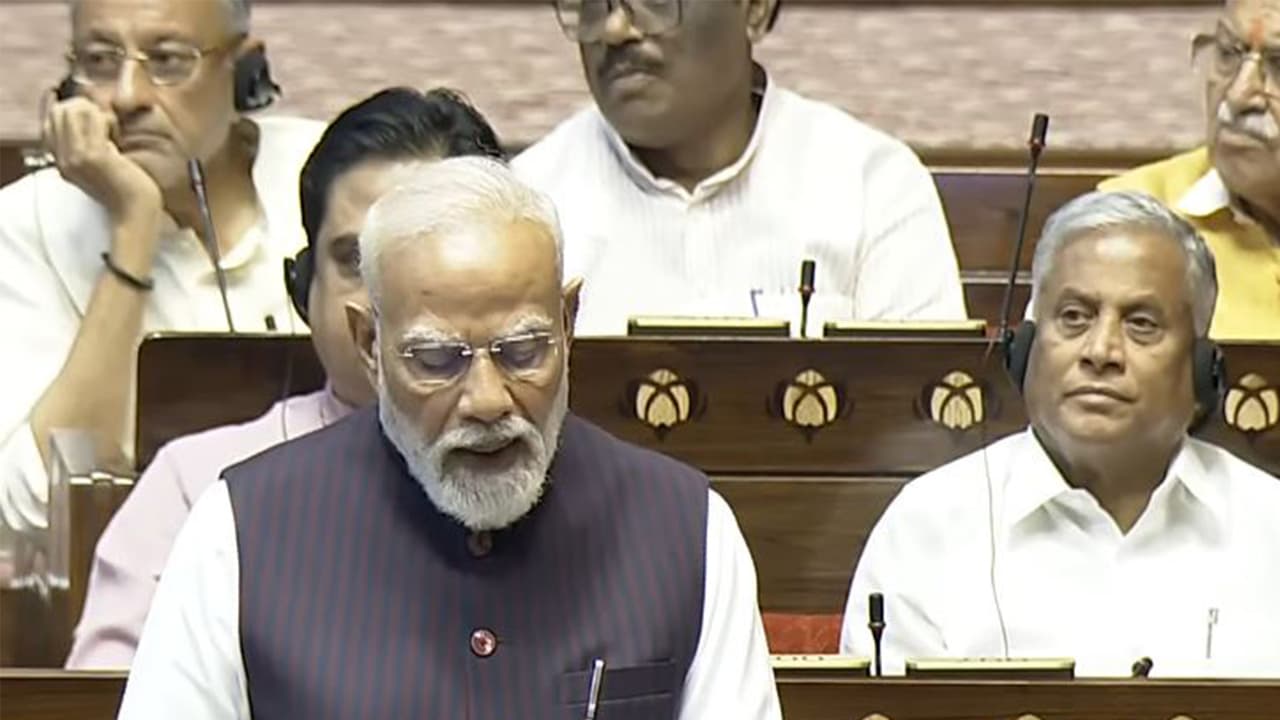
PM Modi urged Centre-state unity to tackle the West Asia crisis, calling for the implementation of PM Garib Kalyan Anna Yojana and action against hoarders. The Opposition, including Rahul Gandhi, criticized the address as partisan and lacking substance.
Calling the coming time a “major test” for the country, PM Modi sought cooperation from state governments and asked them to implement the PM Garib Kalyan Anna Yojana. Addressing the Upper House of the Parliament, he said, “In the coming times, this crisis will be a major test for our country, and the cooperation of states will be crucial for success. Therefore, through this House, I would like to make a few requests to all state governments. In times of crisis, the poor, workers, and migrant companions are most affected. Therefore, it must be ensured that the benefits of the PM Garib Kalyan Anna Yojana reach them on time. Proactive steps should be taken to ease the difficulties of migrant workers wherever they are employed.”
He added that the state governments must take action against black-marketeers and hoarders to ensure the supply of essential goods to the public. “If state governments make special arrangements to monitor such situations, it will provide significant relief. State governments must also pay close attention to another challenge: in such times, black-marketeers and hoarders become very active. Wherever such complaints arise, immediate action must be taken. Ensuring an uninterrupted supply of essential goods must be the top priority of every state,” the Prime Minister said.
Recalling the COVID-19 pandemic, PM Modi asked the states to take each necessary step and reform swiftly. “I would also like to make another request to all state governments. No matter how severe the crisis, maintaining India’s rapid growth is our collective responsibility. For this, every necessary step and every necessary reform must be carried out swiftly. This is also a great opportunity for state governments. During the great crisis of the pandemic, the Centre and the states together presented an excellent model of COVID management. Despite the governments of different political parties, testing, vaccination, and the supply of essential goods were ensured through India’s efforts. We must continue to work in the same spirit. With the combined efforts of all state governments and the central government, the country will be able to face this grave global crisis effectively,” the PM said.
Centre’s strategy to tackle crisis
The Prime Minister also announced that the Centre has established seven empowered groups to work for a “swift and far-reaching strategy” for fuel and gas supply amid the West Asia conflict. PM Modi said that the government has also formed an interministerial group to assess the challenges.
Acknowledging the global crisis amid the tensions in West Asia, PM Modi noted that the fundamentals of the Indian economy are strong and the government is ensuring “minimum impact.” He said, “The current crisis has shaken the entire global economy. The world will take a lot of time to recover from the loss in West Asia. To ensure that there is minimal impact on India, continuous efforts are being made. The fundamentals of our economy are strong. The government is keeping an eye on the frequently changing situation. Government is working strategically for its short-term, medium-term and long-term impact.”
“The Indian government has also formed an interministerial group which meets regularly and assesses all the problems that occur in our import-export. This group has also been working on necessary solutions. Seven empowered groups were formed yesterday. This group will work under a swift and far-reaching strategy for supply chain, petrol, diesel, gas, fertilisers, inflation and other essential things. I am confident that we will be able to face the situation better through a joint effort,” the Prime Minister added.
He maintained that India has sufficient crude oil reserves and robust arrangements for continuous supply amid the ongoing West Asia conflict. He highlighted the expansion of strategic petroleum reserves and increased refining capacity, as global trade through the Strait of Hormuz faces disruptions.
Opposition slams PM’s address
However, the Opposition criticised PM Modi’s address as “partisan” and slammed his handling of the situation.
Rahul Gandhi alleges govt following US, Israel orders
Amid reports of Pakistan allegedly facilitating talks between Iran and the US, Leader of the Opposition in the Lok Sabha, Rahul Gandhi, alleged that PM Modi will follow the orders of America and Israel. Further criticising the Indian government’s foreign policy, Gandhi declared that the Prime Minister is not working in the interest of the country at large. Commenting on the upcoming all-party meeting on the West Asia crisis, he mentioned that he wouldn’t be able to attend the meeting due to a scheduled programme in Kerala. “I would not be able to attend because I have a program in Kerala. All-party meeting should take place, but a structural blunder has been made… And this cannot be fixed, especially since the Prime Minister cannot. He will do whatever America says and will not work in the interest of the farmers and the country. He will do whatever America and Israel say,” Rahul Gandhi said.
Jairam Ramesh calls address ‘self-praise’
Congress MP Jairam Ramesh said that the Opposition was not allowed to seek clarifications over the West Asia conflict after the PM’s address in the Rajya Sabha. In an X post, Jairam Ramesh called the Prime Minister’s address a “pre-prepared text brimming with self-praise.” Ramesh said, “The Prime Minister spoke in the Rajya Sabha for about 20 minutes this afternoon on West Asia. Just like his statement in the Lok Sabha yesterday, after reading out his statement in the Rajya Sabha as well, the opposition was not allowed to seek any clarification whatsoever. As expected, it was a pre-prepared text brimming with self-praise over all its so-called achievements of the past eleven years.”
Flagging “weakening of MGNREGA” with the Viksit Bharat–Guarantee for Rozgar and Ajeevika Mission (Gramin) scheme, he added, “Some hypocrisy was also on display, when he appealed for cooperation from those states whose constitutional rights are being continuously violated; when he asked the states to protect migrant workers after weakening MGNREGA, which proved to be a lifeline for migrant workers during the COVID-19 pandemic; and when he asked the states to implement the Pradhan Mantri Garib Kalyan Anna Yojana, which is based on the 2013 National Food Security Act that he had opposed while serving as Chief Minister.”
CPI(M) MP questions govt’s silence on war
Communist Party of India (Marxist) MP John Brittas also expressed dissatisfaction, stating that the opposition wasn’t allowed to seek clarification over the issue. Speaking to ANI, Brittas stated that whenever the Prime Minister or any other leader speaks in Parliament, the opposition is allowed to seek clarification. The CPI(M) MP stressed that PM Modi spoke on the current crisis, but didn’t mention the reason behind the same. “It is unfortunate that we were not allowed to seek clarification… Whenever the Prime Minister or any other leader makes a statement, we are allowed to seek clarification. Our question was why this government is silent on this war? The Prime Minister was silent; he only spoke on the crisis but said nothing about why this crisis occurred. This statement was a partial account of the facts,” said Brittas.
Conflict background and MEA update
The ongoing conflict in West Asia has entered its fourth week, disrupting trade routes through the Strait of Hormuz. Tensions escalated following the killing of 86-year-old Iran’s Supreme Leader, Ayatollah Ali Khamenei, in joint military strikes by the US and Israel on February 28. In retaliation, Iran targeted Israeli and US assets across several Gulf countries, causing further disruptions to the waterway and impacting international energy markets as well as global economic stability.
Meanwhile, today, the Ministry of External Affairs (MEA) highlighted extensive efforts made by the Government of India to facilitate the return of Indian nationals from the Gulf and West Asia amid regional airspace closures and flight restrictions. Two Indian LPG carriers, Jag Vasant and Pine Gas, have successfully transited through the strategic Strait of Hormuz, marking a significant movement in energy transport. (ANI)
(Except for the headline, this story has not been edited by Asianet Newsable English staff and is published from a syndicated feed.)