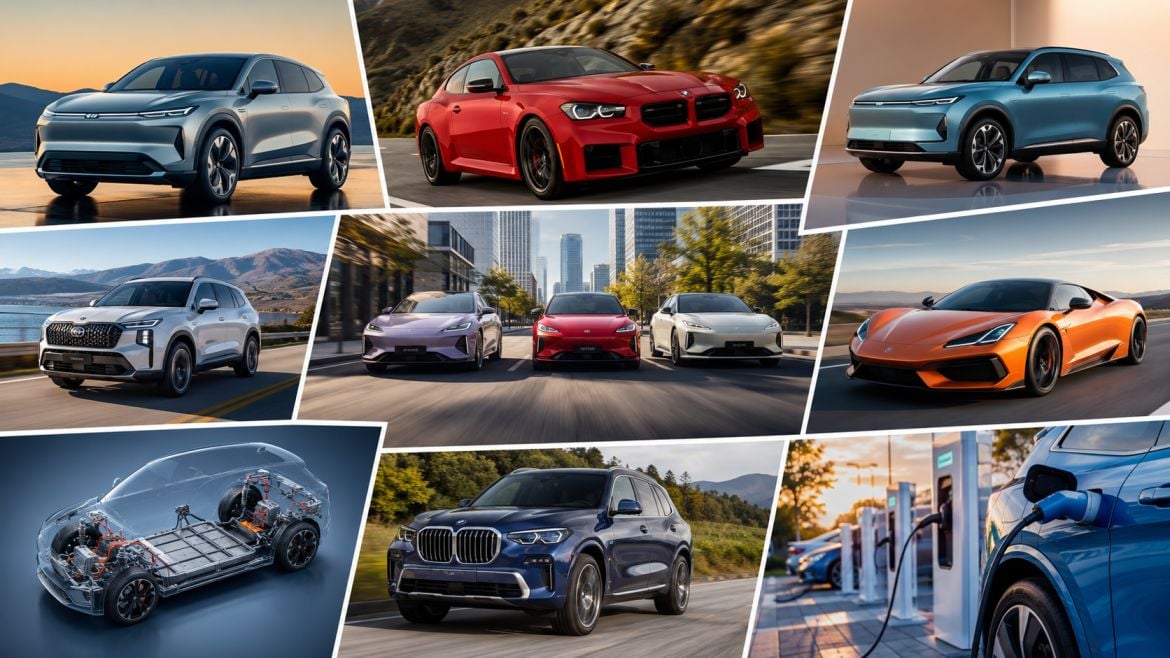
The global automotive industry has once again delivered a week packed with major developments. From manufacturers rethinking their electric vehicle strategies to record-breaking exports from China and the return of performance-focused combustion cars, the industry continues to evolve at an extraordinary pace.
Automakers are no longer chasing electrification at any cost. Instead, they’re balancing customer demand, profitability, and government regulations while investing in next-generation technologies. Here’s a look at the biggest stories that shaped the automotive world this week.
Carmakers Rebalance Their EV Plans
The biggest trend this week wasn’t a new vehicle launch but a noticeable shift in strategy among several global manufacturers.
After years of aggressively pushing electric-only futures, many brands are now slowing their transition. Rather than abandoning EVs, companies are focusing on profitable products while keeping hybrid and internal combustion models alive for longer.
Several manufacturers have delayed or cancelled planned EV programs as demand remains uneven across major markets, particularly in North America. Instead of chasing production targets, companies are investing in vehicles that better match customer buying patterns and regional infrastructure.
Industry analysts believe this marks the beginning of a more balanced automotive era where petrol, hybrid, and electric vehicles will coexist for much of the next decade.
China Continues to Rewrite the Global Auto Market
China’s automotive industry reached another milestone this week by setting a new monthly vehicle export record.
Chinese manufacturers are rapidly expanding across Europe, Southeast Asia, Latin America, and the Middle East, offering competitive pricing combined with increasingly sophisticated technology. Companies such as BYD, Geely, and Chery are strengthening overseas manufacturing operations while continuing to launch new models at an unmatched pace.
The rapid growth is forcing traditional manufacturers to rethink their global strategies. Many legacy brands are accelerating software development, reducing production costs, and searching for new partnerships to remain competitive.
Trade tensions remain a concern, with several governments reviewing tariffs and import policies, but Chinese brands continue gaining market share despite these obstacles.
BMW Faces Growing Pressure in China
Premium automaker BMW is facing one of its biggest competitive challenges in years.
Sales in China continue to face pressure as domestic EV brands attract buyers with faster software updates, advanced driver assistance systems, and competitive pricing. BMW is preparing its next-generation Neue Klasse platform to help reverse the trend, but competition has become significantly more intense than just a few years ago.
The company’s upcoming electric models are expected to play a critical role in restoring momentum in the world’s largest automotive market.
Performance Cars Refuse to Disappear
Despite the industry’s electrification push, enthusiasts received encouraging news this week.
Several manufacturers continue investing in high-performance combustion-powered vehicles alongside their electric offerings. Automakers increasingly believe that performance cars still hold strong emotional appeal and remain profitable in niche segments.
Rather than replacing sports cars overnight, many brands are choosing a dual strategy where electric performance models exist alongside petrol-powered flagships. This approach gives customers more choice while allowing manufacturers to transition at a realistic pace.
For enthusiasts, it signals that the sound and character of traditional performance engines are unlikely to disappear anytime soon.
Recalls Highlight Safety First
Safety remained a major talking point throughout the week.
Authorities across Europe and North America announced multiple recalls involving electrical systems, batteries, airbags, braking components, and software-related issues affecting several manufacturers.
While recalls often generate headlines, industry experts note that they also demonstrate increasingly sophisticated monitoring systems capable of identifying defects before they become widespread safety concerns.
Manufacturers continue issuing software updates remotely where possible, reducing inconvenience for customers while improving vehicle reliability.
Software Is Becoming the New Battleground
The competition between automakers is increasingly shifting from horsepower to software.
Consumers now expect their vehicles to receive over-the-air updates, intelligent navigation, advanced voice assistants and continuously improving driver assistance features.
Traditional manufacturers are investing billions in software development to compete with technology-focused newcomers that already treat vehicles as connected digital platforms.
The next generation of buyers is placing almost as much value on digital experiences as mechanical engineering, forcing even century-old brands to rethink product development.
Global Supply Chains Continue to Adapt
The automotive supply chain continues adjusting to changing geopolitical conditions.
Manufacturers are increasingly diversifying production across multiple regions instead of relying heavily on single manufacturing hubs. Battery production, semiconductor sourcing and critical mineral supplies remain key strategic priorities.
Companies are also building new factories closer to major consumer markets, reducing shipping costs while improving resilience against future disruptions.
This regional manufacturing approach is expected to become standard practice over the coming years.
Consumer Preferences Continue to Change
Customer priorities are evolving faster than ever.
While electric vehicles continue gaining popularity in many countries, buyers are also demanding affordability, long driving range and dependable charging infrastructure.
Hybrid vehicles remain particularly attractive for customers who want improved fuel efficiency without changing their driving habits.
SUVs continue dominating global sales, although compact crossovers and affordable urban mobility vehicles are also experiencing healthy demand as cities become increasingly congested.
Manufacturers are responding by expanding product portfolios rather than betting everything on a single technology.
Technology Partnerships Are Accelerating
Rather than developing every technology independently, many automakers are strengthening partnerships with software companies, battery suppliers and semiconductor manufacturers.
Collaborative development allows manufacturers to reduce costs while bringing new technologies to market faster.
Artificial intelligence is becoming increasingly important in manufacturing, predictive maintenance, autonomous driving development and customer personalization.
The automotive industry is gradually transforming into a technology industry where digital innovation is becoming just as important as mechanical excellence.
Looking Ahead
If this week demonstrated anything, it’s that the global automotive industry is entering a more practical and customer-focused phase.
Electrification remains the long-term direction, but manufacturers are acknowledging that different markets require different solutions. Hybrid technology, efficient petrol engines and battery-electric vehicles will continue sharing showroom space for years to come.
Meanwhile, Chinese manufacturers are accelerating their global expansion, legacy brands are reinventing themselves through software and next-generation platforms, and consumers are benefiting from greater competition than ever before.
The coming months promise even more significant announcements as manufacturers prepare for major international auto shows, unveil next-generation vehicles and reveal fresh investment plans that will shape the future of mobility.
For now, one thing is clear: the global car industry isn’t slowing down. It’s simply changing gears.