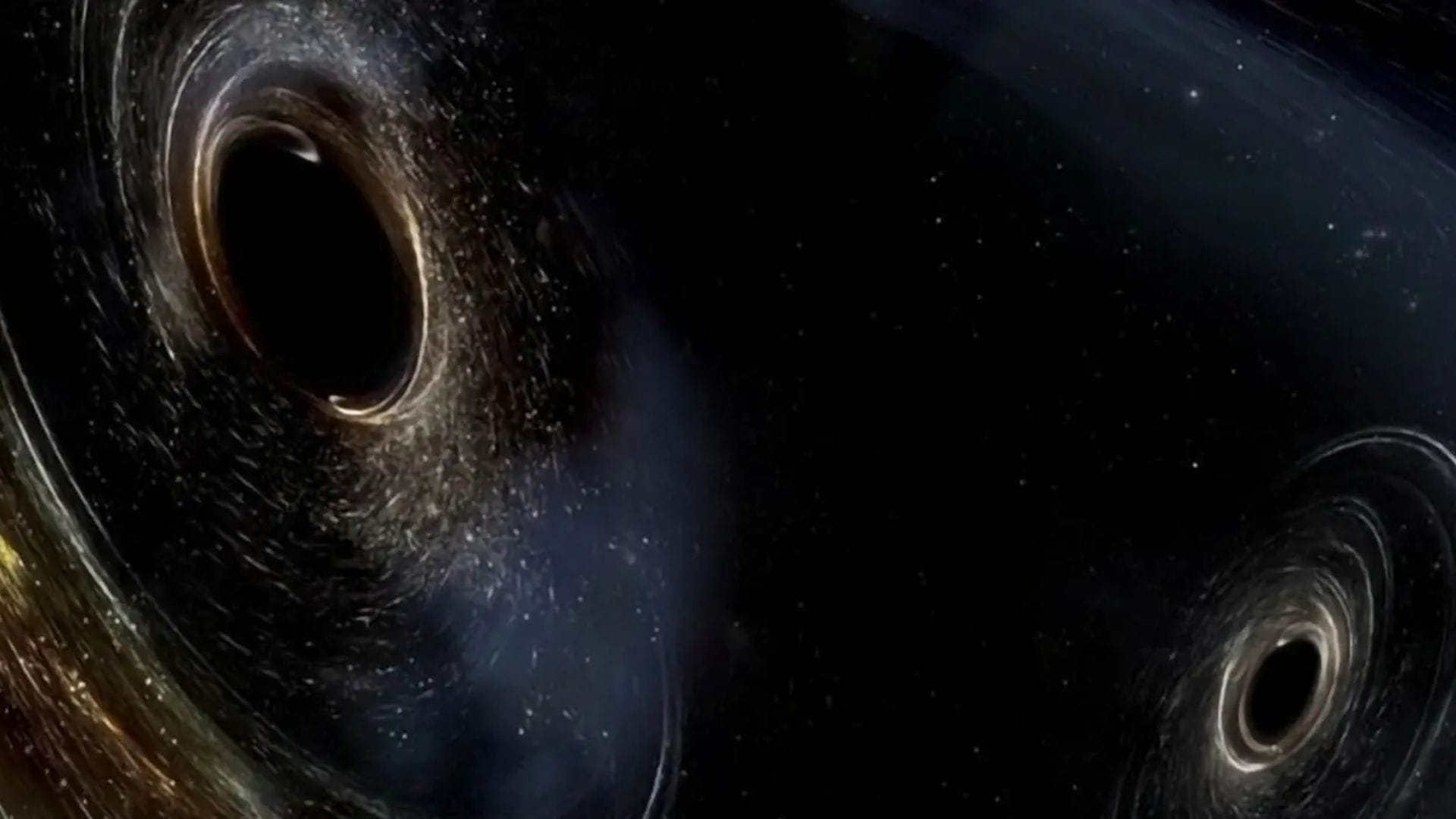
New Delhi: An international team of astronomers have spotted two unusual supermassive black holes that provide new evidence on galaxy formation, evolution and disruption. Both the supermassive black holes were discovered in the Virgo Cluster, at a distance of about 55 million lightyears from the Earth, comprising of 1,300 galaxies, even maybe 2,000. Many of these galaxies are interacting, allowing scientists to study galaxy evolution. The two discoveries show how the central supermassive black hole preserve a record of violent interactions between galaxies. The researchers intend to find more such systems in the Virgo Cluster and elsewhere, to refine models of galaxy evolution.
The compact galaxy designated as NGC 4486B located in the Virgo cluster contains a mass of about 360 million Suns, and is slightly offset from the centre of the galaxy. Most supermassive black holes occupy the cores of galaxies. Astronomers believe that this is an off-centre, post-merger supermassive black hole, providing scientists with a rare opportunity of studying how black hole mergers play into their growth over cosmological timescales. Catching a black hole soon after a merger allows scientists to understand how mergers sculpt the central regions of the host galaxies. Analysis of the gas in the galaxy suggests that the merger between galaxies occurred billions of years ago, but the central black holes merged only about 30 million years ago. The results appear in three papers in The Astrophysical Journal Letters.
A stripped galaxy
In a separate study, the team examined the ultra-compact dwarf galaxy UCD736, one of the smallest known stellar systems. The central black hole contains about two million solar masses, and makes up roughly eight per cent of the total stellar mass fraction of the galaxy. Most supermassive black holes contain less than one per cent of the stellar mass fraction, in galaxies such as the Milky Way. The finding suggests that UCD736 is the remnant of a larger galaxy that was stripped of its outer layers in the dense environment of the Virgo cluster, leaving behind its dense core and black hole.