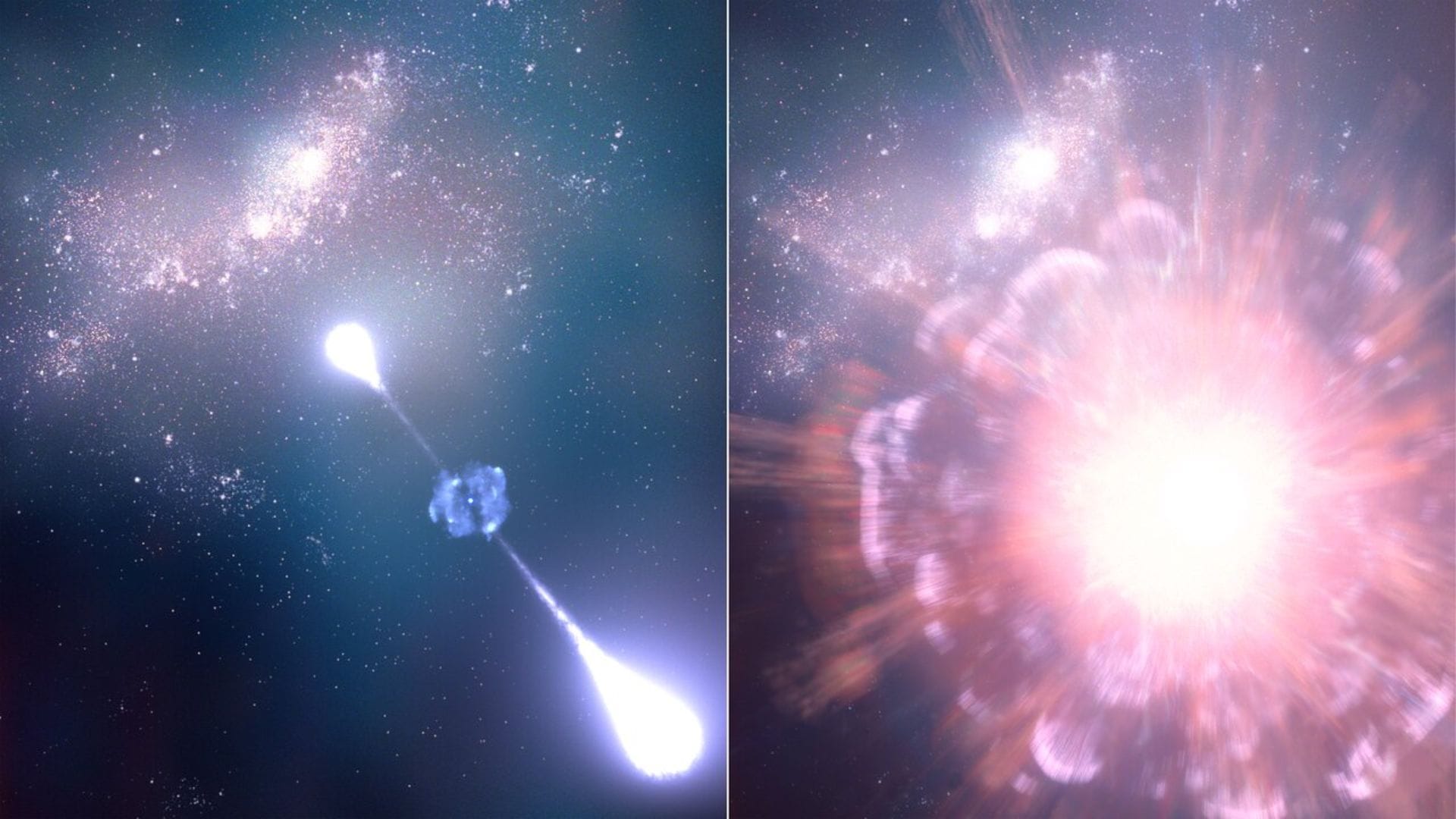
New Delhi: The James Webb Space Telescope has spotted a star dying within 730 million years of the Big Bang, after pointing towards a gamma-ray burst spotted in mid-March designated as GRB 250314A. Webb was also able to identify the host galaxy of the supernova, which is a first for such a distant event. Gamma-ray bursts are brief, lasting mere seconds or minutes, with supernovas increasing in luminosity over weeks before fading. This supernova however continued to increase in brightness for months. Webb turned to the source about three months after the initial detection, when scientists expected the supernova to peak in luminosity.
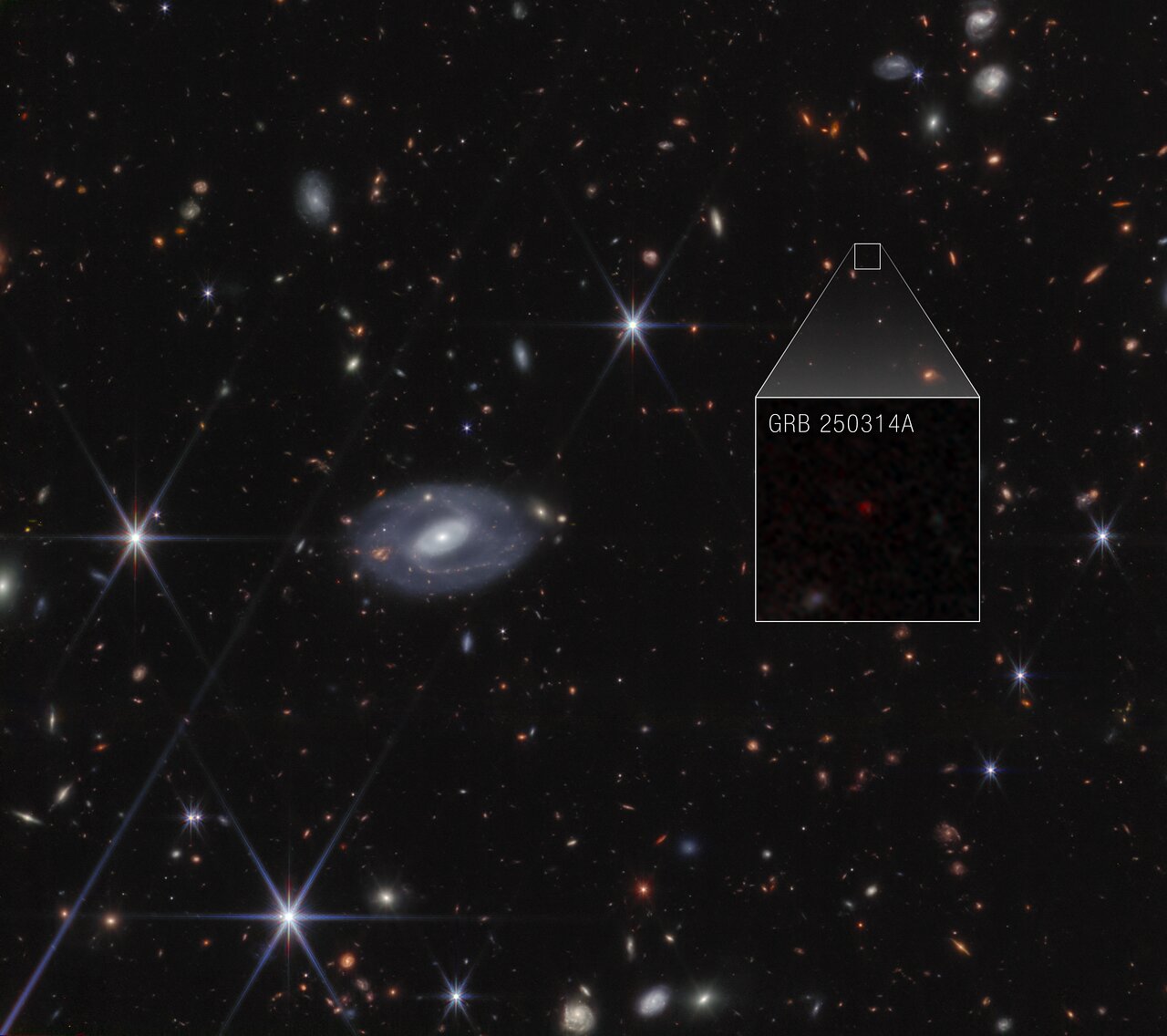
GRB 250314A with its host galaxy. (Image Credit: NASA, ESA, CSA, STScI, A. Levan (IMAPP), Image Processing: A. Pagan (STScI)).
The initial detection was by the SVOM Franco-Chinese telescope designed to detect transients, or fleeting events. NASA’s SWIFT observatory conducted follow-up observations within an hour and a half, pinpointing the source in the sky. The Nordic Optical Telescope in Spain then revealed the infrared-light of the afterglow of the gamma-ray burst. The Very Large Telescope in Chile operated by the European Southern Observatory then determined the distance to the object. The event is rare and exciting to scientists because only a handful of gamma-ray bursts have been spotted within the first billion years of the universe. This is the farthest and earliest supernova known to science.
The exotic infancy of the universe
After the Big Bang, the universe was made up of the lightest elements, primarily hydrogen and helium. The early universe was a very different place than the universe around us today. Massive stars that lived fast and died young forged the heavier elements in the nuclear furnaces within their cores. At this time, the universe was opaque, cloaked in a fog of neutral hydrogen. It was in the Era of Reionisation that the light from the first stars rendered the universe transparent. This supernova is from the Era of Ionisation, and allows scientists to better understand the early universe.