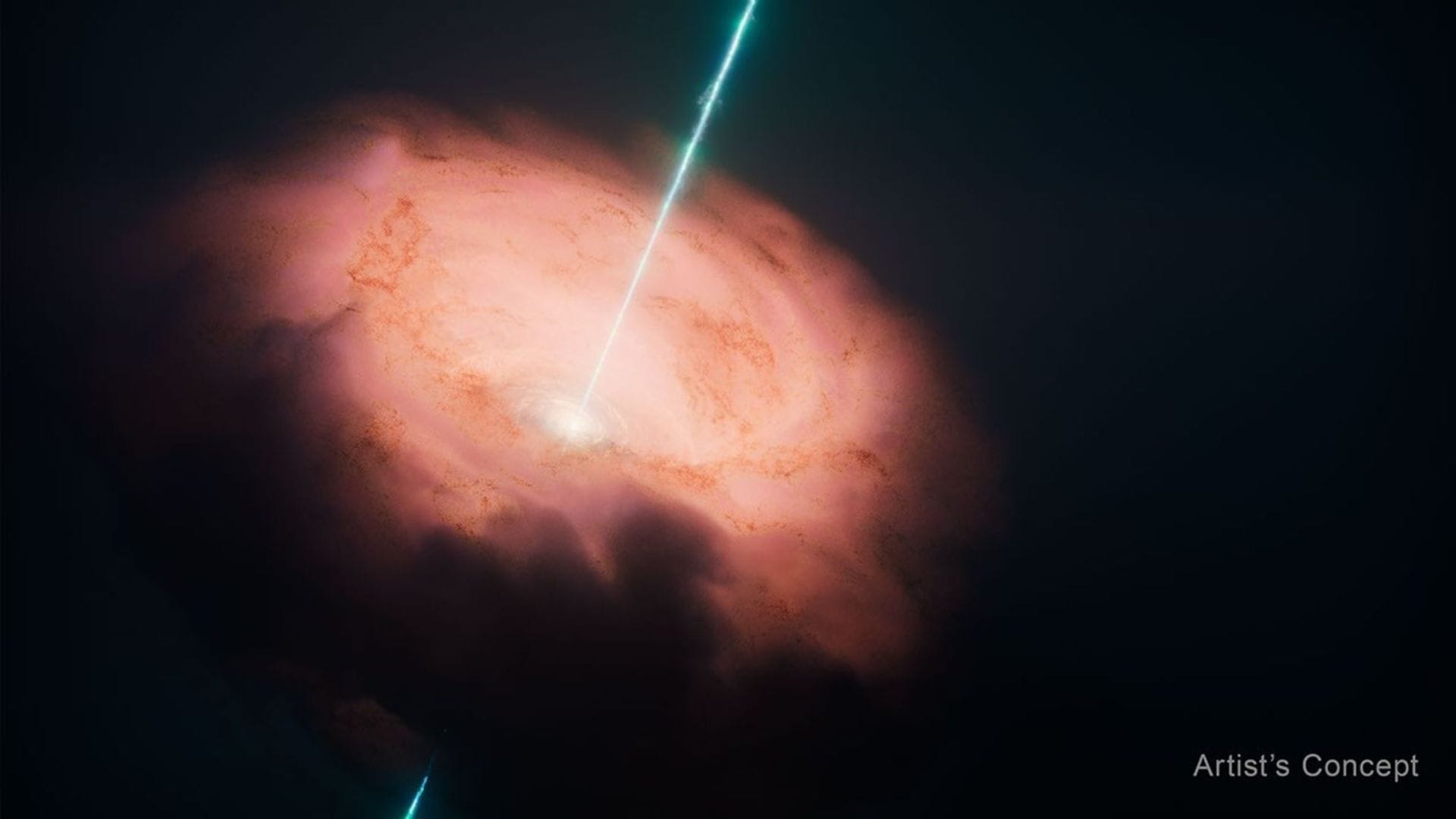
New Delhi: The Circinus Galaxy lies at a distance of about 13 million lightyears from the Earth in the constellation of the same name. Like most large galaxies, a supermassive black hole occupies its core and drives ongoing activity, pulling in gas and dust from the surroundings and shaping the evolution of the galaxy. For years, astronomers have attributed the brightest infrared emissions from the regions closest to the black hole to powerful outflows, streams of superheated matter ejected outwards by the magnetic fields of the accretion disk. These accretion flows have previously been mapped by Japanese researchers using the ground-based ALMA observatory.
Now, observations by the James Webb Space Telescope has changed our understanding of the galaxy. The flagship deep space observatory has observed the central regions of the galaxy in unprecedented detail using its infrared instruments, achieving a resolution equivalent to a 13 metre telescope. The researchers combined light through seven hexagonal holes in a mask to produce interference patterns that revealed fine-grained details of the core, capturing the sharpest infrared image ever taken of the surroundigns of a black hole. The observations revealed a glowing donut-shaped torus of gas and dust encircling the black hole. Friction is heating the material in the inner torus and the accretion disk to extreme temperatures, causing it to emit the intense infrared light.
Solving a decades-long puzzle
Analysis of the data has revealed that about 87 per cent of the hot dust infrared emissions originate from the regions closest to the black hole, where the material feeds the accretion disk. Less than one per cent comes from the dusty outflows, overturning models that were decades old, that assigned most of the excess infrared emissions to these ejections. The remaining 12 per cent were traced to farther regions that were previously unresolved. The research explains the long-studied puzzle of an unexplained excess in active galaxies such as Circinus. Similar research can now be conducted on other nearby black holes.