
Bitcoin analyst Michaël van de Poppe said BTC initially rallied on the news but is now pulling back amid uncertainty around the U.S. market open and a CME gap.
- Bitcoin deposits to exchanges rise during major conflicts, then return to normal levels since the asset isn’t linked to a single country, said analyst George Tung
- He noted that growing participation in exchange-traded funds has reduced pressure on spot markets during geopolitical shocks.
- He highlighted global liquidity, stablecoin supply, rate expectations, and regulatory clarity as key factors shaping Bitcoin’s broader trend.
As tensions between the U.S. and Iran grew, panic spread to the crypto derivatives markets, where about $1.8 billion in aggressive sell orders came in within an hour. But analyst George Tung pointed out that Bitcoin’s sell-offs during wartime appear to be temporary.
In the X post on Saturday, the market analyst George Tung argued that while military escalations create immediate volatility within crypto markets, “capital is not structurally leaving” Bitcoin. Tung, who goes by the handle CryptoRUs, further stated that long-term trends are more influenced by the overall state of liquidity and the market structure, since Bitcoin “isn’t tied to any single country’s economy.”
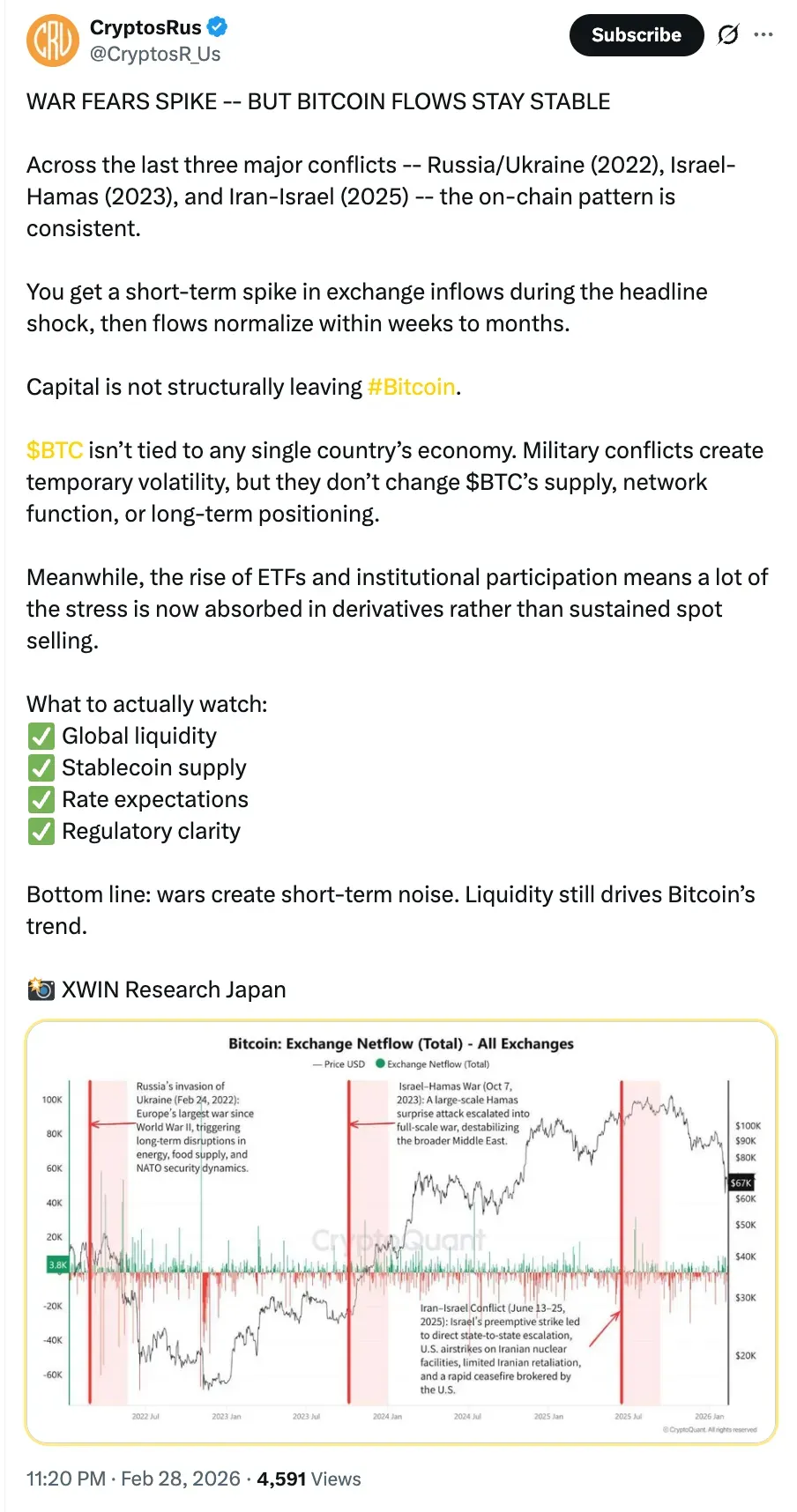
The market watcher attached a chart from CryptoQuant exchange netflow data across major geopolitical conflicts seen historically impacting Bitcoin’s price and noted that “the on-chain pattern is consistent.”
Meanwhile, Tung noted that the rise of exchange-traded funds (ETFs) and institutional participation meant much of the stress has now been absorbed in derivatives markets rather than sustained spot selling. Spot Bitcoin ETFs saw net inflows of $787 million during the week of February 23–27, with BlackRock’s IBIT leading the way with $503 million, as per SoSoValue data.
Exchange Inflows Surge After Wars
Exchange inflows had risen sharply after Russia’s invasion of Ukraine in February 2022, when Bitcoin fell from around the high range of $30,000 to about $34,000 in a sharp intraday move, according to historical data. Data also showed that during the Israel-Hamas war in October 2023, Bitcoin was trading near $28,000 and briefly dipped toward $27,000 before stabilizing. In June 2025, during the Iran-Israel escalation, Bitcoin traded in the mid-$60,000 range and fell to $63,000 amid high volatility.
On Sunday, after a US strike on Iran led to the assassination of Ayatollah Ali Khamenei, the Supreme Leader of Iran, Bitcoin (BTC) traded at $66,313.65, up by 4.5% in the last 24 hours, after hitting an intraday low of $63,857.20. On Stocktwits, the retail sentiment moved up from ‘neutral’ to ‘bullish’ territory; however, chatter around the asset remained at ‘low’ levels over the past day.
The Key Opinion Leader also asked market watchers to closely monitor global liquidity, stablecoin supply, interest rate expectations, and regulatory clarity.
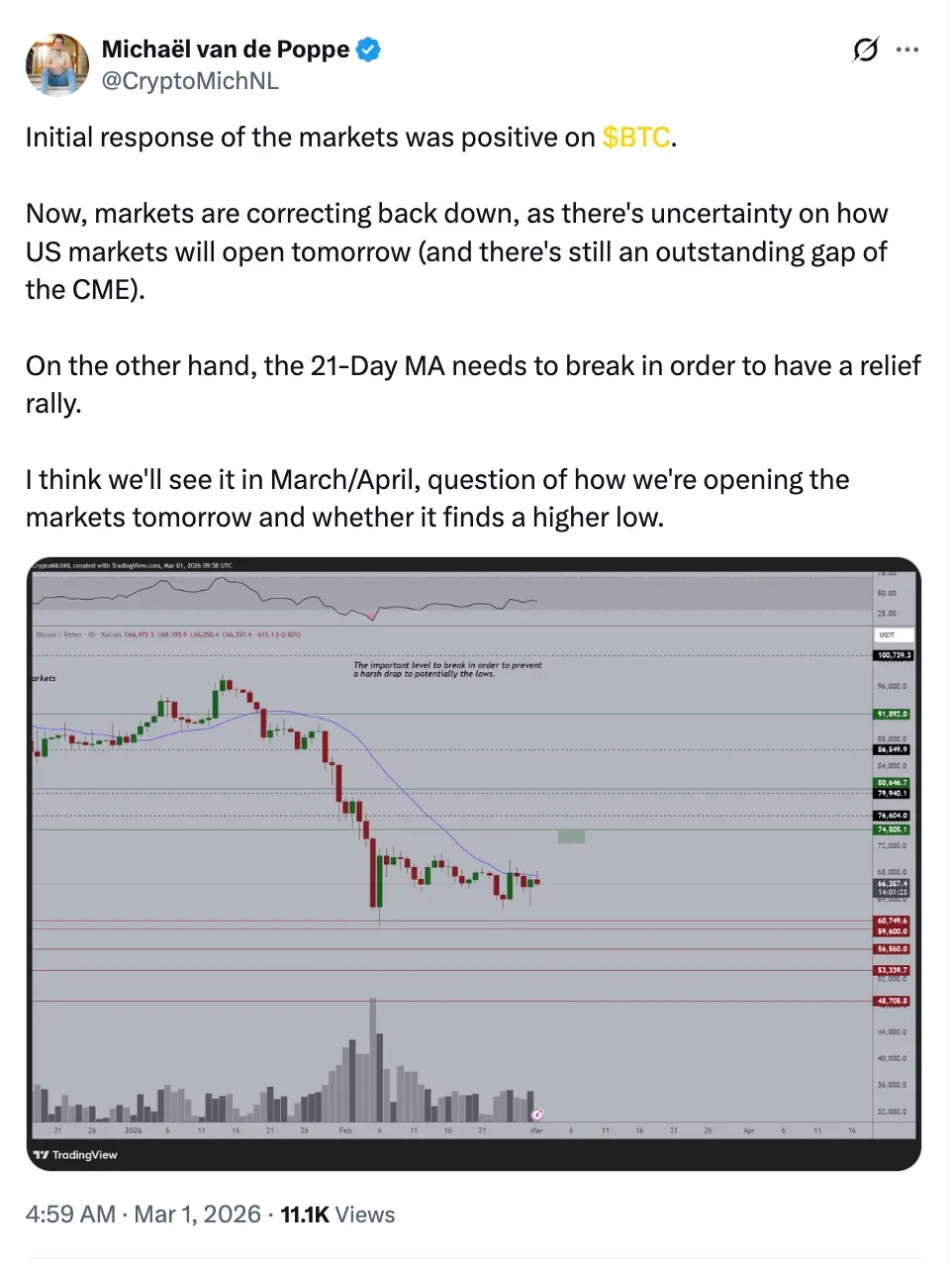
Michaël van de Poppe, a well-known Bitcoin analyst, doesn’t agree with this view. He said that Bitcoin went up at first because of the news, but now it’s going down because people aren’t sure when the U.S. market will open, and there’s a CME gap. It could go up again if it breaks above the 21-day moving average and makes a higher low.
Read also: Senator Calls For Ban On Insider Trading After US Strike On Iran Generated $1.2 Million
For updates and corrections, email newsroom[at]stocktwits[dot]com.<