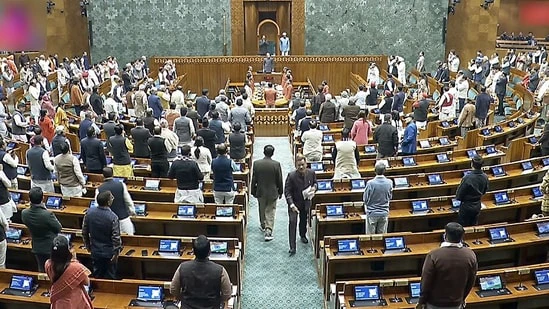
Words were exchanged, Gandhi appeared to defy the presiding officer, Speaker Om Birla, and there were three adjournments.
During the debate on the President’s address to Parliament, Gandhi started reading from the article to counter Bharatiya Janata Party (BJP) MP Tejaswi Surya’s allegations against the Congress. But, defence minister Singh immediately questioned whether the book had been published. “If it has been published, then he can quote from the book. But, if the book has not been published, then there is no justification,” he added. As Gandhi tried to proceed, home minister Shah added, “He (LoP) should clarify whether the book has been published or not. If it is not published, how can it be mentioned?”
To be sure, Naravane’s book was supposed to be published in January 2024, but after an extract appeared in December 2023, its publication was deferred because it had not received clearance from the army. In October of last year, Naravane said the book was still being reviewed by the army.
Amid disagreements, Speaker Birla cited Lok Sabha rules 349 and 353 and ordered that any random material can’t be referred to in the House and if a lawmaker wants to level charges against another MP, advance notices are required.
For more than 40 minutes, the Lok Sabha saw an unusual stand-off. Gandhi repeatedly defied Birla’s ruling and tried to mention the issue. Every time Gandhi spoke about China or the former army chief, the Speaker and senior ministers stopped him on technical grounds. In parliamentary practice, the Speaker’s ruling is considered as the verdict in a dispute.
It was also pointed out to Gandhi that the topic was not related to the subject — the President’s speech.
A defiant Gandhi, however, tried to stick to his point. He argued, “The President’s speech is about the current situation, policies, foreign policies, China, Pakistan and the global situation. I didn’t want to refer to this article but your member (Tejaswi Surya) questioned our nationalism and our character.”
With Birla ruling out any reference to the article, Gandhi said: “The Speaker said, I can’t refer to the magazine or the book. I am not referring to the article. There was a border. On the border there were four tanks…”
This time Shah stopped him and quizzed, “How did you know there were tanks?”
Both sides referred to rulebooks. BJP’s Nishikant Dubey, parliamentary affairs minister Kiren Rijiju and later Shah pulled out the rulebook to argue that Gandhi is not entitled to refer to the matter, which has been published in a magazine. On the Congress side, KC Venugopal too, frequently referred to the rulebook.
Samajwadi Party (SP) chief Akhilesh Yadav stepped in and demanded that Gandhi must be allowed to raise the issue about China. “I think LoP must be allowed to speak on China. It is an important issue,” he said.
As the sparks flew, Venugopal and Gandhi even argued with the Speaker, who reminded the Opposition that no questions could be raised over the Speaker’s ruling. He even warned Gandhi that if he was not interested in participating in the debate, the next speaker, Yadav, would be invited to speak. Gandhi didn’t relent.
At one point in time, Gandhi even asked Birla to tell him what he should speak on at which point the Speaker retorted that he was not an advisor to Gandhi and that the LoP should stick to rules.
Gandhi also trained his attack on the government: “They say, they fight against terror but they are afraid of a line (in a magazine). It is about our relationship with China. This is a fundamental explanation of our relationship with China. Inside this (magazine), is a full explanation of what happened in Doklam.” He meant Galwan and the LAC in the Ladakh sector.
As Gandhi defied the Speaker’s rulings, an angry Rijiju said, “We must decide what to do with a member who doesn’t want to follow the ruling. You should be teaching other teachers. You are a five-time MP.”