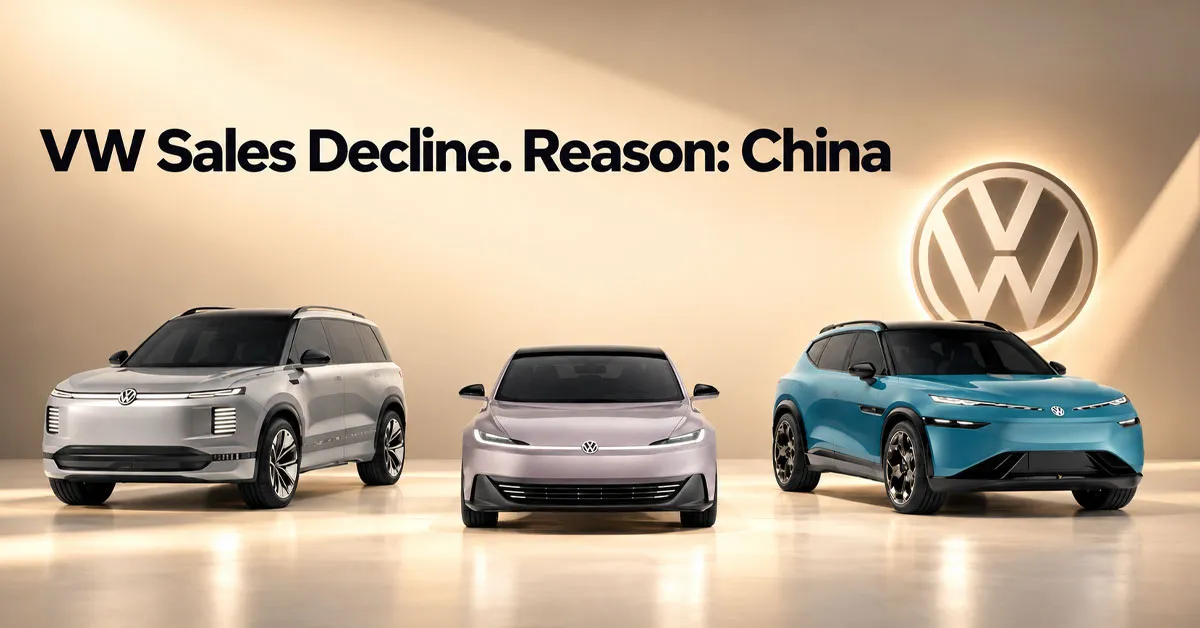
Volkswagen Group deliveries fell 14.3 percent year on year in the third quarter of 2026 to 1.885 million vehicles, its sharpest quarterly decline since the second quarter of 2022.
China explains most of the damage. Group deliveries there fell 38.5 percent in the quarter to 405,800 vehicles. Over the first nine months of 2026, China deliveries were down 30.2 percent to 1.379 million.
That compares with much smaller nine-month changes elsewhere. Western Europe was up 1.1 percent, Central and Eastern Europe rose 5.3 percent, South America gained 4.3 percent, and North America fell 4 percent.
In other words, Volkswagen’s global decline is not simply a story of weak demand everywhere.
China’s Entire Car Market Has Turned Difficult

September passenger-car retail sales in China fell 28 percent year on year to about 1.62 million units, marking another weak month for the world’s largest car market.
Conventional petrol and diesel cars have been hit particularly hard while new-energy vehicles now account for roughly two-thirds of passenger-car sales.
That mix is uncomfortable for Volkswagen because the group built its China scale around joint ventures and combustion-engine cars.
The pressure is visible in retail rankings. FAW-Volkswagen sold about 76,800 vehicles in September, down 44.6 percent year on year, while SAIC-Volkswagen delivered roughly 58,700.
Domestic companies now occupy most of the leading positions, with BYD and Geely ahead of Volkswagen’s two major joint ventures.
Volkswagen Passenger Cars Fell Even Faster
The 14.3 percent headline figure covers the entire Volkswagen Group.
The Volkswagen Passenger Cars brand itself delivered 946,600 vehicles globally in the third quarter, down 19.3 percent.
Audi fell 19.7 percent to 314,900 vehicles and Porsche dropped 15 percent to 56,200.
Skoda was the clear exception. Its third-quarter deliveries were almost flat at 256,700, up 0.2 percent.
That matters because it shows the China problem is hitting the group’s larger premium and mainstream brands much harder than every brand equally.
EVs Show The Same China Weakness

Volkswagen Group delivered 240,200 battery EVs globally in the third quarter, down 4.7 percent.
Again, the regional split is important. European EV deliveries rose 19.6 percent to 209,100. China EV deliveries fell 30.1 percent to just 18,000.
Over the first nine months, Volkswagen Group BEV deliveries in China were down 42.5 percent.
That is a serious problem in a market where electrified vehicles are taking an ever-larger share.
There is one encouraging sign. Volkswagen says its newer locally developed electric, plug-in hybrid and range-extender models are beginning to gain traction, with total electrified-vehicle deliveries in China rising about 30 percent in the third quarter.
But those gains are still coming from a much smaller base than the lost combustion-engine volume.
Volkswagen Is Rebuilding Its China Product Strategy

The group has been moving more development work into China and shortening product cycles so it can respond faster to local brands.
Its strategy includes locally developed EVs, plug-in hybrids and range-extender vehicles rather than relying mainly on global models adapted for China.
That shift is necessary because Chinese brands are competing on software, cabin technology, battery range and price at a pace traditional joint ventures have struggled to match.
For Volkswagen, the third-quarter result shows just how urgent that transition has become.
The group’s deliveries outside China were broadly stable over the first nine months. China alone erased much of that stability.
Volkswagen therefore does not merely need the Chinese car market to recover. It needs its own products to become more competitive inside a market that is rapidly moving away from the kind of cars that built Volkswagen’s dominance there in the first place.