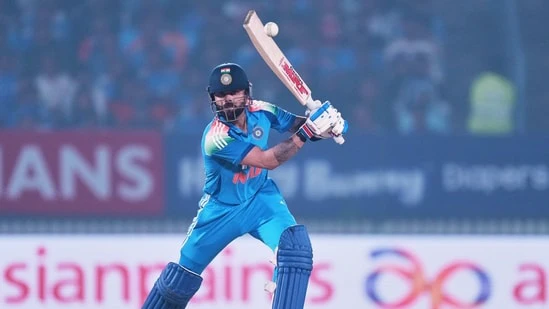
One is longevity: how long you stay at No. 1 without being dislodged. The other is separation: how far ahead you are from the next-best batter while you’re there. Kohli’s longest reign – from 22 October 2017 to 1 April 2021 – is the endurance headline. But if the question is where he was truly miles ahead of the competition, the clearest answer is early 2018, when the gap between Kohli and the rest looked less like a leaderboard and more like a cliff.
That early-2018 window is the purest example of a No. 1 ranking that felt locked. Not because Kohli was merely consistent, but because he was generating a cushion so large that even a strong series from the No. 2 batter wouldn’t instantly threaten his spot.
What “way ahead” actually means in ICC rankings
Rankings aren’t a simple runs table. They are designed to reflect recent performance through a rolling window, with the idea that repeated, high-impact contributions should matter more than a single isolated peak. In practice, that means you don’t build a huge lead at the summit by playing one magical innings. You build it by stacking big innings frequently enough that the gap becomes structurally hard to close.
At the top end of rankings, gaps usually compress. The elite batters tend to live within touching distance of each other, and small runs of form can swap positions. That’s why a large points gap at No. 1 is so revealing: it signals not just who is best, but how far the second-best is from catching up without sustained outperformance across multiple updates.
The separation peak: February 2018 and the 65-point gap
Kohli’s most striking separation moment arrived after India’s ODI series in South Africa in February 2018. He surged to 909 rating points and, crucially, opened a 65-point lead over second-placed AB de Villiers.
In ranking terms, 65 points at the summit is enormous. It is the difference between “No. 1 today” and “No. 1 even if someone else has a great week.” It creates insulation. It turns a ranking position from fragile to fortified.
The performance base behind that spike was as emphatic as it gets: 558 runs in six ODIs, dismissed only three times, with three centuries. The innings sequence captured the relentlessness: 112, 46 not out, 160 not out, 75, 36 and 129 not out.
That blend is exactly what creates separation in a rolling system: frequent big scores, multiple not-outs, and sustained match impact across the entire tour rather than one standout day.
Why the South Africa run mattered more
A common trap in ODI analysis is treating volume the same everywhere. In reality, context decides how “portable” a batter’s dominance is. South Africa away is not a place where you stumble into 500-plus runs by accident. Even in ODIs, you’re up against high-quality pace, sharper new-ball pressure, and conditions that force constant gear changes.
Virat Kohli’s output on that tour wasn’t just accumulation; it was control. The 160 not out, in particular, functioned like a statement innings because it combined scale with command. And when such innings are paired with repeated contributions in the same series, they don’t merely win matches – they reshape how far ahead a player looks in rankings.
Peak dominance vs sustained dominance
This is where the Kohli story gets interesting. His long No. 1 stint from late 2017 to early 2021 is a different kind of greatness: maintenance of supremacy across seasons, opposition, and tactical shifts. A long reign demonstrates that your baseline is elite and remains elite.
But “way ahead of the competition” is more about the margin at any given time than the duration. A batter can be No. 1 for years while still being chased closely – a few points here, a few points there, and the top spot is always contestable.
Kohli’s early-2018 phase is what happens when both worlds align: he is No. 1, and he is not being meaningfully hunted.
A contrast that proves the point: when No. 1 wasn’t “miles clear”
To understand how unusual the 65-point gap is, compare it with a later period when Kohli was still No. 1 but not separated. During the 2019 ODI World Cup in England, Kohli stood on 891 points while Rohit Sharma closed in on 885 – a gap of just six points.
Six points is not domination. It’s a coin toss across a couple of innings. It means the summit is volatile, and the next challenger is essentially at the door.
That’s the distinction. Being No. 1 is a status. Being No. 1 with a gap that large is a message.
Why 909 points and a huge gap are so hard to build
Three reasons make that early-2018 peak especially telling.
First, rankings reward frequency. A single 150 might move you, but it rarely gives you separation. Kohli’s sequence delivered repeated high scores and multiple hundreds, which compounds influence across updates.
Second, not-outs matter. In any performance evaluation, staying unbeaten while scoring big increases output efficiency. Across a series, it also strengthens the perception of inevitability: Kohli wasn’t just scoring; he was finishing.
Third, timing relative to the field matters. Kohli’s separation didn’t come in a weak era. It came while the No. 2 name was AB de Villiers – not a placeholder, not a fading legend, but a genuine all-time great in the format.
When you build a 65-point gap over that kind of competition, it becomes hard to argue it was a quirk of scheduling or a hollow statistical spike.
The verdict
If you want the most “dominant stint” by duration, Kohli’s 1,257-day stay at No. 1 from October 2017 to April 2021 remains the defining reign. But if you want the moment where he was unmistakably, visibly ahead of the competition – in a way rankings could quantify – the February 2018 peak is the gold standard.
That was the period when Kohli didn’t just lead the ODI batting rankings. He made the chase for No. 1 feel like everyone else was running uphill, in boots, while he was on a moving walkway.