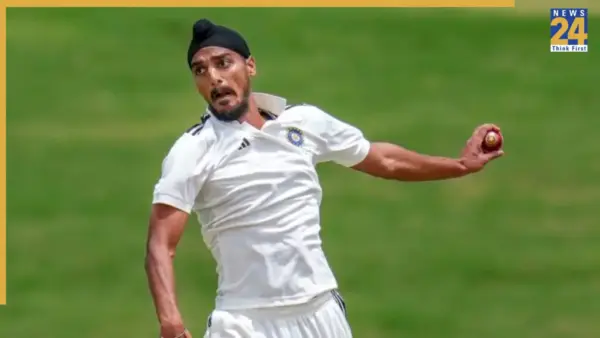
Indian fast bowler Arshdeep Singh used the 2026 Duleep Trophy quarter final to check his fitness for longer format cricket. He took three wickets for 53 runs and one for 40 as North Zone beat West Zone by 52 runs in Bengaluru.
Arshdeep Singh was happy to get a chance to play red ball cricket. He said the game helped him improve his bowling, regain his rhythm and see how many overs he could bowl comfortably.
Why did Arshdeep view post-match body soreness as a positive sign?
After working hard in training, the fast bowler was happy with his display. He said feeling some pain after the match was a good sign, especially because he had helped his team win. ‘Very rarely I get the chance to play red ball cricket. And this was a chance. I wanted to showcase my skill set and just see how many overs I can bowl. The rhythm feels nice. After a long time, I was playing a red-ball game. I put in a lot of hours in practice, and it felt nice. The body is sore, but it’s a good sore because we got the win,’ Arshdeep Singh said, as per Cricinfo.
How does Arshdeep adapt his training routines across formats?
The left-arm pacer said his training changes depending on the type of cricket he is preparing for. Before the Duleep Trophy, he worked mainly on red ball skills while he will now focus on white ball cricket for limited overs matches.
What is Arshdeep Singh’s strategy for format-specific practice?
‘Deciding whether to practice with the red ball or the white ball] depends on what’s coming,’ Arshdeep said. ‘This time around, I knew the Duleep Trophy was coming, I was practising with the red ball. When white-ball season is coming, then you practice with the white ball. It’s very specific training [based on] what kind of season is coming in front of you,’ he said.
Where does Arshdeep Singh stand in India’s international bowling stats?
Arshdeep Singh has played 18 ODIs and 91 T20Is for India but has not played a Test match yet. The left arm fast bowler has 30 ODI wickets and 135 T20I wickets. He is India’s highest wicket taker in T20Is, with Jasprit Bumrah next on the list with 121 wickets.