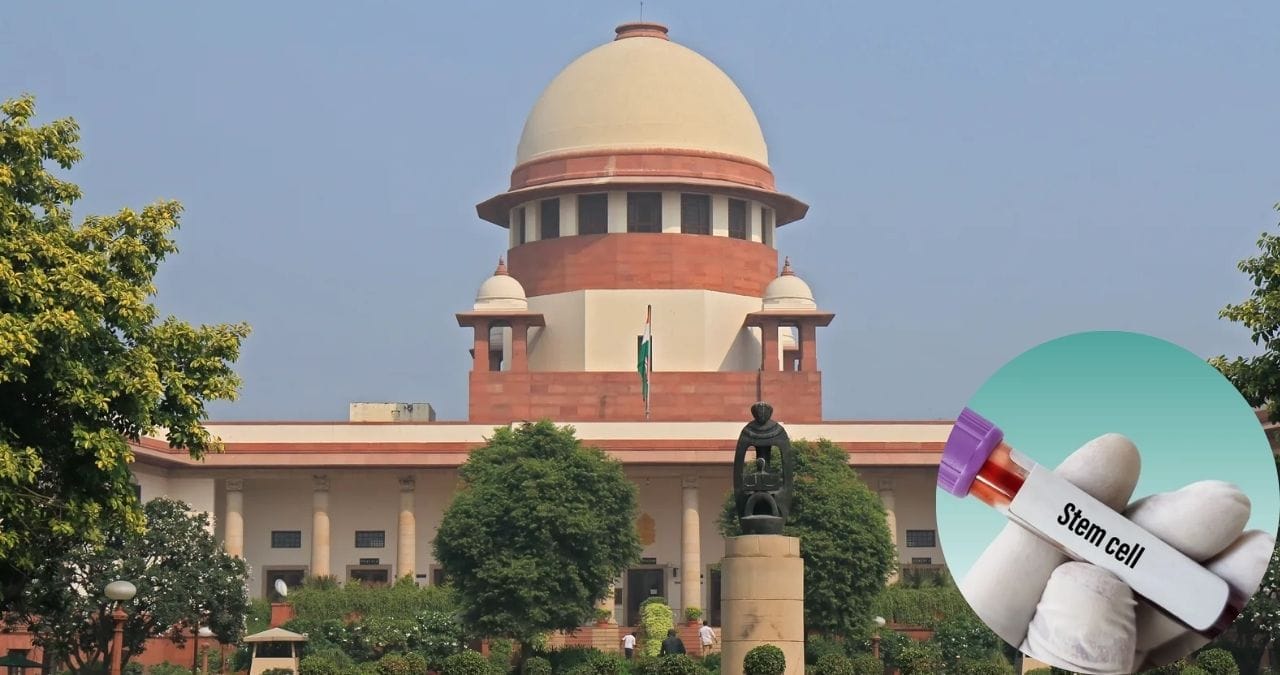
Supreme Court.
The Supreme Court has termed the use of Stem Cell Treatment (SCT) therapy in the treatment of Autism Spectrum Disorder (ASD) as wrong. The Supreme Court said that it is not right to give this therapy in autism spectrum disorder. The court stressed that this is because SCT lacks scientific support as a treatment for ASD.
The bench of Justice JB Pardiwala and Justice R Mahadevan said that SCT can still be approved for supervised clinical research trials. The bench said that it has not been recognized as a correct medical practice supported by empirical evidence. The court said that under the Drugs and Cosmetics Act, regular treatment cannot be considered valid by treating it as a drug. If anyone does this after this, it will fall under the category of medical negligence.
The bench of Justice JB Pardiwala and Justice R Mahadevan said that no unproven method of treatment should be adopted by the parents of the patient. As far as patients who are already receiving the therapy are concerned, the Court has made it clear that it cannot continue as a commercial endeavor in the form of routine clinical treatment.
What did the Supreme Court say to the government
The court also urged the Central Government to strengthen and clarify its legal stand so that the directions can be better implemented. Therefore, the Court has directed the Ministry of Health and Family Welfare to provide the best possible solution in this regard in consultation with the officials of AIIMS and National Medical Council. The Supreme Court said that this can ensure that such patients continue receiving therapy until they can be transferred to institutions that are conducting clinical trials. Four weeks’ time was given for this.
Treatment without information is a gross violation of medical ethics.
The court said, “We believe that a patient cannot demand treatment as a matter of his right. The decision of this Court in the case of Sameera Kohli (cited above) emphasizes that adequate information about a particular treatment is necessary and consent to it should be based on such adequate information.
The court said that in our view, continuing medical treatment even when patients are under such misunderstanding is a gross violation of medical ethics. The court said that even if patients had voluntarily chosen such procedures, such choices would not constitute valid consent for treatment due to the lack of “adequate treatment”.