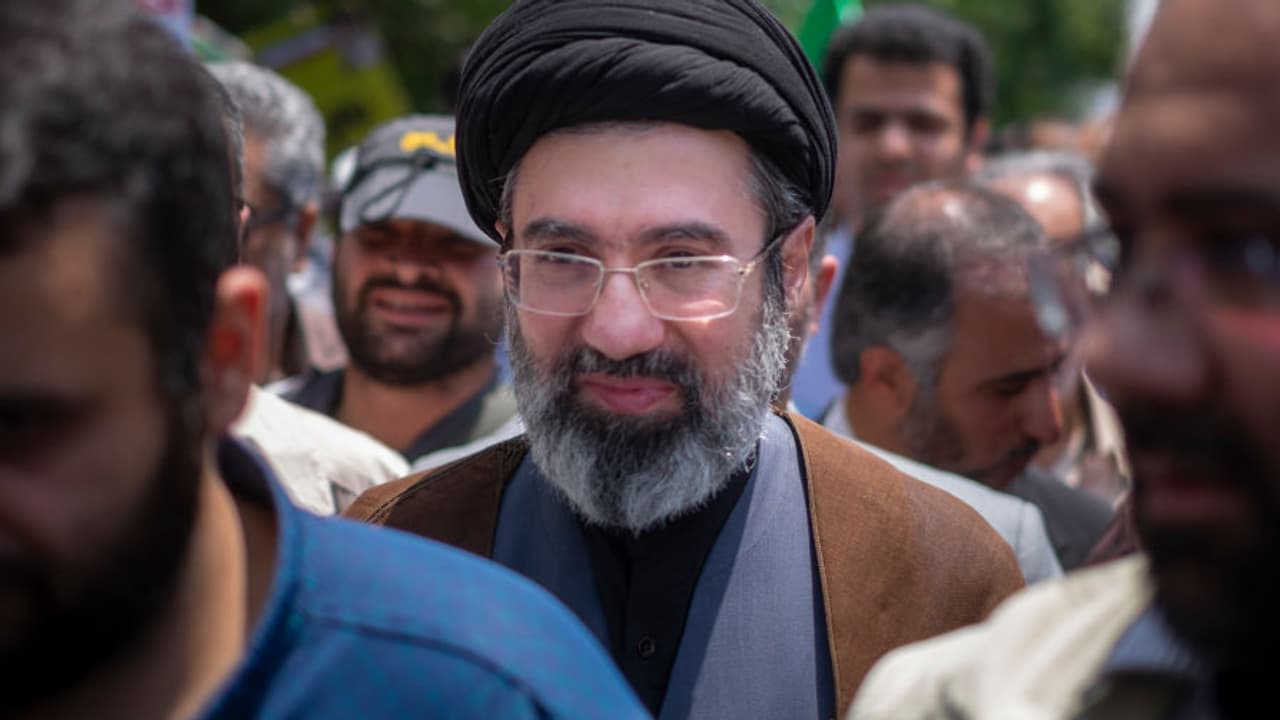
Unverified US intelligence reports claim Iran’s new Supreme Leader, Mojtaba Khamenei, may be gay, sparking global discussion. The allegations, which reportedly surprised Trump, suggest a long-term same-sex relationship. This controversy arises amid high geopolitical tensions and uncertainty about Khamenei’s leadership and health.
Intel Claims on Mojtaba Khamenei Spark Global Buzz
Fresh controversy has emerged around Iran’s leadership transition after reports claimed that US President Donald Trump reacted with surprise during an intelligence briefing discussing the personal life of Iran’s newly elevated Supreme Leader, Ayatollah Mojtaba Khamenei, mat be gay, according to a report by the New York Post.
The development comes at a time when geopolitical tensions in the region remain high and questions continue to swirl about the younger leader’s public visibility and political authority.
According to reports, intelligence officials allegedly presented assessments indicating that rumours regarding Mojtaba Khamenei’s sexuality had circulated in diplomatic and political circles. While such claims have not been independently verified in the public domain, they were reportedly considered significant enough to be raised at senior levels of discussion. Accounts suggested that Trump appeared “stunned” by the briefing, with insiders describing reactions ranging from surprise to disbelief during internal deliberations.
According to sources cited by the New York Post, the briefing prompted a visible reaction from the President. “Trump couldn’t contain his surprise and laughed aloud when he was briefed on the intel,” the report quoted sources as saying, adding that others present in the room also reacted with amusement.
The subject is particularly sensitive given Iran’s conservative political and social structure, where same-sex relations are criminalised under national law. Analysts say that even unproven personal allegations can carry serious political consequences in such environments, potentially affecting perceptions of legitimacy, elite power struggles and the broader narrative of succession within the Islamic Republic’s leadership hierarchy.
Claims on Relationship and Personal History
Reports citing US intelligence sources suggest that Iran’s Supreme Leader Ayatollah Mojtaba Khamenei may have been involved in a long-term personal relationship with a man believed to have been his childhood tutor. According to individuals referenced in the report, the association allegedly continued for several years, while another source claimed the person had previously worked for the Khamenei family.
Separate claims carried by international media outlets indicated that Mojtaba was also accused of making “aggressive” advances toward male caregivers while recovering from injuries reportedly sustained during the February 28 US-Israeli airstrikes that killed his father, Ayatollah Ali Khamenei.
The report noted that US intelligence agencies do not have photographic or direct visual evidence to substantiate these allegations. However, officials quoted by the publication maintained that the information was viewed as credible within certain intelligence and diplomatic circles.
Sources further told the outlet that rumours regarding Mojtaba Khamenei’s sexual orientation had begun circulating among Iranian political insiders following the 2024 helicopter crash that killed former Iranian president Ebrahim Raisi, who had previously been seen as a potential successor to Ali Khamenei.
Leadership Uncertainty Deepens Amid Ongoing Iran Conflict
The intelligence-related controversy has unfolded alongside growing uncertainty about Mojtaba Khamenei’s physical condition and ability to govern during a period of armed conflict. Speculation intensified after reports suggested he may have been injured in airstrikes during the early stages of the war. Trump himself publicly acknowledged the ambiguity surrounding the situation, remarking that officials lacked clarity about the Iranian leader’s status and noting that “nobody has seen him.”
The absence of confirmed public appearances has fuelled widespread conjecture about whether the new Supreme Leader is fully capable of exercising authority. In separate remarks, Trump said he believed Mojtaba Khamenei was alive but “damaged,” further reinforcing perceptions of a fragile leadership transition in Tehran.
Observers say such uncertainty can create both domestic and international ripple effects. Within Iran, competing factions may attempt to consolidate influence during times of leadership ambiguity. Externally, global powers closely monitor the stability of Iranian governance structures, given their direct implications for regional security dynamics, diplomatic engagement and energy markets.
Trump also indicated that diplomatic efforts become more complicated when there is confusion about who holds effective decision-making power. His comments contributed to a broader sense of unpredictability about Iran’s political trajectory as the conflict continues to reshape alliances and strategic calculations across the Middle East.
Personal Allegations Add New Twist to Geopolitical Crisis
Political analysts note that intelligence leaks and personal controversies often play a role in modern geopolitical rivalries, where narratives and perceptions can be as influential as military developments. In the current context, allegations related to Mojtaba Khamenei’s personal life have sparked intense debate on social media platforms and within international policy circles.
Some experts caution that such information may form part of psychological or information warfare tactics designed to weaken adversaries by undermining leadership credibility. Others argue that regardless of intent or accuracy, the circulation of sensitive claims can deepen political polarisation and distract from urgent humanitarian and security concerns linked to the ongoing conflict.