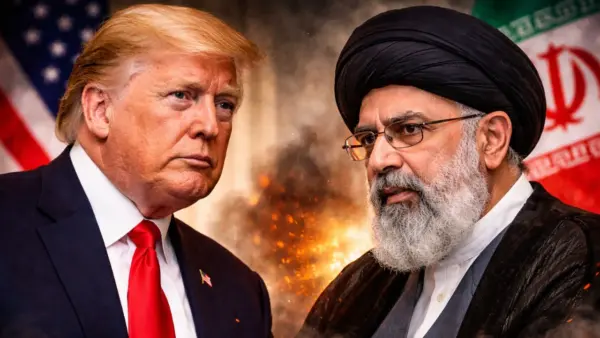
The United States has revealed that its military operations against Iran have already cost a massive $37.5 billion (around ₹3.64 lakh crore).
This figure was shared by US Defence Secretary Pete Hegseth while speaking to lawmakers on Tuesday. In simple words, this is the total money the American military has spent, and expects to spend, to keep fighting Iran.
According to The Statesman, this amount covers money already spent and the expected costs till the end of September. It includes soldiers’ salaries, daily operations, and maintenance of equipment. Hegseth appeared before the Senate Appropriations Committee along with General Dan Caine, the top military officer, to explain the rising expenses. Answering Democratic Senator Richard Durbin, he clearly stated that as of today, the estimated cost stands at that amount.
At the same time, the Trump administration has asked Congress for an emergency defence package of $87.6 billion (around ₹8.50 lakh crore). Of this, nearly $67 billion (around ₹6.50 lakh crore) is only for the military. The money is needed to keep operations running smoothly and to strengthen America’s overall defence.
Why So Much Money?
Defence Secretary Hegseth explained that $21 billion (around ₹2.04 lakh crore) will be used to improve “military readiness” – that is, to pay troops, buy fuel, replace damaged equipment, support the National Guard, and move forces quickly when needed. Readiness simply means keeping the army fully prepared to act at any moment.
Another $46 billion (around ₹4.46 lakh crore) will speed up production of advanced weapons such as hypersonic missiles (which travel many times faster than sound), counter-drone systems, and military satellites in space.
Hegseth warned that without this extra funding, the US military could face serious shortages – difficulty in paying soldiers, quickly replacing weapons, or continuing important operations without interruption.
Democrats Raise Questions
Not everyone is convinced. Democratic lawmakers pointed out that the Pentagon still has about $75 billion (around ₹7.28 lakh crore) left from an earlier package that has not yet been fully used. They questioned why fresh money was needed when so much remained unspent.
Senator Patty Murray objected to parts of the request that include spending on US military activities in South America, National Guard deployment in Washington, and security operations at the US-Mexico border. According to her, the funding should focus only on the most urgent defence needs. She said Americans want the war to end quickly and wisely, and do not want $70 billion (around ₹6.79 lakh crore) of taxpayers’ money spent just to keep the war going.
Lawmakers also raised a legal point. They asked whether President Trump has the legal power to continue the war under the War Powers Resolution – a law that controls how long a President can fight without Congress’s approval. Hegseth replied that the White House believes the President has full constitutional authority to continue. General Caine, however, did not confirm whether ground troops would be sent, explaining that planners always prepare different options for possible situations.
Russia and China Helping Iran
During the hearing, Hegseth made a serious claim, saying that both Russia and China are supporting Iran. But he did not explain what kind of help they were giving or how big it was. He only said the two countries were helping Iran in different ways and at different levels, while answering a question from Republican Senator John Hoeven. General Caine also refused to share more, warning that revealing intelligence openly could expose sensitive secrets.
As further reported by The Statesman, Hegseth said US forces had struck Iranian targets for the tenth night in a row. This came after Iran allegedly restarted attacks on commercial ships in the important Strait of Hormuz – a narrow sea route through which much of the world’s oil passes every day.
He said the United States had once again placed a very strong blockade on Iran, one that is extremely hard to break. Recent operations, he claimed, had weakened Iran’s ability to operate near the strait. He added that Iran’s military is now at its weakest level in decades, though it still has some capability, including fast attack boats, coastal missiles, and naval mines.
Finally, Hegseth described America’s huge $1.5 trillion (about ₹144 lakh crore) defence budget as a “generational investment” – a long-term investment for future generations – aimed at countering rivals like Russia and China.
In short, the ongoing conflict in the Middle East is proving extremely costly for the United States, both in terms of money and in serious strategic challenges ahead.