Overindulgence is the kryptonite of filmmakers across the world. An underwhelming film from the outset is painful enough, but what’s even more frustrating is watching a genuinely well-made film lose its way because the filmmaker simply doesn’t know when to stop. The last time I felt this kind of disappointment was after watching Lokesh Kanagaraj’s Tamil action thriller Leo.
Unmadham, starring Kunchacko Boban, leaves me with a similar sense of dissatisfaction. It serves up an excellent starter but stumbles along the main course and never quite sticks the landing. So, what works and what doesn’t in this Malayalam mystery thriller?
Director Kiran Das made his directorial debut with the film after editing acclaimed Malayalam films like Romancham, Ullozhukku, Moothon and Painkili. He collaborated with writer Shahi Kabir, whose filmography includes gritty police dramas like Nayattu and Officer on Duty. On paper, that’s an exciting combination. For a large part of its runtime, Unmadham proves exactly why.
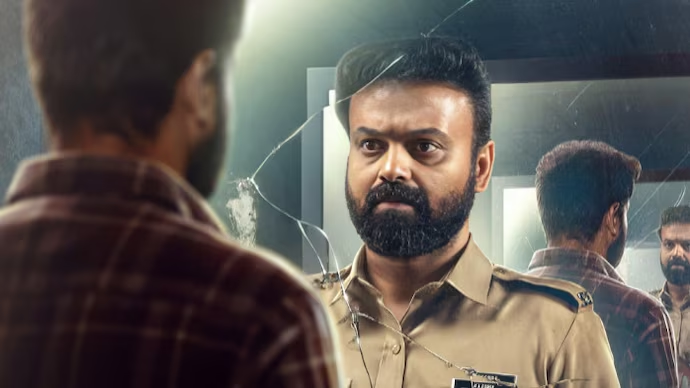
The film follows Shelly (Kunchacko Boban), a suspended police officer weighed down by personal failures and family troubles, who finds himself obsessed with an abruptly closed case known as ‘Case 174’. What begins as a mystery slowly transforms into something far stranger, blurring the line between reality, guilt and the supernatural.
Kabir once again shows his strength in constructing grounded police investigations. But unlike his previous works, Unmadham frequently switches between a serious procedural tone and surprisingly endearing, light-hearted moments. The tonal shifts, rather feeling jarring, make the characters more human before the film gradually descends into complete madness.
The first half is where Unmadham shines brightest. It is admittedly a slow burn, but every scene feels purposeful. Kiran Das patiently lays the groundwork instead of rushing into the mystery. The interval block is particularly effective, raising just enough questions to leave you eager for answers.

One of the film’s most fascinating ideas is its use of a recurring lizard as a symbolic presence. The imaginary creature almost becomes Shelly’s silent guide in uncovering the truth behind ‘Case 174′. On another level, it mirrors his own existence. In one striking visual, a lizard trapped inside a mug becomes a metaphor for Shelly himself, caught between an unresolved investigation, his fractured family life and his inability to move forward. It is subtle, imaginative filmmaking that trusts the audience.
Kiran Das’ years in the editing room are evident throughout the film. Several scene transitions are genuinely impressive, with the narrative flowing naturally despite constantly shifting timelines and perspectives. One nightmare sequence, in particular, stands out. The way the scene extends beyond what initially appears to be a dream, combining the performances, editing, cinematography and sound design, makes for one of the film’s most memorable stretches.
Later in the second half, the tone undergoes a dramatic transformation. Reality begins to crumble, paranoia takes over, and the film embraces psychological chaos. Kunchacko Boban communicates this shift brilliantly. There is one standout scene where Shelly transforms almost instantly from someone cornered and vulnerable into an intimidating aggressor. It is an outstanding performance that captures the character’s deteriorating mental state without ever feeling theatrical.
Unfortunately, this is also where Unmadham begins to lose control of itself.
The deeper the story digs into its mythology and backstory, the more fascinating it initially becomes. Every revelation encourages you to lean in closer. But somewhere along the way, the film mistakes complexity for depth. Instead of carefully putting together the puzzle pieces, it keeps adding newer ones. The mystery dives so deep into its own chaos that it struggles to climb back out. By the time the film attempts to tie everything together, it no longer feels seamless.
The climax is where that overindulgence hurts the most. The finish line is right there – within touching distance – and Unmadham could have ended on a deeply satisfying note. Instead, it stretches the climax like a chewed-up piece of gum. More reveals, more ideas, more layers and even more confusion piled onto a conclusion that had already said enough. Rather than leaving you stunned, it leaves you wondering, “Wasn’t I just enjoying this thriller? What exactly happened?” And unfortunately, not in a good way.
An unnecessary mass action sequence towards the end only adds to that feeling. While one can understand the thematic intention behind drawing parallels with its metafilm, it sticks out like a cardamom in biryani – impossible to ignore, completely disrupting the flavour of everything around it.
Through all of this, Kunchacko Boban remains the film’s greatest strength. Even when the screenplay starts slipping, his performance refuses to let the film fall apart. He convincingly portrays Shelly’s exhaustion, vulnerability, obsession and eventual descent into madness, making him the emotional anchor of an increasingly chaotic narrative.
Lijomol Jose, who plays Shelly’s headstrong wife Soumya, also delivers a commendable performance. Soumya is a prickly character – quick to lose her temper, often becoming Shelly’s biggest demotivator, yet also someone who deeply cares for him and instinctively knows when to stand by him. She is the kind of character who frequently gets on your nerves, but that is precisely what makes Lijomol’s performance so convincing.
Mujeeb Majeed’s music is another major asset. While the songs are serviceable, it is the background score that truly elevates the experience. At several points, it quietly creeps under your skin, adding an unsettling atmosphere that enhances the mystery without overpowering it. Kiran Das and Jithin John also deserve credit for the film’s sharp editing, particularly in the first half where the narrative remains consistently engaging.
Unmadham is a frustrating film to review because it gets so much right before tripping over its own ambitions. There is imagination, confidence and genuinely exciting filmmaking on display. Kiran Das announces himself as a filmmaker to watch, while Shahi Kabir once again proves his ability to create compelling investigative worlds. But somewhere between ambition and excess, the film forgets that sometimes the strongest thrillers are the ones that know exactly when to stop.