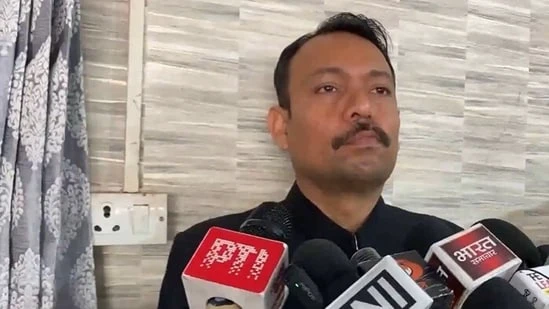
Submitting a five-page resignation letter, the city magistrate of Uttar Pradesh’s Bareilly Alankar Agnihotri resigned from service on Monday levelling serious allegations for which he cited the new University Grants Commission (UGC) rules and the controversy surrounding Swami Avimukteshwaranand being prevented from taking a holy dip at the Magh Mela.
Agnihotri resigned alleging a “complete erosion of democratic and republican values,” and cited the above-mentioned incidents as key examples.
The Uttar Pradesh government suspended Alankar Agnihotri on charges of indiscipline after he resigned from service. Agnihotri has now been attached to the office of the Shamli district magistrate, according to an order issued on Monday night.
‘Biased’ UGC norm cited
In his five-page resignation letter addressed to UP governor Anandiben Patel and the Election Commission of India, Agnihotri-a 2019-batch Provincial Civil Service officer-said he was stepping down from the Uttar Pradesh Provincial Civil Service (UPPCS) because democracy and the republic no longer existed in either the central or state governments, HT reported earlier.
He said that the system had deteriorated into what he described as a “bhramtantra” (a system of illusion).
Notified on January 13, the UGC’s Promotion of Equity in Higher Education Institutions Regulations, 2026 have triggered widespread criticism from general category students, who argue that the framework could lead to discrimination against them.
While introduced to curb caste-based discrimination in colleges and universities, the regulations mandate the creation of special committees, helplines and monitoring teams to address complaints, particularly from SC, ST and OBC students.
Calling the regulations a “black law,” the 43-year-old official alleged that they were vitiating the academic environment in higher education institutions and should be withdrawn immediately.
He claimed the rules were discriminatory and harmful to general category students, alleging that meritorious students from this category were being treated as “self-declared criminals,” thereby fostering an atmosphere of suspicion on campuses.
According to Agnihotri, the equality committees proposed under the regulations could turn into instruments of mental and physical harassment, as the framework allows unverified or malicious complaints that could jeopardise a student’s academic future.
He warned that false complaints driven by jealousy against high-performing students might rise, leading to serious misuse of the system.
Agnihotri also raised concerns about the potential physical exploitation of general category girl students under the guise of inquiries. He argued that the regulations disproportionately impacted general category communities and would institutionalise discrimination rather than promote fairness. Describing the move as divisive, he said it reflected a “divide and rule” mindset and could intensify social conflict, questioning whether parents could safely send their children into such an environment.
He asserted that when governments adopt policies that divide society and the nation, it becomes necessary to “awaken” them.
Magh Mela controversy also cited
Before submitting his resignation, Agnihotri posted several messages on Facebook, holding placards with slogans such as “take back the black law” and “boycott BJP.”
He also wrote that the country no longer had an indigenous government, but instead one run by a “foreign public party.”
Another major issue highlighted in his letter was the recent controversy over Swami Avimukteshwaranand, the Shankaracharya of Jyotishpeeth in Uttarakhand, being stopped from taking a holy dip at Triveni Sangam on Mauni Amavasya during the Magh Mela in Prayagraj.
He alleged that elderly acharyas were beaten and that a Batuk Brahmin was thrown to the ground, dragged by his shikha (tuft of hair), and assaulted, resulting in a violation of his dignity.
Agnihotri stressed that the “choti” or “shikha” holds deep religious and cultural significance for Brahmins, saints and sages. Identifying himself as a member of the Brahmin community, he said the Prayagraj incident clearly demonstrated the humiliation of Brahmins by the local administration.
Describing the incident as serious and deeply disturbing, he wrote that such events under the present government shook the soul of an ordinary Brahmin. He further alleged that the episode indicated the local administration and the current state government were operating with an “anti-Brahmin ideology” and were undermining the identity and dignity of saints and religious leaders.
Who is Alankar Agnihotri?
A resident of UP’s Kanpur Nagar, Agnihotri previously served as sub-divisional magistrate in several key districts, including Unnao, Balrampur and Lucknow, and was known within administrative circles for his forthright views and strict work style.
An alumnus of Banaras Hindu University (BHU), Agnihotri holds degrees in B Tech and LLB and has also worked in the United States. Officials said his resignation on Republic Day has raised serious questions about the prevailing system and policies.
Responding to the development, a state government spokesperson said the Department of Appointment and Personnel would examine the matter and take appropriate action.
Agnihotri on Tuesday declined to comment on his suspension by the Uttar Pradesh government, maintaining that he had already tendered his resignation a day before.
He claimed that a conspiracy was hatched against him, and that he overheard a derogatory remark about him while he was at the district magistrate’s office on Monday night.