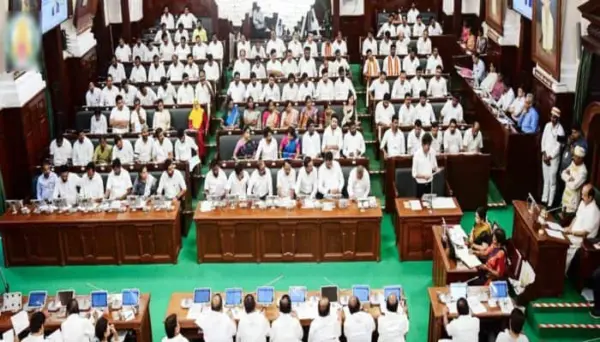
Chennai: The Tamil Nadu Assembly on Tuesday (August 11) passed two resolutions on issues that have been part of the states political agenda for years, with all major parties backing the demand to abolish the National Eligibility cum Entrance Test (NEET) for medical admissions and the ruling establishment calling for the withdrawal of the proposed FCRA Amendment Bill, 2026.
The two resolutions deal with different subjects, but both address issues that Tamil Nadu says affect the rights and interests of the state. The first deals with proposed changes to rules governing foreign contributions received by organisations, while the second seeks an exemption from NEET for undergraduate medical admissions in Tamil Nadu.
The FCRA resolution called on the Centre to withdraw the proposed legislation in its present form and hold wider consultations with state governments and organisations affected by the changes. The NEET resolution sought changes to the relevant central laws to end the common medical entrance examination for undergraduate admissions in the state.
Tamil Nadu objects to proposed FCRA changes
Moving the resolution on the Foreign Contribution (Regulation) Amendment Bill, Tamil Nadu Minister Rajmohan said the proposed changes could affect educational institutions, hospitals, elderly care homes and other organisations that receive foreign contributions.
“The Union Government has introduced the Foreign Contribution Regulation Bill in Parliament to legally regulate international aid. Because of this, educational institutions run by minority organisations and others are being affected. Cancellation of registration and cancellation of renewal are also impacting them,” he said in the Assembly.
The minister added organisations working in education, healthcare and social welfare could face difficulties under the proposed law and stressed that regulatory procedures should follow constitutional principles.
“Hospitals, elderly care homes and educational institutions will be affected through the FCRA. The Tamil Nadu government objects to this,” he said.
“Regulatory procedures must be in accordance with the Constitution,” he added.
Rajmohan also raised concerns over provisions that could allow the government to take over, manage, dispose of or sell assets belonging to charitable organisations if their FCRA registration is cancelled, renewal is refused or an organisation surrenders its registration.
“The institutions that are being handed over to the government must be given an opportunity. If there are no charges against that institution, it should not be taken over through the FCRA,” he said.
The minister also made it clear that the state supports measures related to national security and preventing misuse of foreign funds.
“The state government is also firm on ensuring national security. Therefore, we have some objections. Hence, the state government is moving a resolution urging the Union Government to withdraw the amendment bill,” he added.
The resolution sought broader consultations with state governments and stakeholders, including charitable, religious, educational, medical and social organisations. It also called for safeguards based on natural justice, proportionality, property rights, legitimate expectation and federalism.
At the same time, the resolution recognised the need for transparency and accountability in the receipt and use of foreign contributions. Tamil Nadu has raised objections over the possible consequences for organisations whose FCRA registrations are cancelled, refused for renewal or surrendered.
DMK seeks withdrawal of FCRA Bill
The DMK has also opposed the proposed amendments at the national level. Its Rajya Sabha MP P Wilson said the party has conveyed its position to Union Home Minister Amit Shah.
“We are completely opposed to this bill because our leaders have clearly stated that the FCRA Amendment Bill 2026 should be withdrawn,” Wilson said.
He said the DMK had written to Shah and attended a meeting with the Union government on August 6 after receiving an invitation.
“We jointly submitted a memorandum and made it clear that we demand the withdrawal of the FCRA [amendments] and the repeal of Section 15. If the government is not considering this, they should refer it to a Joint Parliamentary Committee,” he said.
“The Home Minister has asked us for a detailed report, and we are preparing it. We will hold a meeting with the core committee and submit it to the home minister,” he added.
NEET resolution gets support across parties
The second resolution dealt with NEET, which has been a major political issue in Tamil Nadu for several years.
Health Minister K Arunraj moved the resolution seeking the abolition of NEET for undergraduate medical admissions. He argued that the examination affects social justice, equality and the rights of states.
“NEET is against social justice, equality and state rights,” Arunraj said.
The resolution calls for amendments to central laws so that Tamil Nadu can discontinue the uniform NEET system for undergraduate medical admissions.
The state government has argued that NEET creates difficulties for students from rural and economically weaker families, especially those studying in Tamil-medium schools. According to the state, the role of private coaching has made preparation for the examination difficult for many students.
Tamil Nadu has also proposed using Class 12 examination marks for undergraduate medical admissions. The government says this would avoid another competitive examination after 12 years of schooling and reduce dependence on expensive coaching centres.
The resolution received support from the DMK, the AIADMK, the Congress, the PMK, the DMDK, the Left parties and other smaller parties.
BJP MLA walks out
BJP’s lone MLA, M Bhojarajan, opposed the resolution and walked out of the Assembly. He said NEET gives students an opportunity to compete for medical seats and argued that the state should improve access to coaching instead of seeking an end to the examination.
“NEET is an encouragement for the people of Tamil Nadu. There is hope that the future will be better,” he said.
Citing Pollachi as an example, he said, “In Pollachi, 10 students from the same school have cleared the exam.”
He asked why the state government is not putting greater effort into providing coaching facilities.
“Why is the state government not seriously considering conducting coaching classes? Why are you thinking with an inferiority complex?” he asked.
Bhojarajan said students should not have to depend on wealthy individuals or expensive private coaching centres.
“We don’t want a situation where only wealthy private individuals provide coaching. The state government should come forward to provide a special scheme for students,” he said.
He later announced that he would not take part in the voting. “I am not participating in the voting taking place in the Assembly. I am staging a walkout,” he said.
BJP state spokesperson Narayanan Thirupathy also criticised the Assembly’s decision and said any move concerning NEET should take into account the Supreme Court’s role in setting the examination system.
“As far as NEET is concerned, whatever they want to make, let them submit to the Supreme Court because NEET has been framed only in the direction of the Supreme Court,” Thirupathy said.
He recalled that when NEET was introduced, the Centre had approached the apex court seeking additional time for Tamil Nadu.
“Even in Tamil Nadu, long back when NEET came, even the central government went to the Supreme Court and supported Tamil Nadu, saying, they need one more year. But the Supreme Court refused,” he said.
Thirupathy also claimed that NEET had increased the number of government school students entering medical education.
“Before NEET, how many government school students qualified for medical education? Now, in the last seven or eight years, how many people are qualifying every year for medical education from government schools? NEET has helped poor rural school students,” he said.
AIADMK backs DMK-led NEET stand
The AIADMK also supported the resolution despite its long-running political rivalry with the DMK. Party MLA O S Manian said, “The AIADMK is firm in its anti-NEET policy.”
DMK MLA Muthuraja also backed the resolution. Its Rajya Sabha MP Tiruchi Siva said the party’s support is based on the interests of Tamil Nadu students.
“The Union government would have passed a resolution today and our party would have supported… so they would have said we do not want NEET exams,” he said.
“The bill is pending with the President. We supported AIADMK’s resolution against NEET as well because we don’t see politics when it comes to the interest of the people of Tamil Nadu and the students,” he added.
The state has made several attempts to secure an exemption from NEET. The Assembly had earlier unanimously passed the Tamil Nadu Admission to Undergraduate Medical Degree Courses Bill, 2021, seeking exemption from the examination. The state government has repeatedly asked the Centre to approve the legislation.
Kamal Haasan welcomes Assembly unity
Makkal Needhi Maiam founder and actor-politician Kamal Haasan also welcomed the passage of the two resolutions.
Haasan, who is a Rajya Sabha MP, described the developments as a positive sign of political unity in the state.
“It is heartening that two resolutions have been unanimously passed in the Tamil Nadu Legislative Assembly. The resolutions call for the complete abolition of the NEET entrance exam and the withdrawal of the Foreign Funding Regulation Bill introduced by the Union Government,” he said in a post on X.
“It is a welcome development that these resolutions have been passed with the unanimous support of all political parties in Tamil Nadu, beyond the BJP,” he said.
“Kudos to the Tamil Nadu government. This trend of unity for the welfare of Tamil Nadu must continue,” he added.
The two resolutions now add to Tamil Nadu’s continuing demands for greater consultation with the Centre on matters involving education, foreign-funded organisations and the powers of state governments.
On the FCRA Bill, the state has said it supports national security and accountability in the use of foreign contributions, while seeking safeguards for genuine organisations working in education, healthcare, religion and social welfare.
On NEET, the state continues to argue that Class 12 marks offer a more suitable basis for medical admissions in the state and would reduce students’ dependence on private coaching.
The BJP continues to support NEET as a common national standard and says the focus should be on making preparation accessible to students from rural and government schools.
The Assembly’s action has brought the two issues back into the Centre-state debate, with Tamil Nadu seeking changes to policies that it says directly affect students, institutions and people across the state.