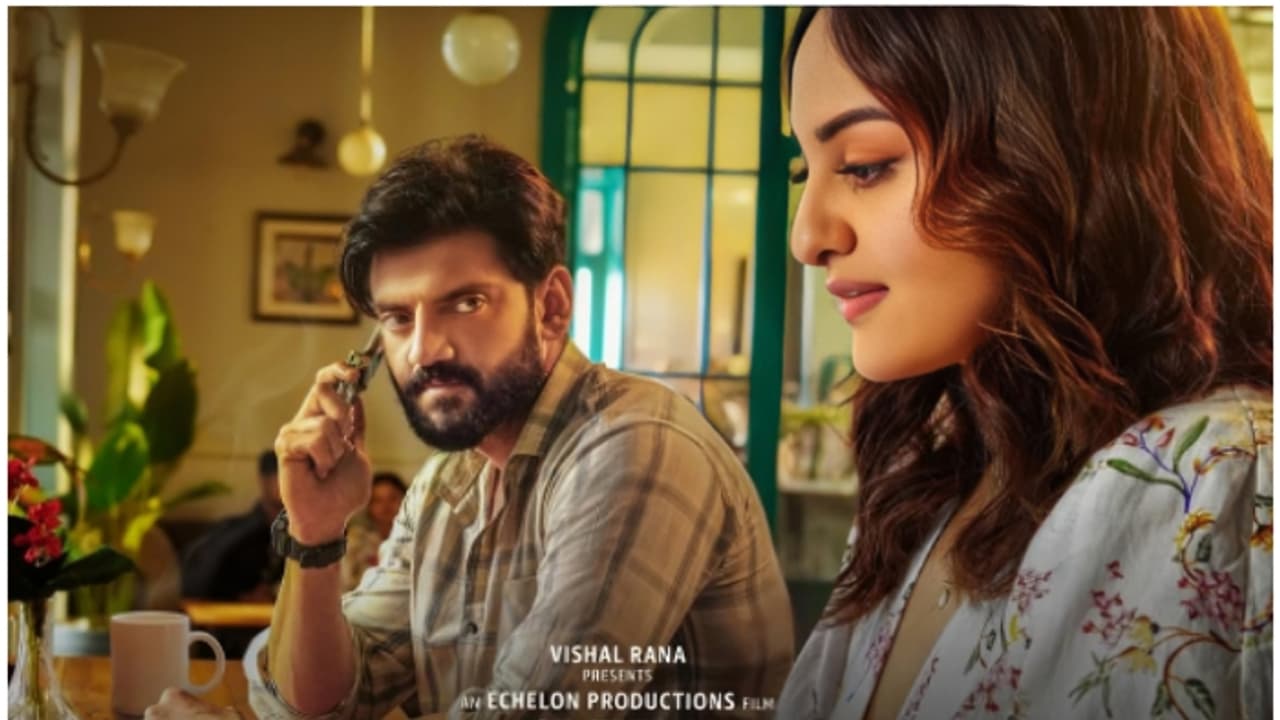
Tu Hai Meri Kiran Review: Sonakshi Sinha and Zaheer Iqbal’s Tu Hai Meri Kiran brings a mysterious phone, a decade-spanning connection and a dangerous obsession to the screen. However, weak writing and uneven execution undermine its potential
Written and directed by Karan Rawal, Tu Hai Meri Kiran revolves around Kiran (Sonakshi Sinha), a successful author who discovers a mysterious phone in her new home. Her attempt to locate its owner leads her to Samar (Zaheer Iqbal), a man living in 2016, while she belongs to 2026.
Initially, their unusual connection offers Kiran fresh inspiration for her next novel. For Samar, however, the phone becomes an opportunity to improve his financial circumstances. As they grow closer, he begins developing an unhealthy attachment to her, mistaking her willingness to listen and laugh with him for romantic interest.
The situation becomes increasingly complicated because Kiran is already married to Riyaan (Ankit Gupta). When she tries to distance herself from Samar, his obsession takes a darker turn. Their connection also introduces the possibility of altering the future, allowing events from 2016 to influence Kiran’s life a decade later.
The premise has the makings of an engaging psychological thriller, combining romance, time travel and manipulation. Unfortunately, the film struggles to develop these ideas into a coherent story. What could have been an intriguing exploration of obsession and the consequences of changing the past instead becomes an uneven narrative weighed down by unanswered questions.
Sonakshi Sinha, Zaheer Iqbal’s Performances Struggle With an Underdeveloped Script
Sonakshi Sinha plays Kiran as a successful and capable woman, but her performance lacks the emotional depth required to make the character’s vulnerability convincing. Some of the more intense moments feel underplayed, leaving the audience struggling to connect with her predicament. Even her interactions with her best friend lack the natural warmth needed to establish a believable relationship.
Ankit Gupta’s Riyaan suffers from limited character development. The film does not give him enough emotional substance to make his marriage to Kiran feel meaningful. As a result, the uncertainty surrounding his character becomes a distraction rather than an effective addition to the central conflict.
Zaheer Iqbal fares comparatively better as Samar. He brings energy to the role of a man whose initial fascination gradually turns into an unsettling fixation. His portrayal occasionally captures the character’s disturbing intensity, but the screenplay does not give him enough material to make the transformation entirely convincing.
The central problem is the writing. The relationships lack the emotional groundwork necessary to make the characters’ decisions believable. With stronger characterisation and more carefully constructed conflicts, the performances might have had a greater impact.
Tu Hai Meri Kiran Technical Review: Visual Problems, Plot Holes and a Disappointing Climax
The film’s technical execution further weakens its storytelling. The visual treatment of Kiran’s 2026 world feels oddly artificial, with the cinematography failing to establish a distinct atmosphere. Rather than drawing viewers into the story, several scenes resemble glossy promotional footage.
The transitions are equally distracting. Unnecessary cutaways and awkward visual inserts interrupt the narrative, while the sound design occasionally makes ordinary background elements as prominent as major sounds. A lengthy conversation between Kiran and Samar, presented through mimed exchanges accompanied by background music, also feels unnatural.
More importantly, the screenplay leaves several questions unanswered. Given Kiran’s intelligence and professional experience, her failure to investigate Samar online seems difficult to justify. The circumstances surrounding the mysterious phone, Samar’s disappearance and the mechanics of the time connection are never explained convincingly enough.
Although the first half manages to build some curiosity around the central mystery, the second half loses momentum. The climax is particularly disappointing, feeling more like a hurried attempt to conclude the story than the culmination of carefully established ideas.