In Donald Trump’s second term, America’s Asia policy has shifted from partnership to tariff and performance-based diplomacy. Japan, South Korea and Malaysia have adopted the strategy of getting relief through pressure, posturing and personal deals.
Author: Serene Joshua
Nearly a year after his second term, Donald Trump’s attitude towards his main partners in South-East and East-Asian countries clearly shows how Trump has changed American diplomacy in his second term. Months of tariff threats, broken alliances and negotiations, starting with April’s “Liberation Day” tariffs and leading to recent Asia tours, reveal an approach to diplomacy based less on partnership and more on performance. Former diplomats describe it as ‘more transactional’, where personal reach rather than mutual respect and win-win outcomes determines influence.
Trump announced reciprocal tariffs ranging from 10 to 50% on almost all American trading partners on “Liberation Day”. The result was that there was a race to talk to him in more than 50 countries. At the same time, major economies like China and Canada took retaliatory action by imposing similar tariffs on $155 billion of American goods. Along with this, the European Union replied that it is ready for trade war. However, the response of Japan, Malaysia and South Korea during this period was completely different from these.
What started as a conversation to showcase their geopolitical power, ended in a calculated performance during the October summit to please Trump and get financial help. Thus, South-East and Eastern Asia marked a major shift from a personal, ostentatious, and coercive diplomacy with the current US administration.
From conversations to guidelines…
At the beginning of his second term, Trump had good relations with his Asian allies. Japanese Prime Minister Ishiba’s February visit was well received. Trump praised him and the decades-old friendship between the two countries. Diplomatic relations were also maintained continuously with South Korea and Malaysia. However, the April tariffs cemented Donald Trump’s strategy in a way that cannot be saved by historic partnerships or alliances.
Meanwhile, Trump’s allegations were based on a pattern, such as Japan blocking American cars and rice, while South Korea imposed tariffs 4 times higher than the US despite receiving military aid. In response, South Korea’s acting President Han Duk-soo clearly said that retaliating would not improve the situation. Along with this, South Korean officials often went to Washington to try to get relief.
Similarly, Japan’s Economy Minister Ryosei Akazawa was specially appointed as the chief negotiator for tariffs on April 7. Officials made several trips to Washington focused on securing relief through concessions rather than relying on WTO procedures. Malaysia was more vulnerable due to the lack of security from its long-term alliance with America. The impact of Trump’s tariffs destabilized Malaysia’s domestic growth, forcing it to call a special session of Parliament in May.
US Secretary of State Scott Besant has previously stressed that governments are “more eager to come to the table, get it done, and then go home and campaign on it.” This business-style framing of the talks reflects a shift in US and international trade policy – one where countries are succumbing to Trump’s pressure for ‘quick deals’ rather than thoughtful agreements that focus on protecting national interests and long-term partnerships.
Trump’s letters to individual countries in July were essentially ultimatums, setting tariff rates with warnings of changes ‘up or down’ depending on the relationship. In each letter the trade deficit was described as a major threat to the American economy and especially its national security.
From partnership to performance…
By the time Trump began his high-profile tours of Southeast and Eastern Asia in late 2025, all three countries had recognized that to achieve good results, it was necessary to recognize Trump in a broad and ostentatious manner, as was seen during his 6-day Asia tour.
The strategic response of these countries was clear. Caught between China’s growing aggression, weakening WTO measures and strong economic dependence on the US market, he had no option but to appease Trump and build a personal connect.
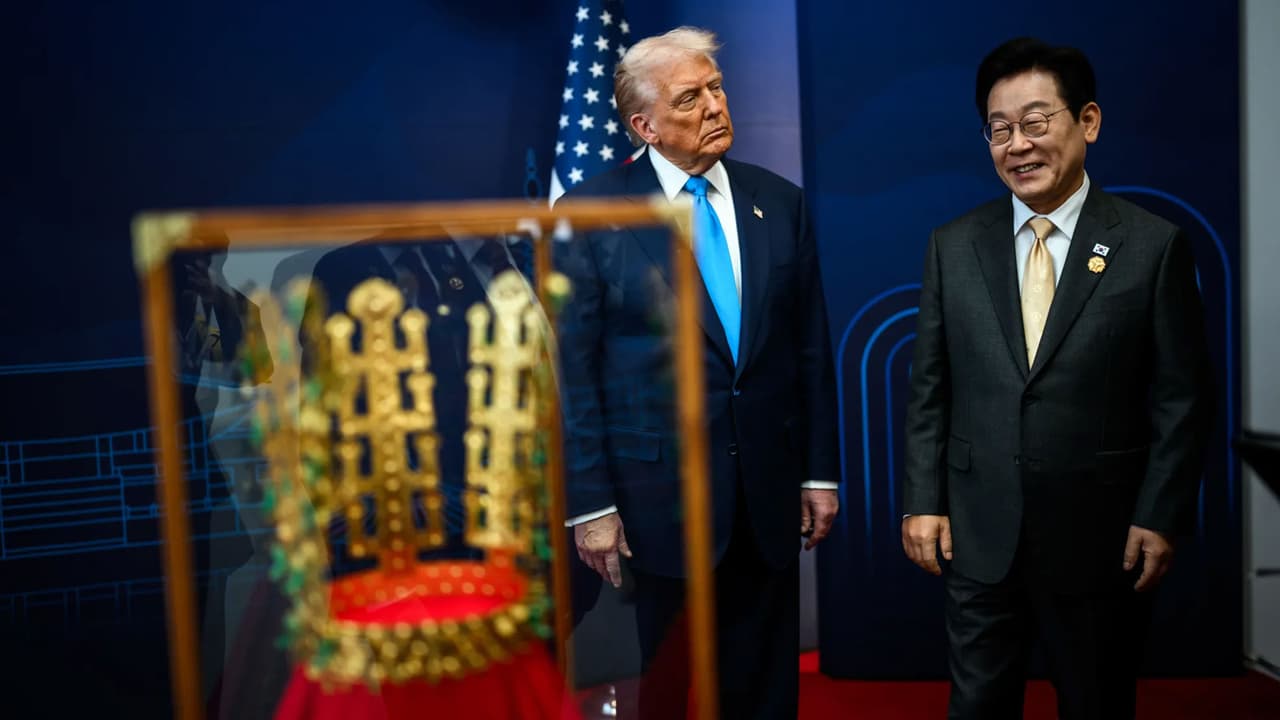
Trump’s arrival in South Korea began with spectacular images of warplanes escorting his Air Force One, a YMCA performance by a military band during a 21-gun salute, and Trump being presented with a replica of the Silla-era gold crown, South Korea’s highest honor. During this time, as per Trump’s choice, President Lee also wore a custom gold tie.
In Japan, Trump was welcomed in gilded palace rooms, where Prime Minister Takaichi remembered his mentor, the late Prime Minister Shinzo Abe, symbolizing the ‘golden era’ of relations. During a luncheon consisting of American rice and beef, Takaichi also presented a map showing Japan’s investments.
Trump dancing on the tarmac in Malaysia shows how impressive his welcome was there. Prime Minister Ibrahim even broke protocol and rode in Trump’s limousine. These appearances were not mere decoration, but indicative of a deeper, more calculated response to a president who values visible loyalty too much. Grandeur thus becomes one of the most valuable things in Trump’s second term, i.e. 2.0.
After the summit, Trump was full of praise. He stressed that he would help Japan at any time. He promised good relations with Prime Minister Takaichi. With this, Japan managed to maintain the 15% tariff rate and insure that the $550 billion investment MOU would not be extended again. Along with this he also made a new rare earth minerals deal. Trump called Malaysia a great and vibrant country. With this, Malaysia achieved 19% tariff, with 1711 tariff lines exempted with 0% tariff rate.
Trump described the visit to South Korea as a special visit with a wonderful Prime Minister. During this visit, South Korea achieved a tariff reduction from 25% to 15% after several months of difficult negotiations. Also promised an annual cash investment of $20 billion and $150 billion for American shipbuilding operations.
Tariffification of alliance…
A major highlight of Trump’s diplomacy over the past year has been how tariffs have affected America’s relations with countries like Japan, South Korea and Malaysia. Policies that once sought to enhance strategic cooperation and partnerships in security, regional stability, technology, and shared democratic values have been largely dismantled, using them to obtain tariff relief. At the same time, traditional alliances focus on many dimensions of mutual cooperation. Apart from the tariffs, the talks in Trump 2.0 focused only on what kind of response various countries can give to stop them.
These summits in Asia simply confirmed what these countries had realized from months of irregular negotiations: that with Trump, sustained policy discussions rarely yield results. The gold crowns, custom ties and personalized gifts are strategic calculations aimed at appeasing Trump by flattering him and showing off. Such actions, which publicly demonstrate his authority as tariff king, are an easy way to change Trump’s nature from a punisher to a defender.
The second year of a Trump administration could see the weakening of regional structures, like ASEAN, that traditionally promote collective bargaining and rules-based engagement. As individual countries vie for Washington’s favor through personalized deals, the future of coordinated regional responses to other shared challenges, be it security or climate, looks increasingly bleak.
(Serine Joshua is a Young Ambassador for the Security Studies Program at Carnegie India. She holds a bachelor’s degree in Sociology and a minor in International Relations from Ashoka University. Serine previously worked as a research assistant at the Koita Center for Digital Health and the Commonwealth Human Rights Initiative. Her research focused on India’s digital economy, related to health policy and RTI reform, including Transparency and public health delivery were examined.)