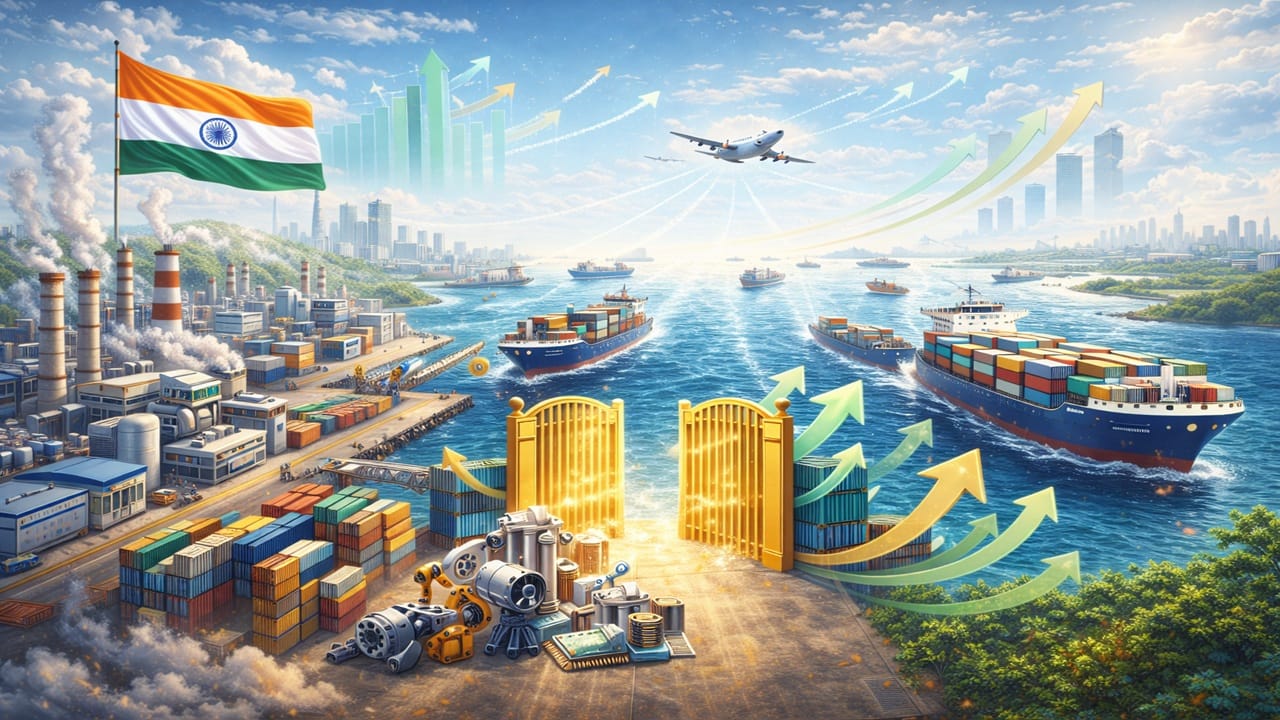
The budget countdown has started. The Finance Minister will announce the budget on Sunday, 1 February. But this time the budget is going to be something special. This time, preparations are being made to completely remove Trump’s tariffs in the budget. This time in the budget, the government is going to open its doors for foreign goods. So that the domestic supply chain will be strengthened.
Also, efforts will be made to reduce input costs. However, easy entry of foreign products may impact the sales of local products. But this step is being taken at a time when US President Donald Trump has increased tariffs drastically and the world is looking for alternative markets.
According to experts, this is a defensive stance in a way, but it is part of a risk-free strategy whose objective is to reduce the dependence on such suppliers, which has always been at the center of India. Also, the aim is to reduce dependency on unsafe trade channels and convert disruption into profit.
Trump’s tariff program, which includes reciprocal tariffs of up to 26 per cent on Indian imports into the US, has rattled exporters and created new troubles in a relationship that has historically been based on strong services and goods trade ties.
Instead of taking retaliatory action, the current Modi government has changed its strategy. It is softening its market stance on selected foreign products and attracting trading partners who can reshape the global supply chain. Critics call it risk management, while many consider it strategic diplomacy. Let us also give you detailed information about this.
Change in trade strategy
As the government prepares its next budget, policymakers will have to strike a delicate balance between protecting the economy from external shocks arising from US tariff increases, while maintaining government investment to maintain investor confidence. This balance has become central to India’s broader strategy of selectively opening its factories to foreign goods that strengthen the domestic supply chain.
India has already made considerable progress on fiscal consolidation. According to official budget documents, the central government has reduced the fiscal deficit from 9.2 per cent of GDP in FY 2021 at the peak of the pandemic to 5.6 per cent in FY 2024, and aims to bring it down to 4.5 per cent by FY 2026.
The budget is also expected to play a gatekeeping role in selective trade openness. Under which, lower duties are expected to be imposed on important capital goods, intermediate inputs and advanced machinery and strategically sensitive sectors will also be protected. Gautam Khattar, principal, Price Waterhouse & Company LLP, said in an ET report that the Budget may consider targeted tariff reforms and calibrated duty cuts on raw materials/intermediate goods to reduce input costs and support domestic manufacturing, while the general protective stance on many finished products will be maintained.
impact of us tariffs
The recent tariff measures imposed by the US target a wide range of Indian exports, from steel and chemicals to textiles and engineering components, effectively increasing the cost of access for key Indian products to the US market.
Yet its impact, while obvious, has not been as devastating as feared. Despite these challenges and tariff pressures, India’s export performance remains remarkably resilient.
Much of this resilience can be attributed to exporters exploring new routes and markets, as companies seek to establish a presence away from traditional US demand, and domestic demand continues to strengthen amid strong growth forecasts.
reducing risk in the budget
New Delhi’s strategy is not just about avoiding tariff pain, but converting it into structural benefits. Its main basis is to diversify sources and reduce dependence on single suppliers. Let us try to understand this with an example. Historically, the number of suppliers for crude oil and coal was less than 30, which has been increased to 40.
Khattar said in media reports that while giving priority to Make in India sectors such as electronics and semiconductors, renewable energy and electric vehicles, specialty chemicals and defence, tariff reform measures and changes in entry level discounts on inputs can be expected.
Also, to preserve emerging domestic manufacturing and encourage local value addition, the government may retain high tariffs on finished electronics, passenger electric vehicles and home appliances and select consumer-oriented chemicals. This is in line with the government’s long-running PLI schemes, which are designed to bridge the gap between imports and domestic production. Electronics is a prime example: with the support of PLI incentives, India has emerged as one of the world’s top smartphone makers, with companies like Apple and Dixon Technologies expanding production.
Budget will open doors for strategic imports
Paradoxically, while Trump-imposed tariff protection measures are increasing, India is selectively reducing barriers in sectors where the argument for strengthening supply chains is strong. Policy circles in New Delhi argue that preventing all foreign competition will only perpetuate inefficiencies. Instead, planned openness – especially in advanced machinery, specialized components and capital goods – can help Indian companies control costs, innovate faster and integrate deeply into global value chains.
Khattar said the budget-induced tariff changes could support gradual diversification away from China by encouraging alternative suppliers and building local capacity, although some trade may still be redirected through third countries in the near future. For example, India’s negotiations and trade agreements, such as the India-EFTA Trade and Economic Partnership Agreement which is soon to come into force, will reduce tariffs on most goods between India and the European Free Trade Association states.
How can the budget support new trade routes?
Just as New Delhi is trying to diversify its import sources, it has also intensified its efforts to diversify its export markets. Due to US tariffs, pressure on traditional export routes is increasing, hence Indian exporters are turning towards the markets of European Union, Middle East, Africa and South East Asia. Countries such as Spain, UAE, China and Bangladesh have recorded consistent export growth, reflecting more balanced participation across different geographies.
It is not just a matter of geographical location, but also of product mix. Electronics and high tech products are gaining more importance than traditional labour-intensive exports, creating a strong trade structure with high value added content.
In high-dependence sectors such as electronics, tariff and non-tariff barriers such as high tariffs on finished goods and standard/testing and licensing processing are aimed at promoting domestic manufacturing and curbing lower quality imports. Khattar said these are important for building resilient domestic ecosystems, but in the short term they could also limit access to the cheapest global suppliers, especially where domestic capabilities are still developing.