Donald Trump said he doesn’t care if Iran returns to talks, claiming its military is ‘gone’. He accused Tehran of lying and announced a US Navy blockade of the Strait of Hormuz after negotiations in Islamabad ended in a stalemate.
US President Donald Trump on Sunday (local time) expressed indifference over whether Iran would return to the negotiation table following a stalemate in talks held in Islamabad in order to achieve a complete halt in hostilities in West Asia.
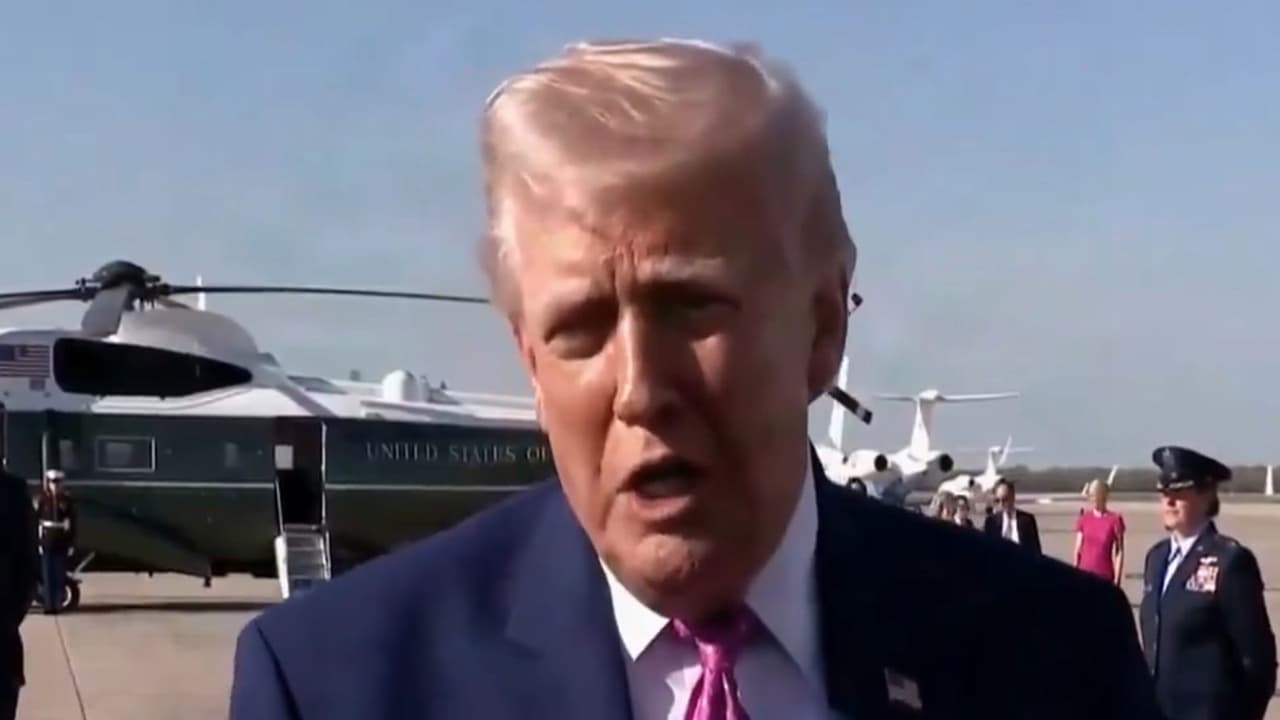
Speaking to reporters at Joint Base Andrews, Trump claimed that Iran was in a “very bad shape” and “very desperate”. The US President reiterated his claims of Iran’s military capabilities being significantly weakened, following over a month-long military operation by the US on the Islamic Republic, asserting that Tehran’s missile stockpiles and manufacturing capacity had been “largely depleted”.
“I don’t know. I don’t care if they come back or not. If they don’t come back, I’m fine. Their military is gone. Their missiles are largely depleted. The manufacturing capability for missiles and drones is largely defeated. We’ve been very nice. We haven’t ripped down too many bridges,” Trump said.
“I think Iran is in very bad shape. I think they’re very desperate. We had a meeting that lasted 21 hours. We understand the situation better than anybody,” he added.
Trump Accuses Iran of Breaching Ceasefire, Vows to Block Nuclear Ambitions
The US President further accused Iran of failing to honour its commitments as part of the two-week ceasefire deal, particularly regarding the strategic Strait of Hormuz, calling the leadership of the Islamic Republic ‘liars’. “Their promise was that they were going to open the Strait of Hormuz. They didn’t do it. They lied,” he said. “We understand the situation better than anybody,” he added.
Reiterating Washington’s long-standing position on Tehran’s nuclear ambitions, Trump said, “Iran will not have a nuclear weapon. There is no way that they’re going to get it.” He added that while Iran continued to seek such capabilities, the United States would prevent it.
US Imposes Blockade on Strait of Hormuz
Announcing further measures, Trump reiterated that the blockade on the Strait would come into effect at 10 am the following day, aimed at restricting Iran’s ability to export oil. He noted that other nations were cooperating with the effort, which he described as “very effective”.
The President also claimed that ships were attempting to bypass traditional routes to transport oil, adding that the situation would be “corrected.” “At 10 o’clock tomorrow, we have a blockade going into effect — that’ll be 10 o’clock tomorrow. Other nations are working so that Iran will not be able to sell oil, and that will be very effective,” Trump said. “There are many boats heading towards our country to fill up with oil and take it. They are not going through the Hormuz Strait. And ultimately, that will be corrected, but they are using us now. We have more oil than Russia and Saudi Arabia put together due to ‘drill baby drill’,” he added.
Trump Justifies Blockade Citing ‘World Extortion’
Earlier, Trump confirmed that the United States Navy would begin intercepting vessels in the region immediately to prevent Iran from profiting from the passage. “Effective immediately, the United States Navy, the Finest in the World, will begin the process of BLOCKADING any and all Ships trying to enter, or leave, the Strait of Hormuz,” Trump stated in a post on Truth Social.
The US President indicated that while the goal is to return to a status where all ships are allowed passage, the current blockade is necessary due to Iranian actions and claims regarding maritime mines. “At some point, we will reach an ‘ALL BEING ALLOWED TO GO IN, ALL BEING ALLOWED TO GO OUT’ basis, but Iran has not allowed that to happen by merely saying, ‘There may be a mine out there somewhere,’ that nobody knows about but them. THIS IS WORLD EXTORTION, and Leaders of Countries, especially the United States of America, will never be extorted,” the post added.
Islamabad Negotiations End in Stalemate
Meanwhile, the negotiations between the United States and Iran in Islamabad, which lasted 21 hours, ended in a stalemate on Sunday, with US Vice President JD Vance stating that no agreement had been reached despite extensive discussions.
Following the marathon talks, US Vice President JD Vance departed for the United States as the stalemate persists between the two parties. (ANI)
(Except for the headline, this story has not been edited by Asianet Newsable English staff and is published from a syndicated feed.)