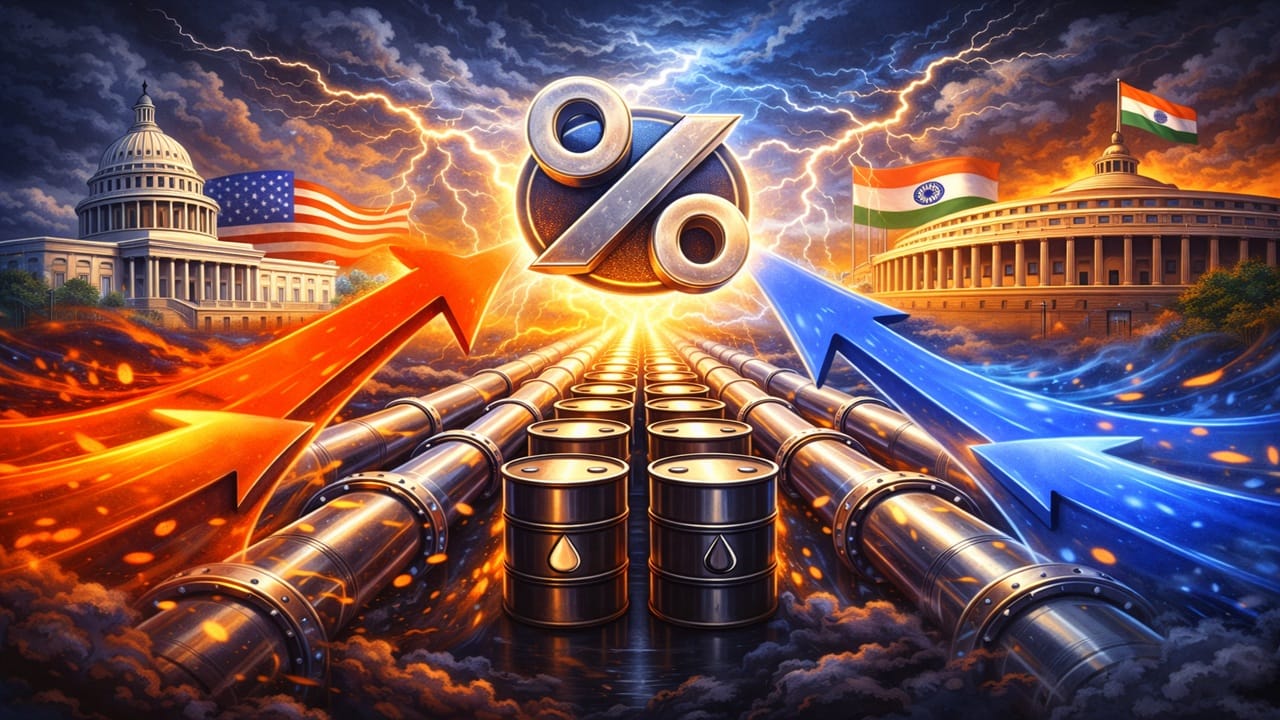
America has indicated to remove Russian oil tariff from India. Image Credit source: ChatGPT
Big news has come for India from the American government. There are indications from America that Russian oil tariff on India will soon be removed. These indications have come at a time when a big trade deal is about to be announced between India and Europe. At present, Europe and America do not have good relations regarding Greenland. In such a situation, a large part of the trade between Europe and America is expected to go towards India. This is why America had refused to impose tariffs on Europe a few days ago in Davos. Now the American government has tried to put pressure on India. If this happens then India can get a benefit of more than 5 billion dollars i.e. about 50 thousand crore rupees. Come, what kind of signals have you received from the American government…
Finance Secretary Scott Besant gave indications
US Finance Secretary Scott Besant said that the US government had imposed tariffs on India’s purchase of Russian oil. He claimed that after the implementation of the tariff, there has been a decline in the purchase of Russian oil by Indian refineries and the step taken by the US government has been successful. He further said that this is a success. 25 percent tariff on Russian oil is still in force. I think the way has now been opened for its removal. So this is a stopgap and a major breakthrough.
He also said that America’s European allies refused to impose tariffs on India’s purchase of Russian energy because they wanted to make a major trade deal with India. In August 2025, when US President Donald Trump imposed tariffs on several countries, he doubled the duty on Indian imports to 50 per cent, citing India’s energy ties with Russia, of which 25 per cent was Russian oil tariff.
India-US trade agreement
Speaking to the media in Davos, Trump described Prime Minister Narendra Modi as his close friend and expressed confidence that despite the ongoing tension over heavy tariffs, the US and India will reach a trade deal. Trump said that I respect your Prime Minister very much. He is a wonderful person and my friend. Trump had earlier publicly linked India’s trade behavior to buying oil from Russia and said that New Delhi had reduced imports in response to US pressure.
Trump’s comments on tariffs
Trump had said that he wanted to make me happy. Actually, Modi is a very good person. He knew I was not happy, and it was important for him to make me happy. He further warned that if India does not agree with Washington’s stance on Russian energy, it may have to face immediate commercial consequences. He said that we trade, and we could raise tariffs on them very quickly, and that would be very bad for them. India has not given any assurance regarding ban on Russian oil imports, adding that the country’s energy related decisions are taken keeping in mind the national interest and price stability.
US government bill and India’s energy policy
These comments come at a time when the US Congress is debating a proposed bill, under which a heavy duty of up to 500 percent can be imposed on countries buying oil from Russia. India says its approach is driven by the need to ensure “affordable energy” for its population.
Despite this proposed US bill increasing tariffs by 500 percent, New Delhi is sticking to its “India First” energy policy. India has repeatedly said that its priority is to ensure affordable supplies for its 1.4 billion citizens.
Responding to the proposed bill, External Affairs Ministry spokesperson Randhir Jaiswal said that India is aware of this development and is closely monitoring it. Jaiswal said during the weekly press briefing that we are aware of the proposed bill. We are closely monitoring the developments.
Despite increasing legislative pressure in Washington, India continues to strive to balance its strategic autonomy with the realities of the global market.
Trump, sanctions and increasing pressure on buyers
Besant’s comments follow comments made earlier this month by US Senator Lindsey Graham, who said that US President Donald Trump has given the green light to the bipartisan Russia sanctions bill. Graham said the bill would give Washington the power to pressure India, China and Brazil to stop buying Russian oil and punish countries that “fuel Putin’s war machine.”
Trump had approved the bill earlier this month. This proposal has a provision to impose duty of up to 500 percent on countries purchasing Russian crude oil, due to which India may face serious trade risks.
Graham said the bill would allow President Trump to punish countries that buy the cheap Russian oil that fuels Putin’s war machine. He had further said that this would give Trump an opportunity to put “extreme pressure” on India, China and Brazil. China and India are currently the world’s largest buyers of Russian crude oil.
Oil refineries reduced Russian oil imports
Due to tough sanctions imposed by Western countries on Russian oil producers and pressure from the Trump administration, Indian refiners had to reduce imports in December and look for alternative sources. Reliance Industries, whose refined products are exported to the European Union, stopped importing Russian oil in January.
Due to reduced demand in India, the availability of Russian crude oil at concessional rates increased for China, which helped China, the world’s largest oil importer, to overcome the shortage of Venezuelan oil. This reduction occurred when Washington took action against OPEC producing country Venezuela and took control of the sale of millions of barrels of Venezuelan oil.
India’s Urals crude oil imports fell to 929,000 barrels per day in December, the lowest since December 2022, according to Kpler data. In comparison, average imports are estimated to be 1.36 million barrels per day in 2024 and 1.27 million barrels per day in 2025.
Indian refiners have started changing their purchasing patterns and are becoming more active in purchasing less sensitive alternatives from the Middle East, West Africa and Latin America. These alternatives can replace Russia’s Urals mix, but their cost is higher.
A clear picture of the changes in India’s crude oil purchases is expected to emerge by the end of the month. According to the ET report, preliminary data shows that in view of the increasing uncertainty due to the decline in Russian supplies and continued pressure from the US, refiners are sourcing oil from new or previously marginalized suppliers.
In the first fortnight of January, Indian Oil, Nayara Energy and Bharat Petroleum were the only refiner companies that received crude oil supplies from Russia. In the last one year, Reliance Industries, the largest importer of crude oil from Russia, did not take any oil from Russia during this period. Hindustan Petroleum, HPCL-Mittal Energy and Mangalore Refinery and Petrochemicals also did not get supplies from Russia.