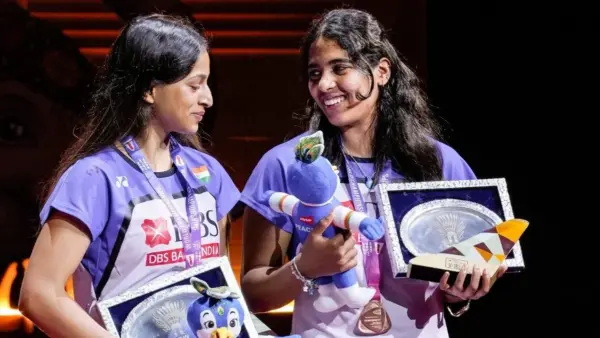
India’s home BWF World Championships ended with a medal, but not the haul the hosts had hoped for. Treesa Jolly and Gayatri Gopichand’s historic bronze in women’s doubles ensured India extended their remarkable run of winning at least one medal at every World Championships since 2011, yet it also served to mask a campaign that exposed several concerns across the singles and doubles disciplines.
The 23-year-olds’ run was one of the most encouraging stories of the tournament. They returned from an injury-disrupted season, overcame higher-ranked opponents from China and Japan and delivered when the pressure was greatest. For a women’s doubles programme that has rarely enjoyed sustained success on the world stage, their bronze was significant.
But one medal from India’s 10 entries was ultimately a modest return on home soil. Only two Indian combinations reached the medal matches, with Satwiksairaj Rankireddy and Chirag Shetty’s men’s doubles campaign ending in a heavy defeat and the singles contingent failing to produce a medal for the second successive edition.
Saina Nehwal believes the result should not obscure the talent emerging behind India’s established stars.
“We are doing well in all categories, and this time it was in women’s doubles, with such a powerful performance from Treesa and Gayatri,” Nehwal told
She also pointed towards the next generation, naming Tanvi Sharma, Unnati Hooda, Lakshya Sen and Ayush Shetty among the players India can build around, while backing PV Sindhu to remain part of the picture.
If India’s campaign had one result worth celebrating without qualification, it was the women’s doubles bronze.
Treesa and Gayatri had plenty working against them. Their season had been disrupted by injury, expectations around the pair had risen sharply and the scrutiny surrounding their partnership had intensified.
Yet they found a way through.
They defeated higher-ranked opposition from China and Japan to reach the medal rounds, producing the sort of resilient run that can alter the trajectory of a young partnership.
Their bronze also carried significance beyond the immediate result. Women’s doubles has not traditionally been one of India’s strongest disciplines, with the country winning its first World Championships medal in the event only in 2011.
For Nehwal, the confidence with which the pair played was particularly encouraging.
“Hopefully, I was expecting medals in singles also, because we are capable of doing it,” she said. “We have won medals in so many World Championships, and medals in the Olympics have also been won.”
The medal was therefore both validation and a reminder that India’s women’s doubles programme has room to grow.
The singles problem is harder to disguise
The most concerning aspect of India’s campaign came in singles.
There was no medal in either men’s or women’s singles, continuing a worrying trend. India’s last singles medals at the World Championships came in the pandemic-affected 2021 edition, when Kidambi Srikanth won silver and Lakshya Sen took bronze.
Since then, India’s singles contingent has struggled to reproduce that level of consistency.
Lakshya’s defeat was perhaps the biggest shock of the tournament from an Indian perspective. The country’s No. 1 men’s singles player lost to 18-year-old American Garrett Tan, ranked 92nd in the world, in a result that exposed once again the uncertainty surrounding his form and confidence.
It was not simply an unexpected defeat. It was another reminder that Lakshya’s camp has yet to find a sustainable solution to the inconsistency that has interrupted his progress.
Ayush Shetty provided one of the tournament’s biggest Indian highlights by eliminating reigning champion Shi Yu Qi in the opening round. But his campaign ended against Alwi Farhan, with the Indonesian exploiting a tactical weakness in Ayush’s game.
For a 6-foot-4 player in an increasingly competitive men’s singles field, developing a Plan B when his physical advantages are neutralised will be crucial.
Sindhu and Unnati offer contrasting lessons
PV Sindhu’s exit was another missed opportunity, although her circumstances are markedly different from those of India’s younger players.
The 31-year-old has already won multiple World Championship medals and an Olympic silver and bronze. Yet her defeat to Wang Zhi Yi was another example of how her game can unravel when the pressure intensifies late in a contest.
Unnati Hooda, meanwhile, represents India’s future.
At just 18, she pushed a higher-ranked opponent to the limit and had two match points but could not close out the contest. The disappointment was obvious, but so was the potential.
Both losses had a mental component, with patience and decision-making becoming increasingly important as the finish line approached.
The difference is that Sindhu is attempting to refine a game that has already delivered at the highest level, while Unnati is still at the beginning of her international learning curve.
That distinction matters when assessing what India should take from the tournament.
## Satwik-Chirag’s defeat needs context
The men’s doubles campaign ended in emphatic fashion, but there are reasons to resist drawing sweeping conclusions from it.
Satwiksairaj Rankireddy has been managing a shoulder injury, and the physical limitation affected one of the pair’s biggest weapons – his devastating smash.
Their preparation was also far from ideal. A first-round bye followed by a walkover meant they entered the tournament short of competitive rhythm, while the need to manage Satwik’s fitness further complicated matters.
They eventually suffered a one-sided defeat to the pair that would go on to become world champions.
It was a poor result, but one that needs to be viewed in the context of the physical and competitive circumstances surrounding the pair.
India’s next generation is beginning to emerge
Nehwal’s assessment of India’s prospects was more optimistic than the medal tally might suggest.
“At the moment, I would say Tanvi Sharma is doing extremely well. Unnati Hooda is doing extremely well, and Lakshya and Ayush Shetty are doing very well. Sindhu is there anyway,” she said.
“In the next Olympics, these are the people to look forward to.”
That is perhaps the most constructive takeaway from an otherwise underwhelming home World Championships.
India do not lack talent. What remains uncertain is whether that talent can be converted into sustained success at the highest level.
Ayush’s victory over Shi Yu Qi showed the ceiling of what he can achieve. Unnati’s near-miss against a seeded opponent showed that she is capable of competing beyond her ranking. Tanvi is another emerging name attracting attention.
But potential needs to be accompanied by consistency, tactical adaptability and the ability to handle pressure.
Delhi delivered even if India did not
The tournament itself was a success from the perspective of the home crowd.
Fans turned up in large numbers throughout the week, travelling from cities including Mumbai and Coonoor to watch the world’s best players. Even when no Indian was involved in the final, the stands remained full, with chants and posters creating a carnival-like atmosphere.
That support matters.
India’s badminton audience has grown alongside the country’s rise in the sport, and the atmosphere in Delhi demonstrated how deeply the game has embedded itself in the country’s sporting culture.
The international results also reflected a changing badminton landscape.
France emerged as a major force, with Alex Lanier winning the men’s singles title while Thom Gicquel and Delphine Delrue triumphed in mixed doubles. Traditional powerhouses such as China and Indonesia struggled, while the men’s singles podium represented three different continents.
Whether the unusual results were influenced by the slower conditions and challenging drift in Delhi or reflected the broader globalisation of badminton, the competitive landscape is becoming increasingly difficult to predict.
The Asian Games are already the next test
India do not have much time to dwell on the disappointment.
The Asian Games in September will bring another major opportunity, with both team and individual medals at stake.
India performed strongly at the previous edition in 2023, but the World Championships have offered little evidence that repeating that success will be straightforward.
The Treesa-Gayatri bronze has ensured that India’s long medal streak survives. It has also provided a timely boost to a women’s doubles programme that needed one.
But it cannot conceal the larger picture.
India remains a serious badminton nation with an established champion in Sindhu, proven stars in Satwik and Chirag, and a promising group of young players coming through. What Delhi showed, however, is that talent alone will not guarantee medals.
The bronze was a salve. The bigger task now is to ensure it does not become a band-aid covering problems that will surface again at the next major tournament.