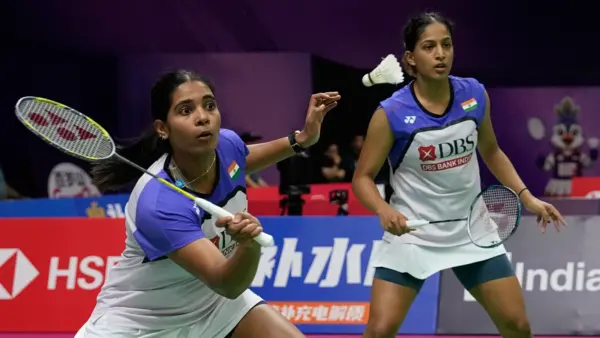
Treesa Jolly-Gayatri Gopichand don’t go looking for weaknesses in opponents, though those are very useful to know. They pick on, they prod, poke and prise open a documented strength of the pairing they face, and then go about demolishing that solidity to pieces.
World No 7s Rin Iwanaga and Kie Nakanishi wouldn’t have imagined that the front-court lunge defence, a skill the Japanese could pull off in their sleep, would see them come up short. And on the biggest stage of the World Championships.
The Indians’ trick? Using the conventional kill weapon – the deep smash – as set-up, and using the soft-drop to turn the knife for a 21-16, 21-12 win.
Treesa-Gayatri were leading 13-9 before the Japanese pulled the weight of their ranking with quick exchanges to get to 13-13, going on to pull the lead to 16-13 with seven straight points. For the Indians ranked World No.39, it might well have been a quiet exit from the home Worlds. But the fight was on.
A late challenge from the Japanese, allowed by the chair umpire, got the Indians agitated. They pointed it out with gusto, even giving the impression that their attention was fragmenting. But Treesa would later recall how she was completely calm and telling herself not to fall apart even if the lead had evaporated.
Coach Pullela Gopichand was completely focused on keeping the Treesa-tornado ready to fire. The Japanese Top 10s are known to be solid. It’s at this point that the Indian rotation kicked in. Gayatri tracked back to stabilise the back court, absorbing in defence, and allowed Treesa to compose her rhythm on the front court. This was the holding stage of the attack.
When they rotated back, both Gayatri and Treesa started sending flatter smashes to the back court.
“We knew what to expect, and that Treesa would send smashes, but we couldn’t do anything about it. Neither could we get our attack going,” Iwanaga would say later. It was only the start of trouble.
For three points in a row after that, Gayatri and Treesa brought on badminton’s version of boxing’s 1-2 jab-punch, using the smash as a dislodging weapon to push both Japanese back, like waves on a high tide warning beach-goers back to shore. The next return would invariably be taken high and early, right after it crossed the net and plonked onto the empty front court.
The Japanese, in their crouching defensive stance, were in no position to lunge for the low retrieves they are otherwise so good at. Tangled in their toes, the torso reflexing back in dreaded anticipation of the Indian smash while the feet needing to stride forward, saw the Japanese in one right mess on the floor. Iwanaga in an attempted vertical split while Naganishi in an awkward knee fold. It would end in the Indians taking the opener 21-16.
Homework works
Japanese retrieving in women’s doubles is legendary. But Gayatri is turning out to be one right puppeteer with her vision from her net perch. In the time that Treesa healed from her injury, Gayatri has upped her backcourt game with her smash not meant for a sensational kill, but for the sly sting simply to put opponents in awkward spots on the court. Treesa’s soft drop-game has been evolving into a crafty variation that boggles opponents who can’t fathom if a smash or drop will ooze forth. But it needs Gayatri to spin the intricate web.
“Those are very crucial shots that Gaya sets up before I take off,” Treesa says. “I like setting up those shuttles for her because I know Treesa will kill them,” Gayatri says. “And when Treesa kills….,” she trails off; they stay killed.
Treesa would even court a yellow card for flailing the racquet mid-game. But it fired her up to drop all nuance and go smashing aggressively and without fear. Gayatri would let the hell-raiser go a little ballistic as the Indians raced to 12-4 in the second.
This was their third match in four days, the first against Top-10 seeds, but the Indians had their plans pat.
“The Indians’ momentum was tremendous. And then they were helped by the crowd,” Iwanaga would say, even as Nakanishi was in a pool of tears fronting the media. It might’ve felt like a yo-yo on the end of a crazy string as the Indians threatened cannonballs on the backcourt, but razed down the ground on the front court.
World Championships medals rarely come without downing a Chinese, or four. And Treesa-Gayatri will play perhaps the biggest match of their early career, facing defending champion Jia Yi Fan who has turned up with a shuffled partner, Zhang Shu Xian in the quarters.
Women’s doubles has been the preserve of Chinese, Koreans and Japanese. But Treesa-Gayatri find themselves in the Last 8 along with three Chinese combines, two Indonesians, a Korean and a pair from Hong Kong. This is top tier. They have the opportunity to match Jwala Gutta and Ashwini Ponappa, who started India’s unbroken streak from 2011. They will need the giant killing act together again.