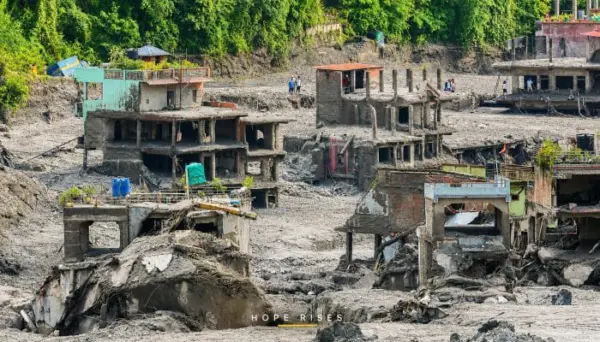
The death toll in the disastrous floods of Nepal rose to 1,200 as rescue teams battled the rains and debris in efforts to look for people stranded in the underground hydropower tunnels of Bhotekoshi River.
Nepal’s National Disaster Risk Reduction and Management Authority reported the deaths as 1,204 across eight districts, as 4,216 are still missing one week after the floods.
In his address to the House of Representatives, Prime Minister Balendra Shah pointed out that the extent of the disaster has highlighted serious climate challenges globally faced by Himalayan regions.
Understanding the origin of the disaster and PM Shah’s plea
In his address, Prime Minister Shah mentioned that the ice-rock avalanche near the border of Nepal and Tibet on August 26 created this huge wave of water. According to him, it is imperative for the international community to shoulder the burden of dealing with climate-induced disasters.
Vulnerability of the Himalayas: Expert testimony proved that this disaster had originated due to ice-rock avalanche at high altitude, indicating climate challenges faced in hilly areas.
International responsibility: Shah stressed that since international carbon emissions caused climate change, it becomes the duty of the international community to support such vulnerable regions.
Acceptance of foreign aid: Highlighting the acceptance of global assistance without any hesitation, Shah stated that there has been continuous support provided by neighboring countries, western nations, and multilateral organizations.
Casualties district-wise and searches
There are still huge deployment efforts with thousands of security personnel being searched in mud, debris, and submerged infrastructures.
Recovered deceased: Official reports revealed that there are high fatalities recorded in Chitwan (348), Nawalparasi East (217), Nawalparasi West (202), Nuwakot (155), and Rasuwa (115), besides casualties in Gorkha, Dhading, and Tanahu.
Missing foreigners: Out of many missing persons, 583 are foreigners trapped because of unexpected floods.
Mobilisation: Joint operations of different forces, including the Nepal Army, have successfully rescued 11,993 individuals using helicopters and clearing ground routes, using more than 21,300 security personnel.
Identification process and mass funeral rites
As a response to continuously increasing bodies, local authorities have made it easier to identify the deceased.
Postmortem process: Authorities informed that identification of 1,113 deceased bodies and postmortem process have been completed and 95 bodies have been handed over to their relatives.
Digital database: Information on 911 unidentified dead bodies has been uploaded on the official Nepal Police website to help the families to locate their missing relatives.