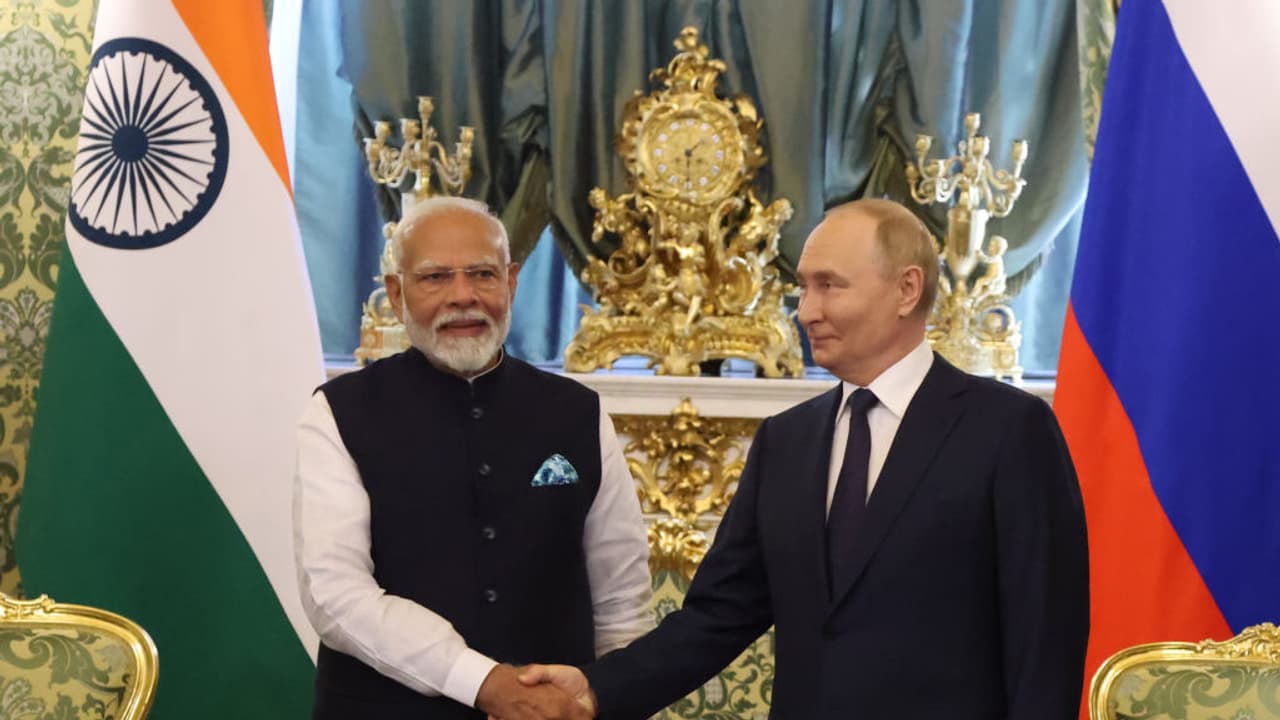
Vladimir Putin visits India as Delhi seeks stronger economic ties, new trade deals, and cultural cooperation amid US pressure, oil disputes, and global geopolitical shifts, highlighting strategic autonomy.
As Russian President Vladimir Putin touches down in New Delhi on Thursday evening, the visit arrives at a time when India’s diplomatic bandwidth is being tested like rarely before. With India–US relations experiencing a rapid downturn, Putin’s presence in the capital adds unusual weight to the 23rd India–Russia summit — a moment New Delhi sees not just as symbolic, but strategically consequential.
Government sources say the visit is loaded with expectations, high-stakes negotiations, and a renewed attempt to rebalance a deeply skewed trade equation.
Strengthening Economic Cooperation: India Eyes a Fairer Trade Balance
According to GoI sources, one of the biggest outcomes expected from Putin’s visit is “a long way in strengthening economic cooperation”. Russia’s president is travelling with a large delegation of business leaders, signalling that both sides are treating this engagement as a major economic reset.
India, which currently faces a massive trade deficit with Moscow, is pushing for structural corrections. “India expects to improve the trade deficit with Russia,” the sources said, adding that multiple avenues are being worked out to increase Indian exports.
The focus areas include:
- Pharmaceuticals
- Automobiles
- Agricultural and marine products
The aim is straightforward: create more demand for Indian goods in Russia and ensure that “Indian businesses and products will get a bigger market and this will also boost job creation and well-being of our farmers.”
New Agreements and MoUs: Shipping, Healthcare, Fertilisers & More
The 23rd annual summit is expected to produce a string of agreements and MoUs, spanning:
- Shipping
- Healthcare
- Fertiliser supply
- Connectivity and logistics
- People-to-people ties
- Culture
- Scientific collaboration
Officials say these new frameworks will be vital for sustaining long-term engagement, especially at a time when supply chains and global trade routes face continued disruption.
A Visit Wrapped in Diplomacy: Dinners, Ceremonies and Symbolism
Putin’s schedule in New Delhi is designed to show continuity, warmth and strategic intent.
Thursday: A private dinner with PM Modi
Putin is likely to land around 6:35 pm, after which Prime Minister Narendra Modi will host him for a private dinner — a gesture mirroring Putin’s own hospitality during Modi’s Moscow visit last July.
Friday: Ceremonial Welcome & Summit Talks
The next morning, the Russian president will receive a ceremonial welcome at Rashtrapati Bhavan, followed by the high-level summit talks at Hyderabad House. Modi will also host a working lunch for Putin and his delegation.
Putin will visit Rajghat earlier in the day, paying homage before the formal negotiations begin.
Evening: Launch of Russian India Channel & State Banquet
After the summit, Putin is expected to launch a new India-focused channel of a Russian state-run broadcaster — a sign of Moscow’s intent to expand its media and cultural footprint.
The day concludes with a state banquet hosted by President Droupadi Murmu.
Why This Visit Matters More Than Usual
Unlike previous summits, this one unfolds under heavier geopolitical clouds. Donald Trump’s steep 50% tariffs on Indian goods and his pressure campaign over Russian oil imports have strained India–US ties in a way not seen in two decades. At the same time, India is navigating the fallout of the Ukraine war, Western sanctions, and the emerging global realignments.
Yet New Delhi remains firm on its long-held principle of strategic autonomy — maintaining old partnerships while building new ones, without bending to pressure.
And in that delicate balancing act, Putin’s 27-hour stop in New Delhi could shape the next phase of India’s economic and geopolitical trajectory.