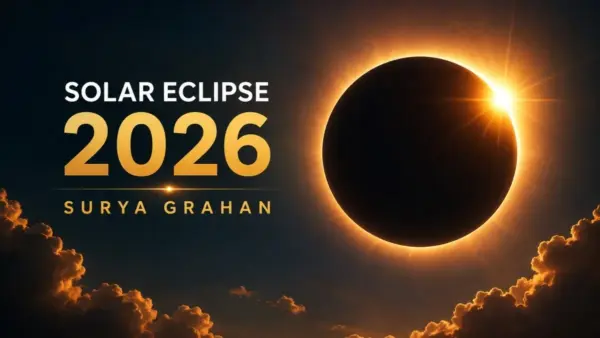
Stargazers have another reason to look up at the sky today as the second and final solar eclipse (Surya Grahan) of 2026 is occurring today, August 12, 2026. The total duration of the solar eclipse will be 4 hours and 24 minutes, stretching from the evening of 12 August into the early hours of 13 August in IST. It is also unique this time because it will be the first total solar eclipse visible from mainland Europe since 1999.
The eclipse will begin at 9:04 PM (IST), when the Moon starts moving across the Sun’s disk. However, the totality will begin at 10:28 PM (IST), followed by the peak of the eclipse at 11:16 PM (IST) over the North Atlantic. The period of total darkness will end at 12:04 AM (IST) on 13 August, and the eclipse will finally come to an end worldwide at 1:28 AM (IST).
While millions of skywatchers in several countries will have the chance to witness the Moon completely block the Sun, people in India will have to sit this one out. The eclipse will not be visible from any part of the country, meaning there will be no opportunity to witness either totality or the partial phases from Indian soil.
Does Sutak Kaal apply in India?
According to Drik Panchang, the total solar eclipse or Purna Surya Grahan, will not be visible anywhere in India. As a result, Sutak Kaal is not observed. Since the eclipse takes place at night in India, traditional Vedic practices do not require temples to close nor do they call for any special fasting or ritual restrictions.
What is a total solar eclipse?
A solar eclipse happens when the Moon moves between the Earth and the Sun, blocking the Sun’s light either partially or completely.
During a total solar eclipse, the Moon lines up almost perfectly with the Sun and completely covers it for people within the narrow path of totality. For a brief period, daylight can fade dramatically, temperatures may drop slightly, and shadows can look unusual. Animals may also react to the sudden change in light.
Where will the solar eclipse be visible?
The eclipse will begin its path of totality over parts of northern Russia on August 12 before moving across Greenland, Iceland, Spain and the northeastern part of Portugal.
In Spain, the path of totality will stretch roughly from the northern city of Oviedo towards Mallorca. Some of the areas along the path have also recently been affected by severe wildfires.
People outside the path of totality will still be able to see a partial solar eclipse across large parts of Europe, Canada, the northern United States and northwestern Africa.
How rare are total solar eclipses?
Solar eclipses are not particularly rare. There can be one or two somewhere on Earth each year. What makes a total solar eclipse special is the narrow path in which the Moon completely covers the Sun.
For any particular location, another total eclipse may not occur for many years sometimes even centuries. That is why people often travel long distances to reach the path of totality.
The next total solar eclipse or Surya Grahan in India is expected on August 2, 2027, with the path of totality crossing parts of southern Spain, northern Africa and the Arabian Peninsula. Totality could last as long as six minutes and 23 seconds in some locations. While Egypt gets the longest totality of the century, India will see a beautiful partial solar eclipse during the evening hours. Most of western and northern India (including Gujarat, Rajasthan, and Delhi) will see 30% to 50% of the sun covered right before sunset.
Do you need eye protection to watch a solar eclipse?
Yes. Looking directly at the Sun can seriously damage your eyes, even during an eclipse.
The safest option is to use specially designed solar eclipse glasses that meet the ISO 12312-2:2015 safety standard. Ordinary sunglasses are not suitable for viewing the Sun.
One reason solar eye damage is particularly dangerous is that the retina does not have pain receptors. This means serious damage can occur without an immediate sensation of pain, and symptoms may only become noticeable later.
Research conducted after the 2024 total solar eclipse in the United States also found an increase in online searches related to eye pain, underlining the importance of using proper eye protection when watching an eclipse.