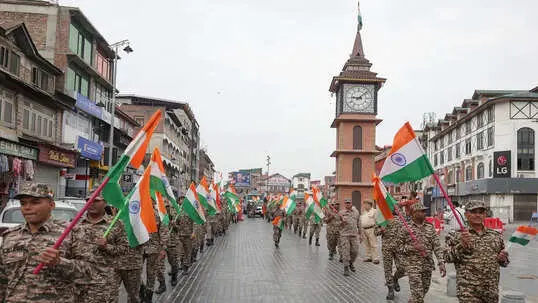
Flag hoisting anywhere and everywhere is par for the course on and January 26 every year. ‘Har Ghar Tiranga’ campaigns and ‘Tiranga Yatra’ may be seen as fodder for friendly political banter and squabble leading up to these days, but practically harmless even by the Opposition’s standards.
But the mandated unfurling at Srinagar’s Lal Chowk, the celebrations at Bakshi Stadium last couple of years, the women-led tiranga yatras now. Why is the Indian flag, rather its visibility, so significant when it comes to Kashmir?
When one types into the web browser: “national flag and Kashmir”, Wikipedia pops up still displaying the old red and white state flag with the plough, years after it was rendered obsolete. On the right it is accompanied with images of a flag often seen across the border in the Pakistan-occupied territory, where it the Pakistani state continues to rain atrocities on civilians.
Few would remember Mehbooba Mufti’s protest vis-à-vis the abrogation of Article 370 two weeks ago. Leading a sit-in protest outside her party office in Srinagar, pictures of the demonstration went viral, not for the cause, that raga is sung all year every year. She held the national flag upside down. If one didn’t know better, it could be chalked up to an accidental faux pas. But one does. The national flag and the defunct state flag were taped together, and the PDP chief was holding it herself. At the expense of quoting Mr Rahul Gandhi on the unrelated issue, either she was complicit or she is incompetent.
Before one takes an educated guess, remember the likes and likings of this Gupkar Alliance. When the abrogation was still a notion, Mr Farooq Abdullah said: “Hum iska muqabala karenge, 370 ko kaise khatam karoge? …Allah ko yahi manzoor hoga, hum inse azad ho jayen… Dekhta hun phir kon inka jhanda khada karne ke liye taiyar hoga…”
The state flag also has a contested history with a complicated narration of the events in 1931. The red flag is supposedly a signifier of the bloodshed seen at the time of the agitation against Maharaja Hari Singh. But the sequence of what the mob trying to catch a glimpse of the instigator (one Abdul Qadeer who is said to have given a passionate speech during tension amid the Muslim population with the Dogra ruler) was really up to remains contentious.
Under Sheikh Muhammad Abdullah the day came to be observed as Martyrs’ Day until the abrogation. More than what thousands of Hindus killed and driven away from Kashmir ever received.
Be that as it may, in 1952, Prime Minister Jawaharlal Nehru and Sheikh Abdullah signed the Delhi Agreement, which states: “the State flag would not be a rival of the Union flag; it was also recognised that the Union flag should have the same status and position in Jammu and Kashmir as in the rest of India”.
Therein perhaps lay the problem… in missing some Is and Ts. And perhaps Dr Farooq Abdullah didn’t receive the complete handover. The agreement said that same status should be granted to the national flag in the valley as in the rest of India, but J&K’s special status remained just too special for some.
What some seem to see as a regular political disagreement over the tricolour, is essentially the ingrained separatist mindset. Not the one that says ‘azaadi abhi adhuri hai’; but missing the irony in the first term the mindset that makes one state: ‘PoK unka hai, yeh humara hai…’
Flags are essential when we speak of Kashmir. The so-called “Azad Kashmir” flag was seen on jerseys worn by the terrorists who massacred innocents in Pahalgam. The Delhi Agreement recognised the J&K state flag: “for historical reasons connected with the freedom struggle in the State…” Makes one wonder if Pandit Nehru would have retained the stance after January 1990.
They were supposed “to build the noble mansion of free India where all her children may dwell.” All.
Kashmiri Pandits who fled at the time refuse to let me go to downtown Srinagar, still. They remember when the national flag was nowhere to be seen. When it was seen at the leadership’s feet during newscasts of Central visits. When it rained stones after any India-Pak cricket match. Some heard ‘Jana Gana Mana’ for the first time in their life after half of it had passed, when they took their kids to school for Independence Day celebrations in an elsewhere town, 12 years after the exodus.
The prime minister’s 1992 unfurling act at Lal Chowk was nothing if not audacious. Ask the exiled locals. A full attendance tiranga yatra in the heart of Srinagar now is path breaking. And Dr Abdullah saluting the Indian flag? History and hypocrisy coming full circle.
The dying embers of Pakistan-sponsored terrorism make the need to ensure the visible dominance of the flag even more urgent. Two attacks within 10 days; one killing a soldier on Amarnath Yatra duty, one conceivably Pahalgam-like on Hindu migrant labourers; refurbished threats on Kashmiri Pandits trying to return to the Valley for long-promised jobs threatening normalcy even in Jammu.
August 15 is the culmination of India’s tryst with destiny. The midnight freedom came at a cost none should forget. Sadly, some of India continues to wake on the other side: ‘…where civilisation sobs and the dollar smiles…’
Kashmir has come far. Some of us can’t go back just yet, but there can be no looking back. We must keep moving forward at Vande Bharat speed. Steady, pausing once in a while, shutting the doors to incompetence. And complacency.