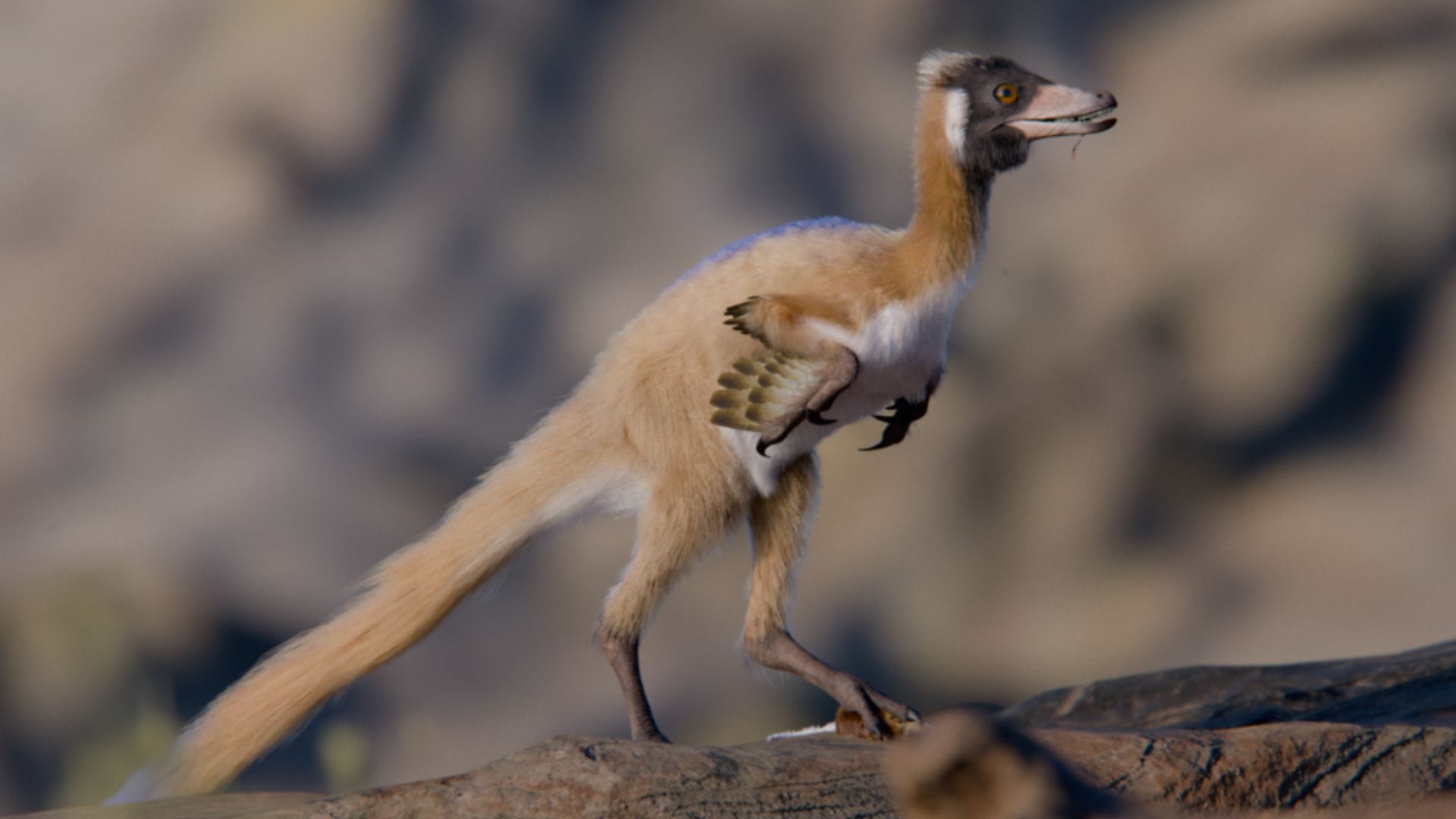
New Delhi: A team of researchers have identified a 90-million-year-old fossil that provides a missing link for a mysterious group of bird-like dinosaurs known as alvarezsaurs, that are famous for their tiny teeth and stubby arms ending in a single, large thumb-claw. For decades, this group has remained mysterious with most of the well-preserved fossils found in Asia, with the records from South America being fragmented and difficult to interpret. The researchers have discovered a nearly complete skeleton of a new species, named Alnashetri cerropoliciensis. The discovery provides a reference point for identifying more fragmented remains, and map out evolutionary transitions in anatomy and body size.
The nearly complete skeleton reveals new information on how the lineage evolved, how the animals shrank in size, and spread across the ancient world. Alnashetri had long arms and larger teeth unlike its later relatives, proving that some alvarezsaurs evolved to be tiny before developing specialised features that are believed to be adaptations for an ant-eating diet. The alvarezsauroids that lived close to the extinction of the dinosaurs, in the Late Cretaceous had specialised forelimbs adapted for digging, along with heightened sensory capacities. The new fossil suggests that these creatures shrank down in size, before specialising in their diets.
Scientists continue to study fossils in the region
Analysis of the bone confirmed that the specimen was a four-year-old adult, weighing less than a kg, making it one of the smallest dinosaurs ever discovered in South America. The researchers believe that as against evolutionary miniaturisation, the findings support repeated evolution within a narrow body size range. The researchers were able to determine that these dinosaurs originated on the supercontinent Pangaea, and were separated by shifting continents. The researchers continue to discover and study fossils from the same region. A paper describing the findings has been published in Nature.