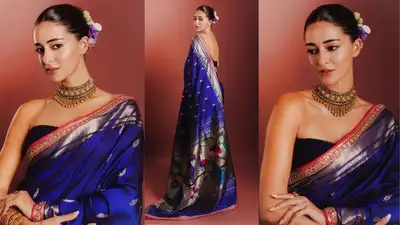
Today is National Handloom Day, and Ananya Panday’s Paithani saree look could not have picked a better day to trend. This weave has been around for centuries, woven by hand in Paithan, Maharashtra, using real gold and silver zari on traditional looms. So while everyone is busy talking about how good she looks, spare a thought for the weavers behind that pallu too.
Now, the look itself. It is a Paithani silk saree by Manish Malhotra, which the actress carries so well. There is no over-the-top drama, no forced ethnic pose, just a girl who clearly knows her six yards. The saree is a deep royal blue Paithani silk, the kind of blue that shift colours depending on how the light hits it. The pallu is where all the craft shows – a rich gold-toned border with the classic peacock and floral motif woven in, done in that unmistakable Paithani style where the birds look almost hand-painted. That is the handloom difference right there – every motif is woven thread by thread and not printed. Little paisley buttis are scattered across the body of the saree.
She has paired it with a strapless black blouse, which is a smart call. A busy blouse would have looked too much, especially with the pallu’s detailing, so keeping it plain and backless let the saree stay the hero. The back reveal is also subtle, not scandalous.
Now coming to the jewellery, because this is where the “Marathi mulgi” energy really comes through. The statement choker is chunky, gold, with an antique temple-jewellery finish. It sits right at the base of her neck, doing the job a nath or a Kolhapuri saaj would usually do. On one hand, she has stacked gold bangles with a pop of pink, tying back into the pink piping on the saree’s border. It is these small details that make a look feel put-together.
Her hair has been pulled into a neat, low bun – which is sleek in the front, soft at the back. It features fresh white and purple flowers tucked in near the ear. A sleek bun with gajra is such a classic Maharashtrian styling move, and it instantly grounds the whole look. Her makeup stays soft and warm – dewy skin, a defined eye, glossy nude-pink lips, and a small red bindi pulling the whole face together. It is such a small detail, but it says “traditional” the loudest.
More About Paithani Silk Saree
Paithani silk gets its name from Paithan, a small town in Maharashtra. Here, this weave has been made for over 2,000 years. It is one of the few sarees in India still woven almost entirely by hand, which is why a single Paithani can take anywhere from a few weeks to several months to finish. It all depends on how heavy the pallu work is. What sets it apart is the use of real gold and silver zari, which is woven directly into the silk using a technique called tapestry weaving, where the weft threads are interlocked by hand instead. It is because of this technique that the motifs – usually peacocks, parrots, lotuses, or vines – look almost painted rather than woven.