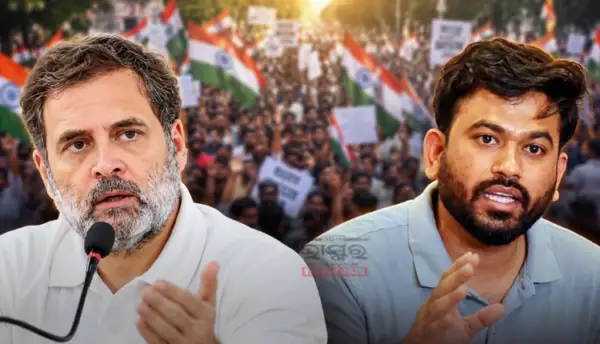
As Rahul Gandhi launched his new ‘Satyagraha’ platform to unite protests against the BJP-led government, an ugly public spat between the Congress and the Cockroach Janta Party (CJP) exposed a familiar problem within India’s opposition space: everyone wants unity, but only under their own leadership.
On paper, the Congress and the CJP are fighting the same battles. Both have questioned the functioning of the Election Commission, raised concerns over education and youth issues, and positioned themselves against the BJP. Yet instead of strengthening each other, they have spent the past week trading accusations and questioning motives.
The trigger was a series of remarks by CJP leaders Ashutosh Ranka and Saurav Das, who accused a “self-declared liberal ecosystem” of behaving like the sole custodian of democracy and the Constitution. Though no party was named, many Congress leaders interpreted the comments as directed at them and responded publicly.
The dispute highlights a deeper contradiction. Rahul Gandhi’s Satyagraha initiative is built on the idea that isolated movements must come together. However, several independent movements believe the Congress often seeks to occupy the centre stage whenever a protest gains momentum.
At the same time, the CJP, which presents itself as a decentralised and issue-based youth movement, has increasingly found itself in political battles over recognition, media attention and influence. Critics argue that a movement claiming to be above traditional politics risks appearing no different when it becomes consumed by public feuds.
The friction is not entirely new. Questions were raised earlier when the Congress launched campaigns similar to some of the CJP’s initiatives. Congress leaders, in turn, have alleged that the CJP enjoys support from political players while projecting itself as independent.
What makes the row striking is that both sides broadly agree on the issues. The disagreement is over who leads the conversation.
For ordinary citizens watching from the sidelines, the spectacle can appear detached from the problems being highlighted. When organisations fighting the same opponent spend more time questioning each other than advancing their causes, the focus inevitably shifts from public issues to political egos.
The Congress accuses others of weakening opposition unity. The CJP accuses established parties of treating democracy as their exclusive domain. Both may believe they are defending a larger cause. Yet the public exchange raises a difficult question: if groups with similar objectives cannot cooperate, can they realistically build a broader movement capable of challenging those in power?
The latest confrontation suggests that the struggle within the opposition is not merely against the ruling establishment. It is also a battle over relevance, ownership and leadership. And in that contest, the opposition risks becoming its own biggest obstacle.