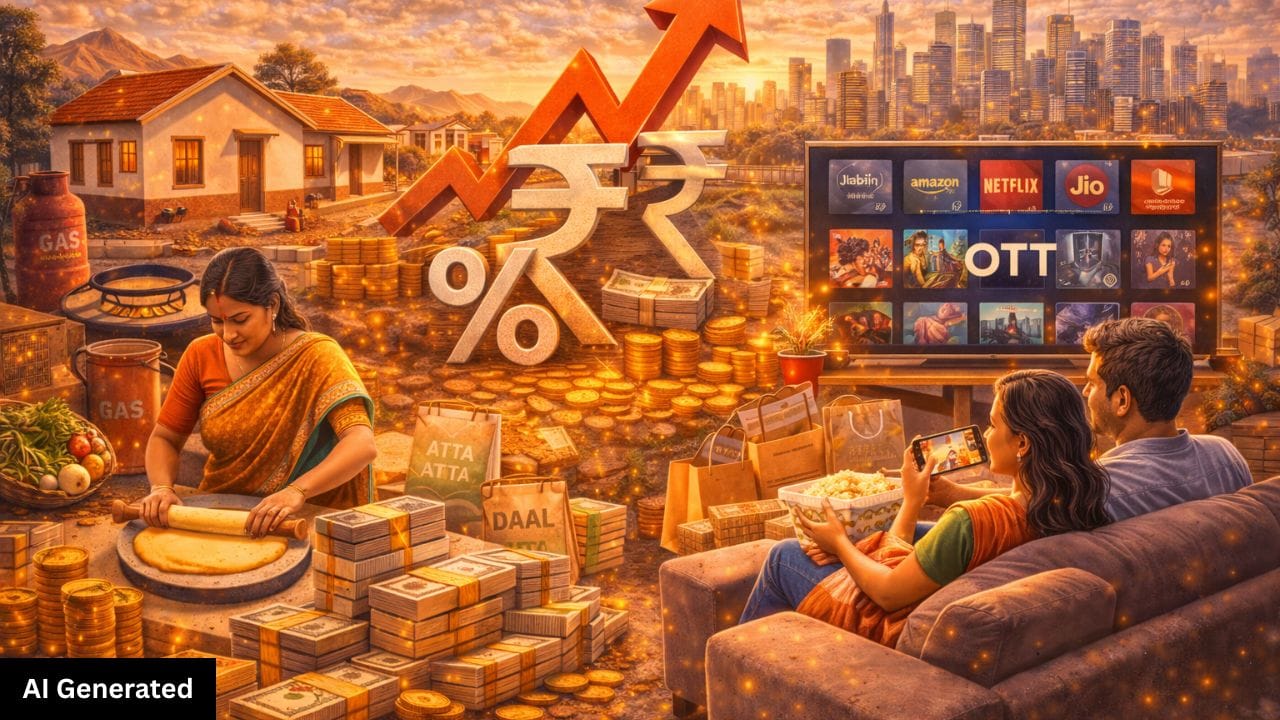
Wholesale and retail inflation figures for the month of January have come out. But the most talked about thing is retail inflation. There is a reason for that too. This time the mathematics of retail inflation has been completely changed. The base year for retail inflation data in the month of January is 2024. Which was earlier 2011-12. If we look at the figures, retail inflation was seen at 2.75 percent in January. Which was in accordance with the target of RBI. But the biggest question is what changed in the mathematics behind these figures?
In fact, the method of measuring retail inflation in the country was somewhat different. Food inflation had the largest share in the retail inflation basket. Which has now been reduced. In the last few years, there has been a lot of change in the lifestyle and spending patterns of people living in villages and cities. Now people are not just spending more on bread or food items. The pockets of common people are no longer affected just because kitchen items become expensive. Now OTT has also entered it. Internet has become a big factor.
The changes to the CPI basket not only refine the way inflation is measured, but also indirectly attempt to explain how Indian households are spending differently than they did a decade ago. The expenses of common people are no longer limited to just bread. It has become quite diversified. Now there is pressure of OTT and Internet on people’s pockets. Whose impact is seen every month on the pockets of common people. Let us try to understand this entire mathematics in detail…
Why was the CPI basket reset?
Calculating inflation depends on accurately estimating what households buy and how much they spend on each category. When there is a change in the structure of consumption, the index should also evolve accordingly. The previous CPI basket was based on the expenditure pattern of 2011-12, which was before the advent of digital services, organized retail trade, app-based transportation, streaming platforms and new fuel forms like CNG and PNG.
The revised series updates the base year to 2024 and incorporates expanded data sources, including digital and administrative records. For the first time, rural house rents have been included, and the size of the housing structure in both rural and urban areas has been increased. Prices of e-commerce platforms have now been included in the index. Items like OTT subscriptions, airfares and telecom schemes are formally tracked. Also, old items like VCR, cassette player and coconut rope have been removed.
These adjustments have seen an improvement in the accuracy of these numbers. But they also reflect a society where digital media subscriptions exist alongside traditional food products, and where consumption goods increasingly reflect modern lifestyles.
Changes made in food products
The most significant change in the revised CPI is the huge reduction in the weight of food items, which earlier was about 46 percent, now it has come down to about 37 percent. Food items still remain the largest component of the CPI basket. However, the decline in its share is economically significant.
Food prices are generally volatile, affected by monsoons, supply disruptions and global commodity trends. The lower weighting of food items could reduce headline inflation volatility and provide an easier outlook for monetary policy. But its deeper implication lies in the real meaning of this burden reduction.
Inflation estimates are obtained from household consumption surveys. If the share of food items in CPI has decreased, it means that households are spending a smaller portion of their total expenditure on food items. This does not mean that there has been a real decline in expenditure on food items. Rather, spending in other categories is increasing rapidly.
This trend is consistent with an established economic principle: as income increases, the proportion of income spent on food decreases. Even if households spend more money on food, the share of food in total consumption continues to decline. The revised CPI structure effectively recognizes that India is moving on this path of development.
What did the household expenditure survey find?
Data from the Household Consumption Expenditure Survey underline this change. Average monthly per capita consumption expenditure (MPCE) in rural India increased from Rs 1,430 in 2011-12 to Rs 3,773 in 2022-23. In urban India, it increased from Rs 2,630 to Rs 6,459 in the same period. Domestic consumption has more than doubled in nominal terms within a decade.
Change in the structure of expenditure is equally important. In rural areas, the share spent on food declined from 52.9 per cent in 2011-12 to 46.38 per cent in 2022-23. In urban areas, this share decreased from 42.62 percent to 39.17 percent.
These figures confirm two types of trends. First, consumption levels are increasing significantly. Second, the importance of food in the household budget is gradually decreasing. Apart from food, families are spending more on other items such as clothing, transportation, housing, healthcare, education and entertainment.
With the CPI revision, the measurement of inflation has been adapted to this new story of consumption. This basket now reflects what people actually buy, not what they bought a decade ago.
Modern cost revealed
The inclusion of services like rural accommodation, streaming services, digital storage devices, value-added dairy products and babysitting in the updated CPI basket reflects broader changes in lifestyle. The inclusion of rural house rents is particularly important, as it captures the trends of rural housing market monetization and formalization.
Similarly, the addition of online media subscriptions and digital services reflects the rapid expansion of India’s digital economy. Telecom schemes, OTT platforms and air travel are no longer an expense limited only to a small elite. Their presence in the CPI basket shows that they are now important components of household expenditure.
This shift toward services is characteristic of economies that are transitioning from lower middle-income to middle-income classes. As incomes rise, households move beyond basic needs to comfort, convenience and experience-based spending.
Food is still important, but not a big component
The story of mature consumption is fascinating, but it is important not to exaggerate this change. With about 37 per cent of the CPI basket, food is still a core driver of inflation. In a country with a large rural and low-income population, food security and price stability remain central policy concerns.
Moreover, the psychological and political impact of food inflation may still be enormous. Despite low burden, a sudden increase in food prices will have a significant impact on core inflation and the welfare of households. The CPI no longer reflects India as an economy where nearly half of household expenditure is on food. Instead, it reflects a more balanced distribution across categories.
The CPI revision of January 2026 makes it clear that India’s consumption story is both expanding and diversifying. Household expenditure has increased significantly over the past decade, and the composition of that expenditure has shifted from food to housing, services and modern goods. This change in CPI is technically important, but it also tells a story. By updating the way it measures inflation, it shows how India is changing its spending patterns.