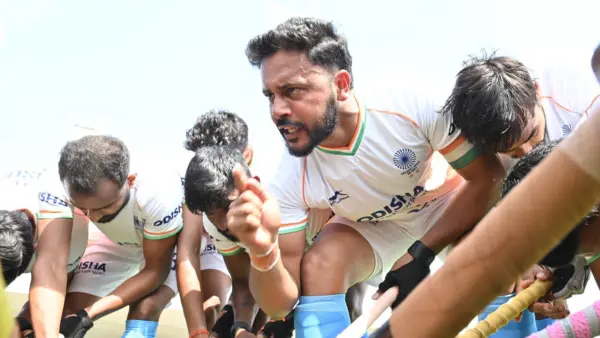
By the time India’s players assemble in a semicircle at the top of the ‘D’ on a June morning in Bengaluru, their training jerseys are already drenched in sweat.
Manpreet Singh crouches to receive the injection from vice-captain Hardik Singh. Rajinder Singh readies himself to flick, while Yashdeep Siwach, Abhishek Nain and Shilanand Lakra take up positions around the circle.
Everyone is present for India’s penalty-corner drills. Almost. Well, almost. India’s captain, and the team’s great big-match weapon, Harmanpreet Singh is instead stretched out on the physio’s table in the dug-out.
After a series of hamstring, lower back, ankle, wrist and finger injuries over the last two years, it is difficult not to wonder whether Harmanpreet – and India – have another problem. He then joins the team’s short, high-intensity five-a-side games, easing concerns over his fitness.
That will be crucial over the next fortnight, with India’s hopes of ending the 51-year wait potentially hinging on the fitness and form of the player whose match-winning flicks ended the decades-long Olympic drought.
Captain’s Burden
Hockey is never a one-man show; India would not have reached the Olympic podium without PR Sreejesh’s brilliance, Hardik Singh’s intelligence and Manpreet Singh’s versatility.
Yet, given how heavily India relies on penalty corners for goals, it’s difficult to overstate Harmanpreet’s influence. At two of the last three major tournaments – the Tokyo and Paris Olympics – the drag-flicker scored a significant share of India’s goals as the team claimed back-to-back bronze medals. The one exception was the 2023 World Cup, where Harmanpreet struggled, and India crashed out before the quarterfinals.
Which is why, over the next two weeks, Craig Fulton’s side will need a fully fit Harmanpreet. For his aerial range, his ability to split defences with long, grounded passes and, of course, his flicks.
“I think in January-February, after the Hockey India League, he wasn’t himself,” Fulton told The Indian Express. “We took a good, hard look at getting him into the right nutrition pattern and training regime. And he’s done a fantastic job. So he’s getting better and better every week.”
The need for Harmanpreet has become more pronounced as penalty corners have become harder to convert.
At the previous World Cup, almost 38 percent of all goals were from penalty corners. But conversion rates have been squeezed by increasingly sophisticated defences and the aggressive, well-drilled runners sent out to charge down flicks.
“In the last two-three years, because of protection and the ability for runners to run very, very consistent, aggressive lines against the drag-flickers, the defenders always seem to get in the way somehow,” Fulton explained. “So you have to have more ways to score off the penalty corner now than ever before.”
India dedicate three hours a week practising penalty corners, a measure of how much they value the set piece. Fulton called India’s penalty-corner defence “probably one of the best parts of our game at the moment”. But it is the attacking end that has demanded more work.
India’s Plan B
Much of 2026 has been spent building a back-up battery of penalty-corner specialists. That June morning in Bengaluru, as Harmanpreet watched from the sidelines, Jugraj Singh and Amit Rohidas got their chances, followed by younger options of Rajinder Singh and Sanjay.
They need those alternatives because even Harmanpreet, for all his pedigree, has found penalty corners harder to convert. At the Paris Olympics, his conversion rate was 17.07 percent, despite finishing as the tournament’s top scorer with 10 goals (7 out of 41 PCs; 3 from penalty strokes). German and Belgian flickers, by comparison, averaged 25 percent.
His goal tally, too, has come down over the last few years: 42 goals in 33 games in 2023, 35 in 39 in 2024 and 15 in 18 last year. This year, he has scored twice in 10 matches.
That does not necessarily mean India has a fading drag-flicker. The game may simply have caught up with one of its most closely studied specialists.
“When you have a specialist, the other teams study him, make plans [for him]. That’s the progression of international sport,” Fulton said. “We obviously can use him in different positions; we can use him in different ways on the penalty corner.”
Harmanpreet has been trying to stay ahead of that curve. At the start of 2026, he told The Indian Express he was working on different drag-flick variations, which he would ‘reveal at the right time’. He was also focusing on short sprints to improve mobility and strengthening his lower back, shoulders and arms – key areas for generating power in his flick.
India will hope all that effort comes together at the Wagener Stadium. Because the alternatives may give them more ways to score. But Harmanpreet remains the one India cannot easily replace. When he scores, India’s win percentage rises to almost 66 percent.
The World Cup starts Saturday. India will need their captain to give them more reasons to believe in that number.
NUMBER BOX
66: India’s win percentage when Harmanpreet Singh scores
Decreasing goal tally
2023: Matches: 33; Goals 42
2024: Matches: 39; Goals 45
2025: Matches: 18; Goals 15
2026*: Matches: 10; Goals 2