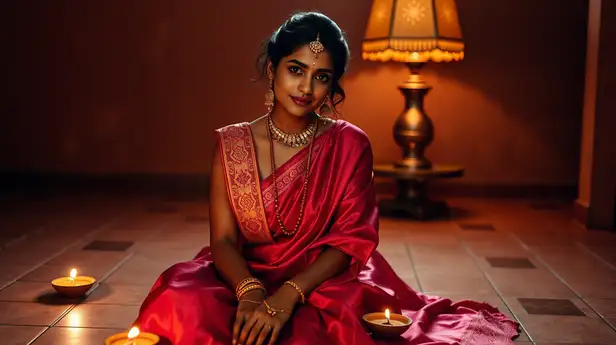
The face you used to put on for Diwali
You know the one. Full-coverage foundation two shades lighter than your actual skin, set into a mask with translucent powder. Contouring that carved cheekbones you don’t have and flattened the nose you do. A lip colour chosen because it photographed well, not because you liked it. By 10 PM your face felt like a plaster cast, and you were touching up in someone’s bathroom mirror under a single yellow bulb, wondering when you’d stopped enjoying the night.
The Diwali face was never really yours. It was assembled from magazine editorials, from what the aunties would approve of, from a collective idea of what festive beauty looked like on a woman who had made an effort. Effort meant visible effort. Skin was something to be corrected, not shown.
What skin-first actually means
The shift happening now is not about wearing less. It’s about wearing differently. Indian women with medium to deep skin tones, the NC40s and NC45s who were told for decades that their skin needed to be brightened, evened, lightened, are choosing bases that match them exactly, or skipping the base altogether in favour of a tinted moisturiser that lets the skin move. A serum foundation. A skin tint pressed lightly over SPF.
The result is that you can see the skin underneath. The small scar near your jaw. The way your cheeks flush when you laugh. The warmth of your natural undertone, which no foundation ever quite captured anyway.
This is not minimalism as an aesthetic category. It’s the decision to stop apologising for what your face actually is before you’ve added anything to it.
Kajal is doing more work than it has in years
When the base steps back, the eyes come forward. And kajal, not precision-lined kohl, not a gel liner applied with a flat brush, but kajal smudged with a fingertip the way your mother did it, is having a moment that feels less like a trend and more like a homecoming.
There’s a reason kajal has been worn across the subcontinent for thousands of years and why it still reads as festive without trying. It doesn’t require symmetry. It doesn’t require skill in the way that a cut crease does. It asks only that you press it into the waterline and let it do what it does: make the eyes look larger, darker, more present. On deep Indian skin, kajal reads like punctuation. The rest of the face can be almost bare and the look is complete.
Paired with a lip, a deep berry, a brick red, a terracotta that picks up the warm undertones in brown skin, kajal-forward makeup is doing in two products what a full face used to take twelve to achieve.
The photograph changed the brief
For a long time, the Diwali face was optimised for the photograph. Heavy makeup read as glamour on film and on early digital cameras. The overlit selfie flattened features anyway, so contouring was necessary to put them back. The full-coverage base erased the skin’s texture, which cameras of a certain era rendered as noise.
Phone cameras now render skin differently. The texture is visible. The natural flush is visible. And the women who look most striking in Diwali photographs are the ones whose skin is alive, not the ones whose faces are most thoroughly covered. The brief changed, and the makeup is catching up.
But the photograph is only part of it. The deeper shift is that Indian women are spending Diwali differently. Longer nights, more dancing, more sitting on the floor with children, more sweat near the diyas. A face that needs to be preserved is a liability at a celebration. Makeup that moves with you is not a compromise.
What this means for the festive look going forward
The new Diwali face, if you can call it that, is built on skin that has been cared for in the days before, not corrected on the night. A good moisturiser, an oil pressed into the cheekbones, kajal applied with intention, and a lip colour that earns its place. The lehenga and the jewellery carry the drama. The face doesn’t have to compete.
What’s emerged is a kind of confidence that heavy makeup was always supposed to project but rarely did. The woman who shows up with her actual skin visible, with kajal smudged at the corner, with a glow that comes from within rather than from a highlighter compact, she looks like she belongs at the celebration. The other face, the corrected one, always looked like it was trying to.
The festive beauty that Indian women are moving toward is not simpler. It’s more honest. And honesty, on a night lit by a thousand diyas, turns out to be the most beautiful thing in the room.