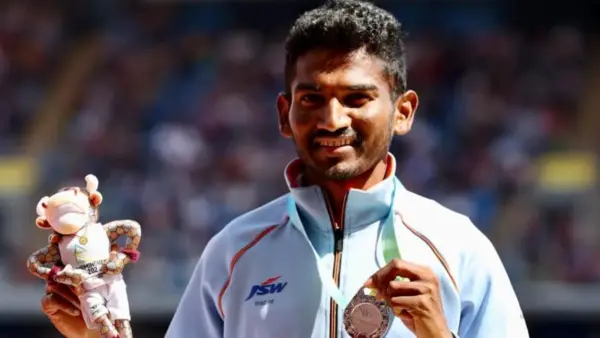
An image for the ages emerged in the men’s steeplechase final at the 2022 Birmingham Commonwealth Games. With 150 metres remaining in the 3000m race, Kenya’s Abraham Kibiwot looked over his shoulder: a glance right, then one left.
Wincing, pushing to hold off a threat that had no business being there, Kibiwot looked rattled.
A Kenyan being challenged for gold was unfathomable this deep into a steeplechase final. An Indian doing the running was rarer still: the country had never won a Commonwealth Games medal in the event.
At the start of the final lap, Kibiwot had built a healthy lead over Avinash Sable. But in the last stretch, that lead began to go. Kibiwot’s two Kenyan teammates, meanwhile, were nowhere close: the race had come down to him and Sable, an army man from Mandwa village in Beed, Maharashtra.
Kenya’s hold on the men’s steeplechase had looked unshakeable, the country sweeping the podium in every edition of the Commonwealth Games since 1998. A seventh sweep was the expectation.
But Sable flipped the script. Determined to shake off a reputation of falling short at major championships, he broke the Kenyan hegemony in one of the greatest races run by an Indian, a strategy as simple as it was risky: keep pace with the Kenyans, and hope he didn’t fade.
“If I had to win a medal, I had to beat at least one of them. I thought whatever happens, I will not fall behind the Kenyan athletes. I was ready to put all my effort into this one race. The Kenyan runners were world-class but I had to be brave. That is the only way I could have beaten them. Perhaps I surprised them,” Sable tells The Indian Express, looking back at the run that won him silver.
Given the quality of the field he was up against, beating two of the three Kenyans and taking silver was a feat worth savouring. Conseslus Kipruto, the 2016 Olympic champion and two-time World champion, was the defending Commonwealth Games gold medallist. Amos Serem, at 19 the youngest of the Kenyans, had been crowned World Under-20 champion the year before. Kibiwot himself would go on to take World Championship bronze the following year, then Olympic bronze at Paris 2024.
Sable stuck to his plan: match the Kenyans stride for stride, for as long as his legs would allow it. He even led the race for the first 400 metres, before the three Kenyans went past him, first Kibiwot, then Serem, then Kipruto, but the Indian simply refused to let them go.
Thrilling finish
By the third-last hurdle, Sable had closed on Kibiwot, the race leader. On landing after the second-last, he was breathing down Kibiwot’s neck. The unthinkable had already happened: he’d run down Serem and Kipruto with 500 metres still to go. Now it was the leader he was chasing.
The water jump before the final hurdle nearly decided it. Kibiwot mis-stepped but cleared it clean; Sable clipped the rail. At the line, Sable dipped for the win but missed it by a stride. His time, 8:11.20, was a national record. Kibiwot’s was 8:11.15. Serem took bronze in 8:16.83.
It was a quick redemption. Less than a month earlier, at the World Championships in Oregon, Sable had finished 11th in one of the slowest 3000m steeplechase finals in the event’s history. The contrast in pace was stark: Soufiane El Bakkali won that race in 8:25.13, more than nine seconds slower than Serem’s bronze-medal time in Birmingham.
“The race was fast but it helped because I didn’t have to overthink about strategy. Just go all out. I had clarity in my mind,” said Sable.
Somewhere in the closing stages of the race in Birmingham, his own target shifted.
“I had wanted to win a medal, even a bronze was fine. With only Kibiwot ahead of me, I was sure I would win a medal. I thought, why not catch the man in front? When I am on silver, why not fight for gold? Why not try more? I had worked so hard but felt like I had not won a medal which reflected the amount of hard work I had put in. I felt I had a real chance to go past Kibiwot. But my last water jump wasn’t great, else maybe I could have done better,” Sable recalled.
India won eight medals in track and field at Birmingham, including gold in men’s javelin. None carried the same significance as an Indian overtaking two Kenyans and briefly threatening a third. That Sable did it weeks after the disappointment at the World Championships made the silver mean even more.
Nikolai’s method
“My fitness was good at the World Championships but I didn’t finish in a good position. I was upset,” Sable said.
Something had to change in the short window between Oregon and Birmingham, too short for wholesale changes, but enough to shift his routine. Sable’s coach in the United States, Scott Simmons, had prepared him for Oregon; after that result, he went back to the hurdles-heavy training his late coach, Belarusian Nikolai Snesarev, used to put him through.
“I felt I had to change something. I was breaking records but somehow the belief to win a race was missing. While coach Scott Simmons’ training had benefits, I felt I needed to go back to old ways. I did a lot of hurdles training like Nikolai coach would have asked me to do. It worked for me because I got my confidence back. My fitness was good anyway. I was mentally and physically strong to take on the Kenyans,” Sable said.
The army man went on to win the Asian Games gold in Hangzhou the following year. But he still comes back to Birmingham.