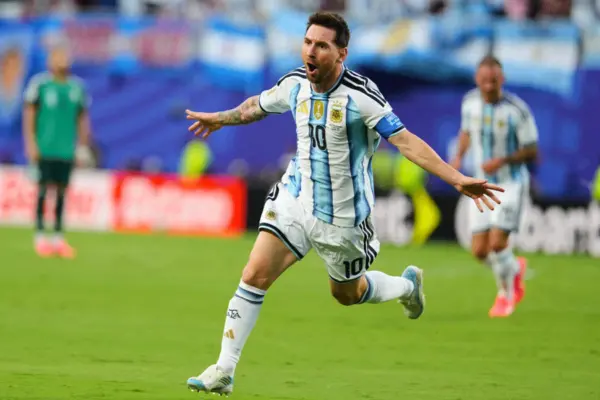
There is a particular cruelty to being a football fan for long enough. One day, the player you grew up watching suddenly stops playing.
There will be no more waiting for the Argentina team sheet to appear and looking for one familiar name. No more No. 10 standing in the tunnel, head bowed, left foot doing things left feet have no business doing. No more wondering whether this might be the night Lionel Messi produces one more piece of magic.
There will be no more Messi for Argentina. And that sentence still feels wrong.
Messi has announced his retirement from international football at 39, a total of 43 days after Argentina lost the 2026 World Cup final to Spain. He leaves as Argentina’s most-capped player and its all-time leading scorer, with 207 appearances and 125 goals. He leaves with a World Cup, two Copa América titles, an Olympic gold medal and an international career that eventually became so successful that the word “failure” sounds almost comical when attached to it.
But the numbers do not quite capture what Messi meant to Argentina – and probably still means.
Perhaps that is because his international career was more about a relationship than numbers. And, for years, it was a fairly dysfunctional one.
When Messi first arrived on the international scene, Argentina knew they had their hands on something extraordinary. He had already begun doing impossible things at Barcelona, turning football matches into demonstrations of applied physics. By 2006, he was already playing at a World Cup. By 2008, he had an Olympic gold.
Yet the deeper Messi went into his Argentina career, the more complicated the relationship became.He was the genius who did not win. The heir to Maradona who could not be “the next Maradona”.
The boy from Rosario who had moved to Barcelona as a teenager and, in the eyes of some critics, had somehow become less Argentine for it. It was absurd, really. But football has never been particularly interested in being reasonable.
Messi took Argentina to the 2014 World Cup final. He took them to Copa América finals in 2015 and 2016. He won the Golden Ball at the 2014 World Cup. He kept producing, even as the trophies kept escaping.
And then came 2016.
If there is one image that should be preserved somewhere in a museum of sporting heartbreak, it is Messi walking away from the field at MetLife Stadium after Argentina had lost the Copa América final to Chile on penalties.
He had missed his penalty. Argentina had lost another final. Again. And Messi had finally had enough.
“I think this is best for everyone,” he said then, announcing his retirement from international football.
For a footballer who had spent years being told that he did not do enough for Argentina, there was something devastatingly logical about his decision.
Perhaps the country did not deserve him. Perhaps he did not deserve this either. Perhaps it was simply time to stop.
Except Argentina did not agree. And neither did Messi. That is where the story changes.
Because the greatest part of Messi’s international career may not be that he eventually won everything; it is that he came back after deciding he had nothing left to give.
He came back and tried again, and again. And eventually, something extraordinary happened. Argentina changed. Or perhaps Messi changed.
Lionel Scaloni’s arrival produced a team that understood something previous Argentina sides had struggled to grasp: Messi did not need 10 teammates trying to give him the ball. He needed 10 teammates willing to run for him.
Rodrigo De Paul became the engine. Ángel Di María became the big-game specialist. Emiliano Martínez became the goalkeeper who seemed to consider penalty shootouts a personal hobby. Young players arrived who did not see Messi as an impossible burden, but as the greatest teammate they could possibly have.
This Argentina team did not ask Messi to save them. It fought alongside him. It was ready to go to war for him.
The 2021 Copa América finally broke the spell. Argentina beat Brazil at the Maracanã, and Messi finally won his first senior major international trophy. He had waited 16 years. He had played in four lost finals. He had retired once.
Now he finally had a medal. Then came Wembley and the Finalissima. Then Qatar.
And Qatar was not simply a World Cup victory. It was the ending football had spent years demanding from him.
Messi scored seven times. He scored in the round of 16, quarter-final, semi-final and final. He scored twice against France in the greatest World Cup final most of us will ever see. He scored Argentina’s first penalty in the shootout. He lifted the trophy. He won the Golden Ball for a second time.
The boy who had supposedly failed Argentina had finally delivered the one thing Maradona had. The comparison could finally be put to rest. Except Messi kept going.
Argentina won the 2024 Copa América too, giving him three major senior international titles, as well as the Finalissima, in four years. And when almost any sensible footballer would have decided that enough was enough, Messi went to the 2026 World Cup at 39.
He scored. He created. He captained. He reached another final. And then he lost. There may be something fitting about that.
Messi does not get the perfect farewell. There is no final goal in the 120th minute-no last-minute winner. No fairytale scriptwriter arriving in the final seconds to tidy everything up.
He loses a World Cup final and, 43 days later, says goodbye. Football, for once, refuses to give us the ending we want. But perhaps Messi’s story is about persistence rather than endings.
For those of us who started watching football with Messi already in it, there is a peculiar sense of loss attached to this retirement. The first Messi we knew was the impossible one: tiny, fast, ridiculous. He seemed to have discovered a cheat code that everyone else had somehow missed.
Then he became the best player in the world. Then the best player ever, depending on your preferred argument. Then, somehow, he became something more interesting.
He became human.
We watched him lose finals. We watched him miss penalties. We watched him sit on the pitch in tears. We watched him walk away from Argentina. We watched him return. We watched him become a father, a captain, an older player, a different kind of footballer.
And eventually, we watched him cry with a World Cup in his hands.
That is why saying “thank you, Messi” feels less ridiculous than it should. Thank you for the goals, obviously. For the free-kicks that seemed to ignore gravity. For the dribbles. For the ridiculous passes that appeared on television before they appeared to the defenders standing five feet away. For making the extraordinary look routine.
But mostly, thank you for coming back.
Because the easiest version of Messi’s story would have been the one where he walked away in 2016. Instead, he returned and gave Argentina another decade of football, three major senior titles and the Finalissima.
He gave a generation of Argentine players the chance to say they had played with Lionel Messi. And he gave a generation of fans the chance to say they had watched him win for Argentina.
Now comes the strange part. Argentina will play again.
There will be another No. 10. Another captain. Another prodigy. Another player who will be asked whether he can be the next Messi, a question that should probably be banned on humanitarian grounds.
But there will not be another Lionel Messi.
Not the Barcelona Messi. Not the Argentina Messi. Not the Messi who made an entire country question him before making that same country fall in love with him.
For years, Argentina asked Messi to prove that he belonged to them. Eventually, he stopped asking for permission. He became theirs.
So, thank you, Leo. Thank you for the 21 years. Thank you for making us believe, then making us suffer, then making us believe again. And thank you, most of all, for refusing to let 2016 be the ending.
Football was better because you were in it. Argentina were better because you came back. And those of us who have been watching since the beginning? We were just extraordinarily lucky to be there.