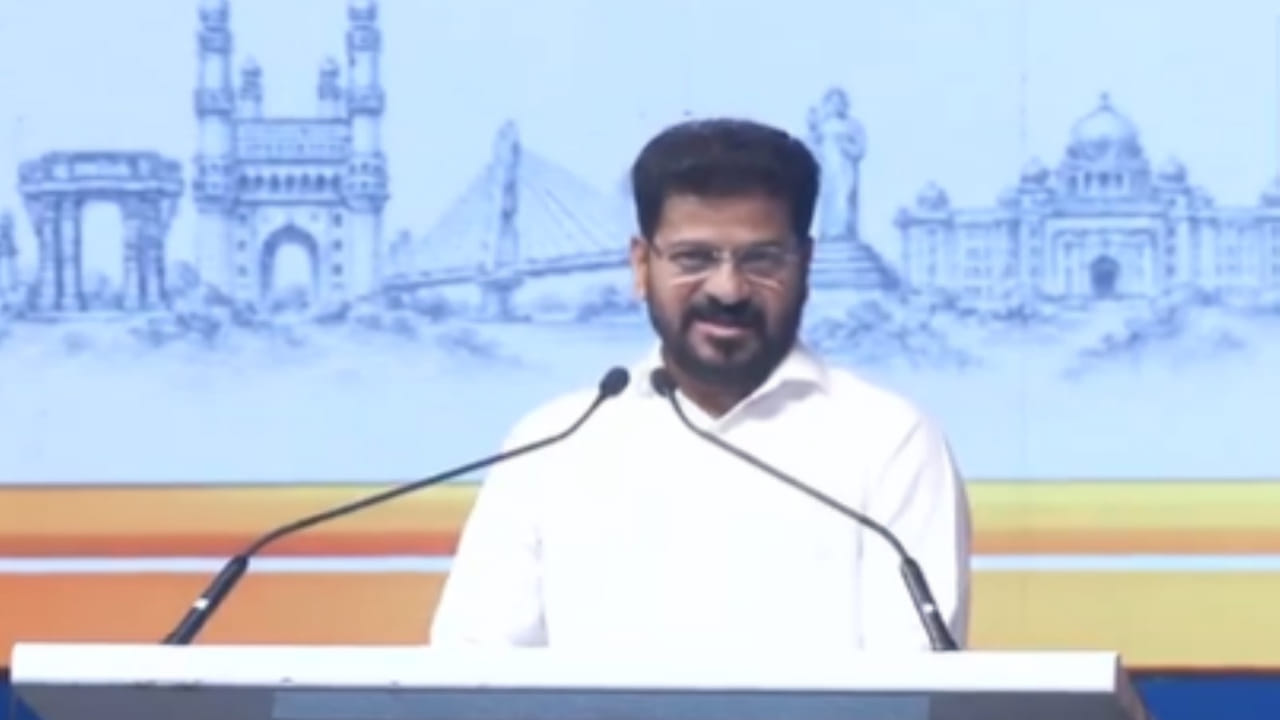
CM Revanth Reddy has unveiled his vision for Telangana, aiming for a 3 trillion dollar economy by 2047. The plan focuses on robust road networks, industrial growth, and expanded social welfare schemes for women and vulnerable sections.
Telangana CM Unveils ‘Telangana Rising’ Vision for 2047
Hyderabad (Telangana) [India], November 19 (ANI): Telangana Chief Minister A Revanth Reddy on Thursday said the state was moving forward with a vision called “Telangana Rising”, aiming to become a $1 trillion economy by 2034 and a $3 trillion economy by 2047. Addressing the inaugural session of the 85th Annual Session of the Indian Roads Congress at Hitex in Hyderabad, Reddy said roads were central to his vision for the state.
Reddy said “Telangana Rising” was aligned with the Viksit Bharat 2047 goal. “Telangana is moving forward with a vision we call ‘Telangana Rising’. We aim to become a $1 trillion economy by 2034 and a $3 trillion economy by 2047… As part of my vision, we have divided the state into three distinct zones. Today, roads define my vision: the Outer Ring Road and the Regional Ring Road… Our focus is to develop a robust road network to connect cities, villages, and industrial clusters to facilitate trade and commerce… ‘Telangana Rising’ is aligned with Viksit Bharat in 2047. India will be a $30 trillion economy, and Telangana will contribute $3 trillion. Today, with 2.5% of the national population, we contribute 5% to the GDP. We want to increase that to 10% by 2047,” he said.
Meanwhile, the Congress government in Telangana has chosen November 26, Constitution Day, to make a major welfare push by announcing new Cheyutha pensions for 4,63,857 beneficiaries and launching the distribution of Indiramma sarees to one crore women. While the two initiatives are being projected as significant steps towards social security and women’s welfare, their timing and scale also carry an unmistakable political dimension.
For CM Revanth Reddy, the announcements offer an opportunity to reinforce the Congress government’s welfare image at a time when the administration needs to demonstrate that its electoral promises are translating into tangible benefits. The government appears keen to communicate that its governance model is centred on reaching ordinary households, particularly women, elderly people and economically vulnerable sections.
The pension announcement is particularly important because it brings 4,63,857 additional beneficiaries into the social security network. The decision to credit the pension amounts directly into their bank accounts on November 26 gives the initiative immediate visibility. For households dependent on government assistance, a regular pension can make a meaningful difference to their daily lives. However, the announcement also raises an important question: why did these beneficiaries have to wait until now, and how many other eligible people are still outside the pension network? Expanding the beneficiary base is welcome, but the government must also explain the criteria used for selection, the process followed to identify beneficiaries and whether all eligible applicants have been covered. Welfare expansion should not become merely a numbers game in which the announcement of new beneficiaries takes precedence over addressing existing exclusions.