
The and are both five-seat electric SUVs that are available with a dual-motor all-wheel-drive setup. Tata offers its ‘QWD’ system on the Sierra EV only in the top-spec 75kWh Empowered A trim, while the VF7 gets AWD in its top-spec Sky and Sky Infinity trims. Both SUVs claim the same 0-100kph time. So, which one is quicker in the real world?
Explore full specs, features and a price breakdown in our comparison.
Tata Sierra EV AWD vs Vinfast VF7 AWD: Specifications
The VF7 makes more power, but the Sierra EV has a bigger battery and weighs less
| Tata Sierra EV AWD vs Vinfast VF7 AWD: Specifications | ||
| Tata Sierra EV 75 QWD | Vinfast VF7 AWD | |
| Battery capacity (kWh) | 75 | 70.8 |
| Electric motor setup | Dual | Dual |
| Power (hp) | 306 | 353 |
| Torque (Nm) | 504 | 500 |
| Kerb weight (kg) | 2,130 | 2,218 |
| Power-to-weight ratio (hp/tonne) | 143.7 | 159.2 |
| Torque-to-weight ratio (Nm/tonne) | 236.6 | 225.4 |
| Tyres | 225/55 (R19) | 245/50 (R19) |
| Claimed 0-100kph (seconds) | 5.8 | 5.8 |
| MIDC range (km) | 624 | 510 |
The Sierra EV QWD’s front and rear motors make 140hp and 209hp, respectively, for a combined output of 306hp. That’s 47hp less than the VF7 AWD’s 353hp figure, though there’s only a 4Nm difference in their torque values (in favour of the Sierra EV). The Sierra EV also has a 4.2kWh larger battery pack and weighs 88kg less than the VF7.
That said, the VF7’s extra power gives it the better power-to-weight ratio of the two, while the Sierra EV has the edge in terms of torque-to-weight. The Vinfast VF7 AWD rides on wider 245-section tyres, compared to the Sierra EV QWD’s 225-section rubber.
Tata Sierra EV AWD vs Vinfast VF7 AWD: Acceleration timings
The Sierra EV is quicker to 100kph, but the VF7 pulls ahead at higher speeds
| Tata Sierra EV AWD vs Vinfast VF7 AWD: Acceleration timings (in seconds) | ||
| Tata Sierra EV 75 QWD | Vinfast VF7 AWD | |
| 0-20kph | 1.05 | 1.11 |
| 0-40kph | 2.00 | 2.05 |
| 0-60kph | 2.99 | 3.03 |
| 0-80kph | 4.22 | 4.30 |
| 0-100kph | 5.95 | 6.03 |
| 0-120kph | 8.29 | 8.30 |
We tested the Sierra EV QWD in its most aggressive ‘Boost’ mode and the VF7 AWD in ‘Sport’, which is the Vietnamese EV’s most aggressive drive mode. The Sierra EV QWD got off the line slightly quicker – being 0.06 seconds ahead at 20kph. As for the VF7 AWD, we experienced some tyre spin when launching it hard. The Sierra EV held on to a small lead all the way to 100kph, which it crossed in 5.95 seconds – just 0.08 seconds before the VF7 AWD. Neither car matched its manufacturer-claimed 5.8-second 0-100kph time, though the Sierra EV was the closer of the two.
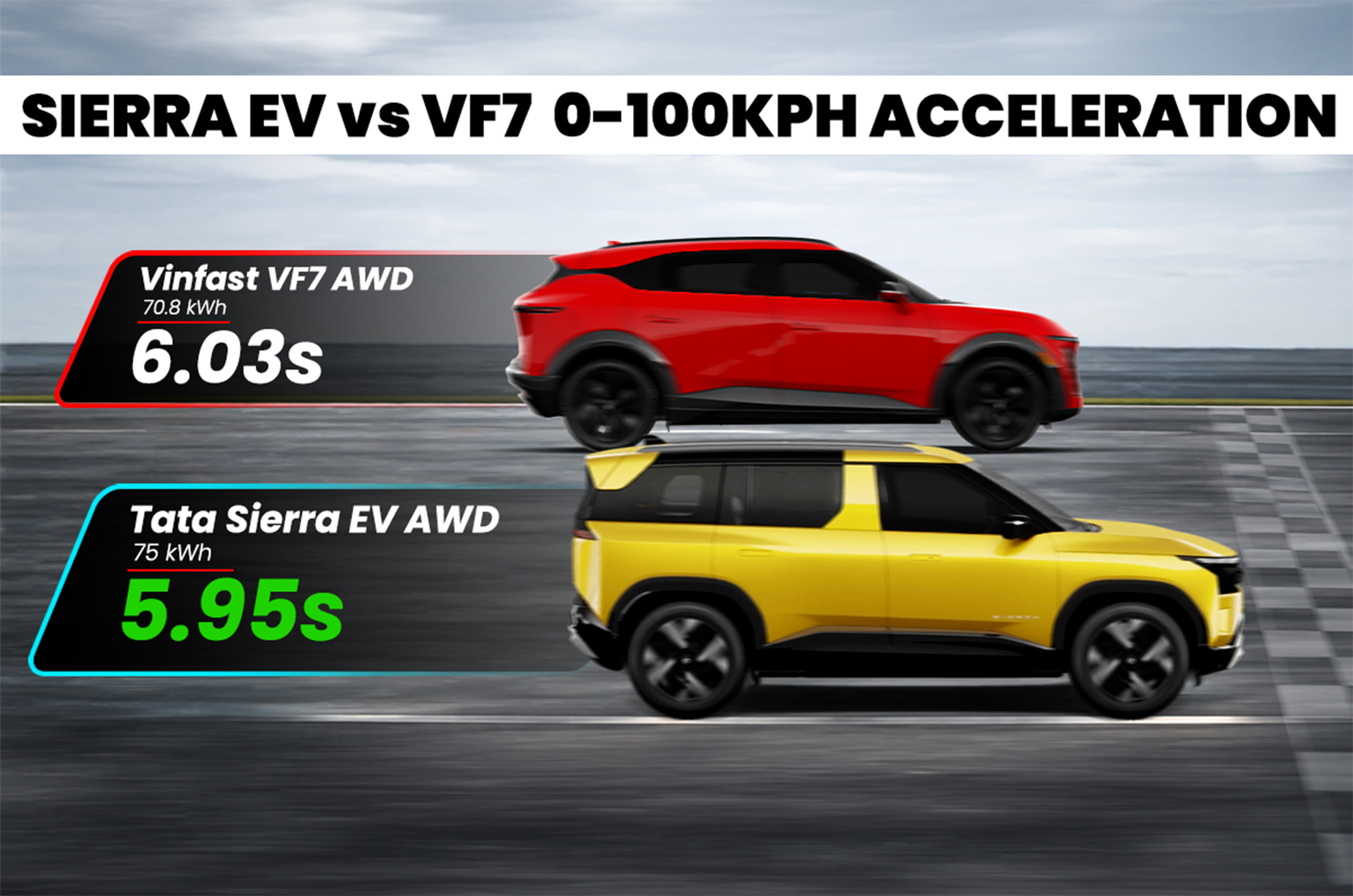
This gap all but disappeared by 120kph, with the VF7 just 0.01 seconds behind the EV. Beyond this, the VF7’s extra power meant that it was 0.08 seconds ahead by 130kph. This lead grew to 0.48 seconds by the time the two cars crossed 150kph. When taken out of its sportiest ‘Boost’ mode down to ‘Sport’, the Sierra EV took 6.62 seconds to hit 100kph – that’s 0.59 seconds slower than the VF7 in its ‘Sport’ mode.
Tata Sierra EV AWD vs Vinfast VF7 AWD: Rolling acceleration timings
The VF7 is the quicker of the two when accelerating on the move
| Tata Sierra EV AWD vs Vinfast VF7 AWD: Rolling acceleration timings (in seconds) | ||
| Tata Sierra EV 75 QWD | Vinfast VF7 AWD | |
| 20-80kph (in kickdown) | 3.32 | 3.16 |
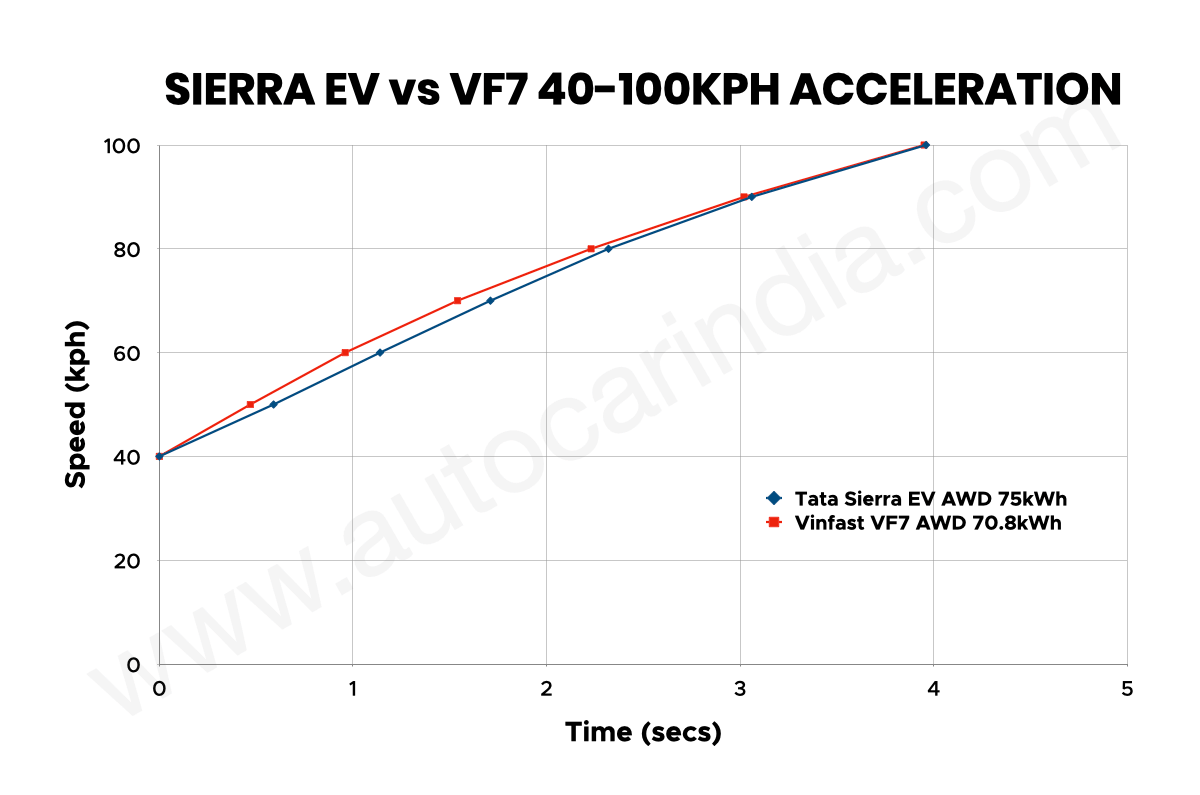
| 40-100kph (in kickdown) | 3.96 | 3.95 |
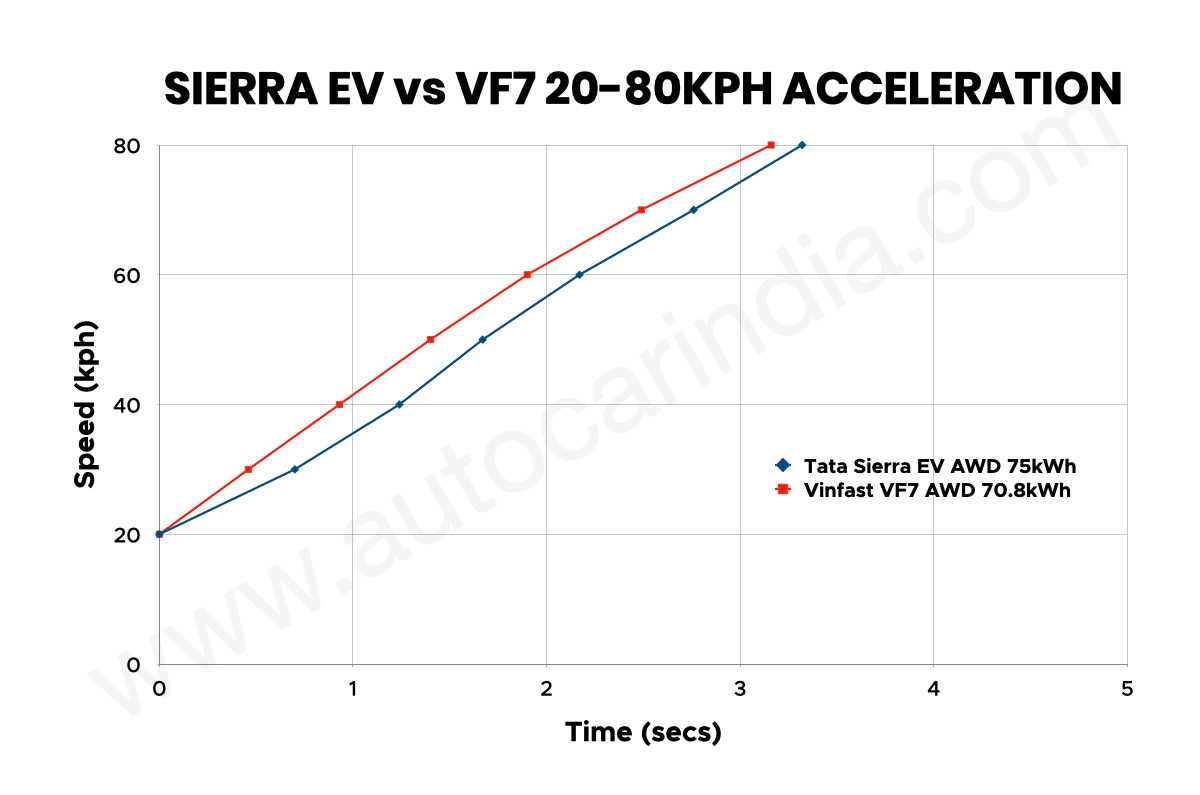
When accelerating on the move, the VF7 AWD had the upper hand. It went from 20kph to 80kph in 3.16 seconds, which was 0.16 seconds quicker than the Tata Sierra EV QWD. However, the gap was negligible between 40kph and 100kph, where the VF7 was just 0.01 seconds ahead.
Tata Sierra EV AWD vs Vinfast VF7 AWD: Braking tests
The VF7 stops shorter, but the Sierra EV’s regen is far stronger
| Tata Sierra EV AWD vs Vinfast VF7 AWD: Braking tests | ||
| Tata Sierra EV 75 QWD | Vinfast VF7 AWD | |
| 80-0kph distance (metres) | 28.92 | 24.82 |
| 80-0kph time (seconds) | 2.23 | 2.27 |
| 80-20kph regen distance, Level 1/Low (metres) | 313.79 | 636.14 |
| 80-20kph regen distance, Level 2/Medium (metres) | 177.44 | 308.11 |
| 80-20kph regen distance, Level 3/High (metres) | 132.12 | 161.48 |
Despite being the heavier of the two, the VF7 AWD came to a halt from 80kph in 24.82 metres, 4.10 metres shorter than what the Sierra EV QWD managed. Tata’s SUV did come to a stop sooner, though only by 0.04 seconds.
The Sierra EV’s regenerative braking is far more effective at every level. It offers regen Levels 1 to 3, while the VF7 gets Low, Medium and High settings. On Level 1, the Sierra EV slowed from 80kph to 20kph in 313.79 metres, which is less than half the distance the VF7 needed on Low. The gap narrows as the regen gets stronger, but even with the Sierra EV on Level 3 and the VF7 on High, the Tata needed 29.36 metres less to slow down.
Tata Sierra EV AWD vs Vinfast VF7 AWD: Prices
The Sierra EV AWD undercuts the VF7 AWD on price
| Tata Sierra EV AWD vs Vinfast VF7 AWD: Prices (in Rs lakh) | ||
| Tata Sierra EV 75 QWD | Vinfast VF7 AWD | |
| Price range (ex-showroom) | 25.99 | 27.49-28.09 |
The Tata Sierra EV QWD costs Rs 1.50 lakh less than the most affordable Vinfast VF7 AWD. This gap grows to Rs 2.10 lakh against the top-spec ‘Sky Infinity’ trim, which gets a large glass roof. However, the VF7 offers more power, stops over a shorter distance and is quicker at higher speeds and during rolling accelerations. The Sierra EV QWD, on the other hand, gets to 100kph first and has much stronger regen.
Autocar India’s testing standards
Before conducting our performance tests, we check and maintain tyre pressure based on the manufacturer’s recommendations and ensure that the car is charged to 100 percent. The car is then tested in a controlled environment with two people on board, and the data is collected via highly accurate GPS-based timing equipment.