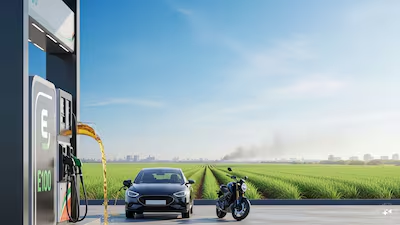
I signed the file, finalising the regulations to legally authorise the use of 100% ethanol,” Gadkari said. The approval gives automakers, fuel retailers, and testing agencies a legal framework to develop and sell E100-compatible vehicles.

Gadkari said 12 manufacturers are preparing flex-fuel models, and announcements from Tata, Mahindra, Hyundai, Toyota, Suzuki, and MG are expected within six weeks.
India’s first E100-compatible vehicles were recently launched. Maruti Suzuki unveiled the WagonR Flex Fuel, the country’s first such passenger car. Hero MotoCorp introduced flex-fuel variants of the Splendor+ and HF Deluxe motorcycles.
Gadkari also asked manufacturers, including Hero, to develop retrofit conversion kits for existing vehicles.
What Is E100?
E100 is not pure ethanol. It typically contains 93–95% anhydrous ethanol, with the remainder being petrol and additives that aid cold-start performance and fuel stability.
It sits above E20 (20% ethanol, 80% petrol) and E85 (roughly 85% ethanol) on the ethanol-fuel spectrum. The new regulations extend India’s ethanol programme beyond E20 to cover E85, E100, and intermediate blends.
Who Can Use It?
Only vehicles specifically certified for E100 can use the fuel. Existing petrol or E20 vehicles cannot switch without risking component damage.
E100-compatible vehicles require ethanol-resistant fuel lines, seals, and gaskets; revised engine calibration; higher fuel-flow capacity; and modified engine-control software.
Flex-fuel vehicles use sensors to detect the ethanol concentration in the tank and automatically adjust ignition timing and fuel injection. This allows them to run on anything from E20 to E100.
Fuel Economy and Cost
Ethanol contains less energy per litre than petrol, so E100 vehicles consume more fuel per kilometre. The economic case depends on cost per kilometre, not pump price alone.
Purpose-built ethanol engines with higher compression ratios can partially offset this. Petrol blended with 22–30% ethanol has already been exempted from central excise duty, and similar fiscal support for E100 will be critical for adoption.
Energy, Environment, Farmers
India imports over 85% of its crude oil, costing approximately ₹22–23 lakh crore annually. The government says ethanol blending between 2014–15 and July 2025 saved over ₹1.44 lakh crore in foreign exchange and displaced around 245 lakh tonnes of crude oil imports.
Sugarcane-based ethanol produces an estimated 65% lower lifecycle greenhouse gas emissions than petrol; maize-based ethanol achieves around 50%. Gadkari cited an IISc Bengaluru study stating blended fuel reduces emissions by 88%. Transport accounts for 40% of India’s air pollution.
India produced roughly 450 lakh tonnes of sugar in 2024–25, making it the world’s second-largest sugar producer. Expanded ethanol demand could boost income for sugar mills, distilleries, and farmers.
The petroleum ministry estimates that if 50% of new two- and four-wheelers adopt flex-fuel technology, it would generate demand for an additional 311.8 crore litres of ethanol and ₹12,403 crore in additional farmer income. The flex-fuel vehicle market is projected to grow 15% between 2025 and 2030.
Infrastructure Still Needed
Regulatory approval alone will not make E100 widely available. Ethanol absorbs moisture and requires dedicated storage tanks, pumps, and handling at fuel stations.
The government plans around 500 ethanol-dispensing outlets by December 2026 and approximately 5,000 by end-2027, starting with Delhi-NCR and the Mumbai–Pune–Nagpur corridor.
Separately, Gadkari announced a hydrogen mobility pilot in Nagpur involving a refuelling station and two green hydrogen buses for public transport, reinforcing India’s broader multi-fuel strategy that includes electric, CNG, hybrid, and hydrogen vehicles alongside ethanol.