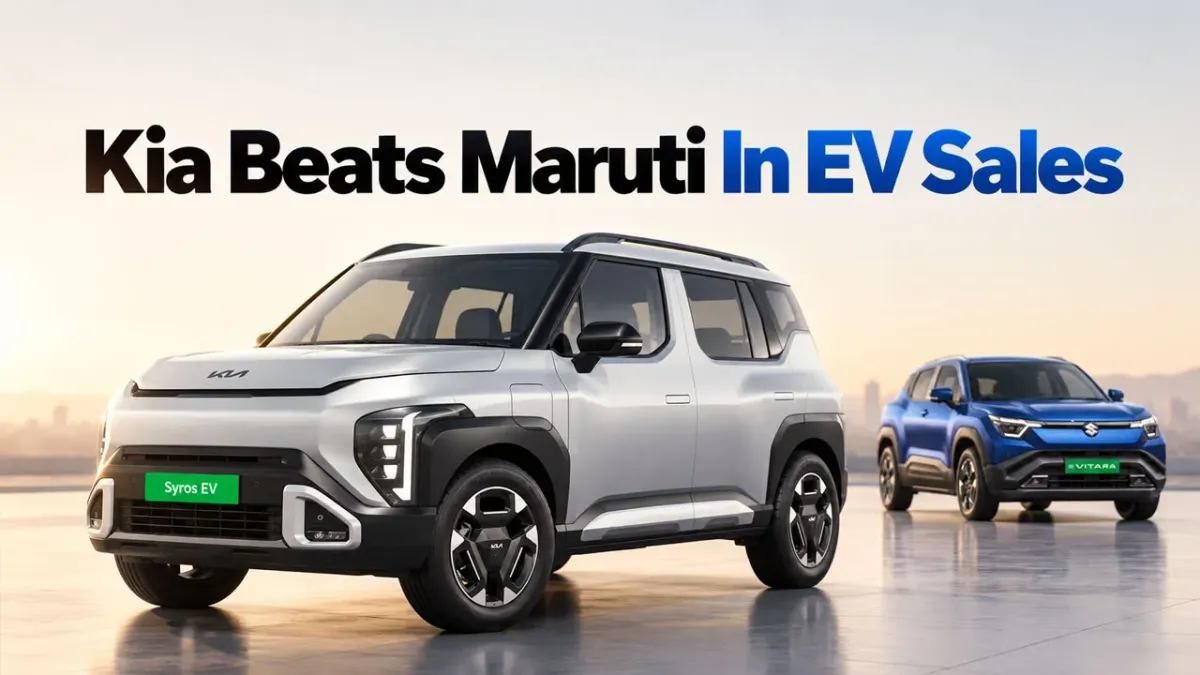
Kia has moved ahead of Maruti Suzuki in electric passenger vehicle sales for September 2026, and the timing points directly to the arrival of the Syros EV. Kia registered 1,263 electric cars during the month, compared with 1,103 for Maruti Suzuki. That put it in fifth place in the electric car market and pushed Maruti Suzuki to sixth.

The gap was only 160 units, but the direction of movement was very different. Kia’s EV sales rose 48 percent from 851 units in August and were 111 percent higher than the 598 units registered in September 2025. Maruti Suzuki, meanwhile, saw e Vitara registrations fall 25 percent from 1,472 units in August.
Kia ended September with a 3.50 percent share of the electric passenger vehicle market, against Maruti Suzuki’s 3.06 percent. Total electric passenger vehicle registrations during the month reached a record 35,995 units.
Syros EV Gives Kia A Lower Entry Point

Until recently, Kia’s electric line-up was weighted towards expensive models. The EV6 and EV9 are fully imported, while the Carens Clavis EV gave the company its first serious attempt at larger volumes. The Syros EV changes the price equation more sharply.
Launched at Rs 13.50 lakh to Rs 20 lakh ex-showroom, the Syros EV is Kia’s most affordable electric car. It is offered with 42kWh and 51.4kWh battery packs. Claimed range goes up to 526km with the larger battery, while the smaller battery version is rated at up to 443km.
That places the Syros EV in a much wider part of the market than Kia’s earlier electric cars. Its direct competition includes the Tata Nexon EV and Mahindra XUV 3XO EV, both of which operate in the same compact electric SUV space.

There is no publicly disclosed model-wise September registration split for Kia’s EVs at the time of writing. So it would be incorrect to attribute all 1,263 units to the Syros EV. However, there are clear signs that it has added meaningful volume. In August, combined Syros petrol, diesel and electric wholesales rose to 1,742 units, up 34 percent from July. Kia’s EV retail volume also reached a new high after the Syros EV entered the line-up, and one dealer delivered .
Why Maruti Slipped Behind

Maruti Suzuki’s September EV volume came entirely from the e Vitara. The company registered 1,103 units, down from 1,472 in August. Even after that decline, September was its sixth straight month with four-digit electric car sales.
The e Vitara itself is not short on range or battery choice. It is offered with 49kWh and 61kWh battery packs, with a claimed driving range of up to 543km. Maruti Suzuki has also introduced a Battery-as-a-Service option, with an introductory starting price structure announced earlier this year.
The bigger constraint has been domestic availability. A substantial portion of e Vitara production has been allocated to exports, limiting the number of cars available for local retail. Maruti Suzuki is expected to raise domestic supply as additional production capacity comes on stream at its Hansalpur facility in Gujarat.