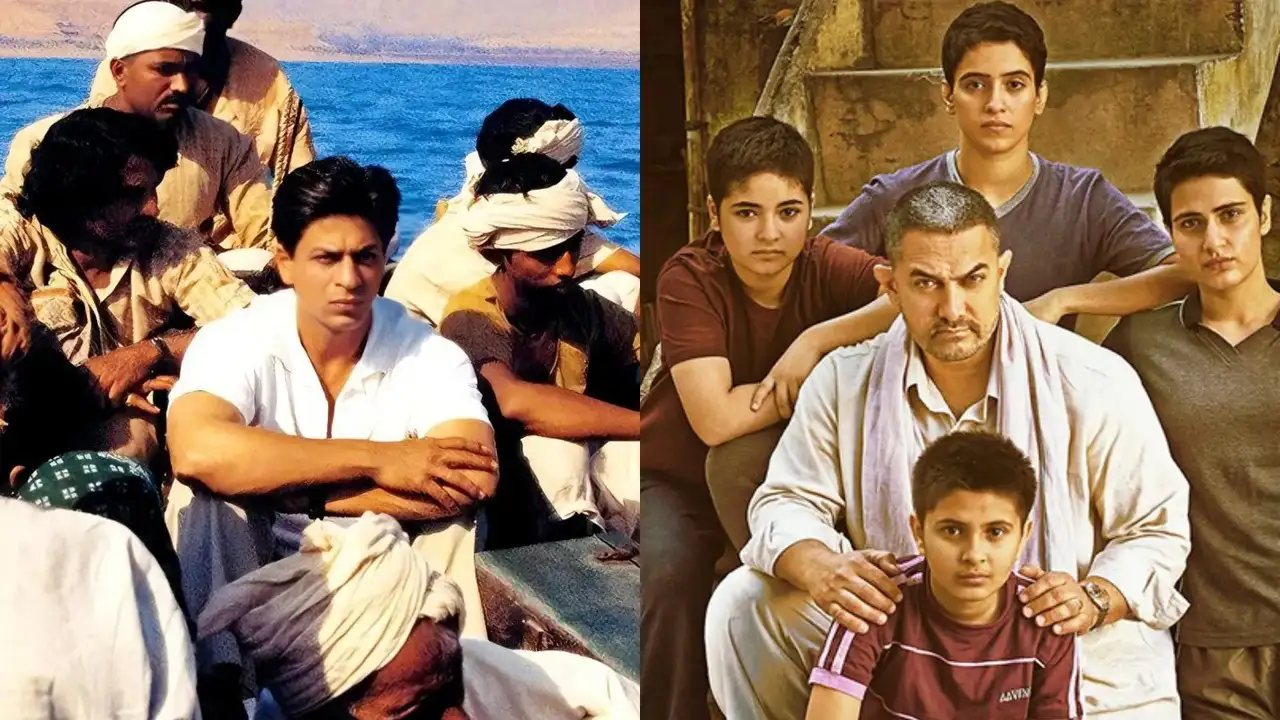
When Bollywood talks about patriotism, images of soldiers, battlefields, national flags and freedom fighters often come to mind. But India’s relationship with its cinema is far more nuanced. Some of the country’s most powerful stories have celebrated India without explicitly being patriotic films. They have explored the nation’s diversity, ambition, resilience, sporting spirit, social challenges and the dreams of its people. From Swades and Chak De! India to Dangal, Gully Boy and 12th Fail, these films found different ways to capture what makes India unique. This Independence Day, we look at films that celebrate the country beyond conventional ideas of patriotism.
7 films that found patriotism in India’s people, dreams and diversity
Swades
 Swades
Shah Rukh Khan plays Mohan Bhargava, a successful NASA scientist who returns to India to find his childhood nanny, Kaveri Amma. His stay in the village of Charanpur exposes him to issues such as unreliable electricity, social divisions and limited opportunities. Gradually, Mohan begins questioning his life abroad and decides to use his technical knowledge to help the community. Swades celebrates patriotism through development and personal responsibility rather than conventional nationalistic imagery. Its central idea is simple: contributing to the progress of one’s own community can be as meaningful as any grand patriotic gesture.
Chak De! India
 Chak De! India
Shah Rukh Khan stars as Kabir Khan, a former Indian hockey player who becomes coach of the women’s national team after facing public humiliation. The team brings together players from different states, cultures and social backgrounds, creating tensions rooted in regional identities and personal rivalries. Kabir’s challenge is to make them see themselves as one team before they can compete for India. Through their journey, Chak De! India celebrates India’s diversity and the ability to find common ground. Its patriotism comes naturally through sport, teamwork and the players’ shared determination to represent their country on the international stage.
Lagaan
 Lagaan
Aamir Khan plays Bhuvan, a young farmer in the fictional village of Champaner during British rule. When the villagers are threatened with an oppressive tax, Bhuvan accepts a challenge from the British to play a cricket match for their freedom from the levy. He brings together villagers who differ in caste, religion and social standing, teaching them the unfamiliar game in the hope of defeating their colonial rulers. While Lagaan is built around cricket and an underdog story, its larger appeal lies in how ordinary people overcome divisions and unite against a common oppressor.
Rang De Basanti
 Rang De Basanti
Siddharth and Sharman Joshi star as a group of friends who initially live carefree lives with little interest in India’s political history. Their outlook changes when they participate in a film about freedom fighters and begin drawing parallels between those historical figures and contemporary India. After the death of a friend exposes corruption and injustice, they decide to take action rather than remain passive. Rang De Basanti presents patriotism as something that can involve questioning authority, demanding accountability and refusing to accept injustice. Its focus remains on young Indians discovering what responsibility towards their country means.
Dangal
 Dangal
Aamir Khan plays Mahavir Singh Phogat, a former wrestler who dreams of winning a gold medal for India but eventually turns to training his daughters, Geeta and Babita. What begins as a father’s determination to make his children successful becomes a journey that challenges deeply rooted ideas about what girls can achieve. The sisters train rigorously and eventually compete at national and international levels, bringing recognition to Indian wrestling. Dangal is primarily a sports and family drama, but its story of women breaking barriers and representing India on the global stage gives it a strong connection to the theme.
Rocketry: The Nambi Effect
 Rocketry The Nambi Effect
R. Madhavan’s tells the real-life story of ISRO scientist Nambi Narayanan, whose work contributed to India’s space programme. The film follows his journey from his early years as an engineer to his work on India’s cryogenic technology and the controversy that changed his life. Rather than focusing on conventional ideas of patriotism, the film highlights scientific ambition, perseverance and the people working behind India’s technological progress. Nambi’s commitment to India’s space programme makes the film a fitting example of how contributing to the country’s scientific achievements can be a powerful expression of national pride.
 Newton
Newton
Rajkummar Rao plays Newton Kumar, a government clerk tasked with conducting an election in a remote, conflict-affected area of central India. Determined to follow electoral rules despite difficult circumstances, he struggles to ensure that villagers get a genuine opportunity to vote. The film offers a grounded look at India’s democracy, exploring the challenges faced by election workers and the gap between democratic ideals and realities on the ground. Rather than relying on conventional patriotic imagery, Newton finds its connection to the theme through its focus on citizens, voting and the effort required to uphold one of India’s most fundamental democratic processes.