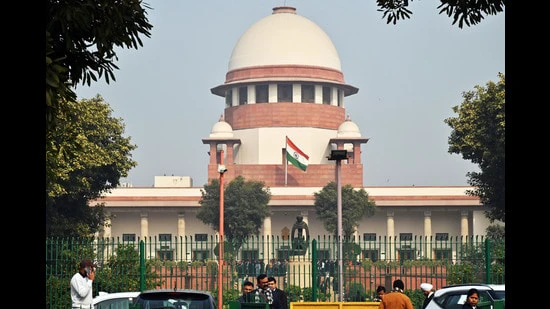
Emphasising that simplicity in public transactions is “good governance” and a constitutional value, the Supreme Court on Friday ruled that executive actions imposing unnecessary or excessive procedural requirements must be struck down as illegal.
In a ruling with wider significance for administrative efficiency and rule of law, a bench led by Justice PS Narasimha held that the principle that governance should facilitate, rather than burden, citizens’ access to administrative processes.
“Simplicity in public transactions is good governance. Constitutional courts uphold this virtue to strengthen the rule of law and ensure access to justice,” noted the court, stressing that administrative procedures must avoid “complexity, redundant requirements, and unnecessary burdens, which waste time, expense, and disturb peace of mind.”
The bench, also comprising Justice Atul S Chandurkar, underscored that judicial review must take into account not only relevant and irrelevant considerations behind executive decision-making but also broader constitutional commitments to efficiency and good governance.
The ruling is significant for curbing bureaucratic layering and executive overreach, often criticised as contributing to delays and inefficiencies in public administration. It reinforces that courts will intervene where procedural mandates result in avoidable obstacles for citizens or organisations.
The judgment came as the bench set aside a 2009 memo issued by the Jharkhand government that mandated cooperative societies to obtain a recommendation from the Assistant Registrar, Cooperative Societies, as a precondition for availing stamp duty exemption under Section 9A of the Indian Stamp (Bihar Amendment) Act, 1988.
The bench held that such an additional requirement, over and above the statutory certificate of registration already recognised as conclusive proof of the existence of a cooperative society, was “demonstrably superfluous and unnecessary,” consumed time and resources, and did not contribute value to the integrity of transactions.
The ruling came on an appeal filed by Adarsh Sahkari Grih Nirman Swawlamblambi Society Ltd, which challenged the state’s insistence that it must obtain an Assistant Registrar’s approval before availing exemption under the 1988 Act. The Society argued that this insistence had no basis in statutory mandate and merely prolonged administrative processing.
The bench agreed, holding that once a society is registered under the Jharkhand Self-Supporting Cooperative Societies Act, 1996, Section 5(7) of that Act states that the registration certificate is conclusive proof of its existence. Insisting on a second recommendation, the court observed, amounted to creating “a condition which the statute does not recognise, authorise, or require.”
Calling the additional certification mandate an “irrelevant consideration leading to illegality in action,” the bench found that once a cooperative society is registered under the Jharkhand Self-Supporting Cooperative Societies Act, 1996, Section 5(7) of the Act renders its registration certificate conclusive proof of existence. Therefore, insisting on a further recommendation was redundant and an impediment to ease of doing transactions.
Calling the State’s stand an example of defective decision-making, the court said judicial review is not confined to examining relevant and irrelevant considerations alone but must evaluate whether the executive process aligns with broader constitutional values of transparency, reasonableness and efficiency.
The bench noted that the memo was contrary to the legislative intent that encouraged cooperative housing activity by providing financial concessions in the form of reduced stamp duty. By inserting an unauthorised layer of certification, the State, instead of facilitating the intended benefit, had impeded it.
“This requirement is disruptive of ease of transaction, without any value addition to the integrity of the process,” the court observed, adding that procedures that merely consume time and administrative resources, without substantive purpose, cannot survive judicial scrutiny.
Criticising bureaucratic layering that results in delays and inefficiencies, the court said unnecessary procedural hurdles undermine predictability and certainty in public administration, which are components that are integral to investment, planning, and legal compliance by citizens.
Allowing the appeal, the bench set aside the judgments of both the single judge and the division bench of the Jharkhand High Court, which had previously upheld the state’s directive.