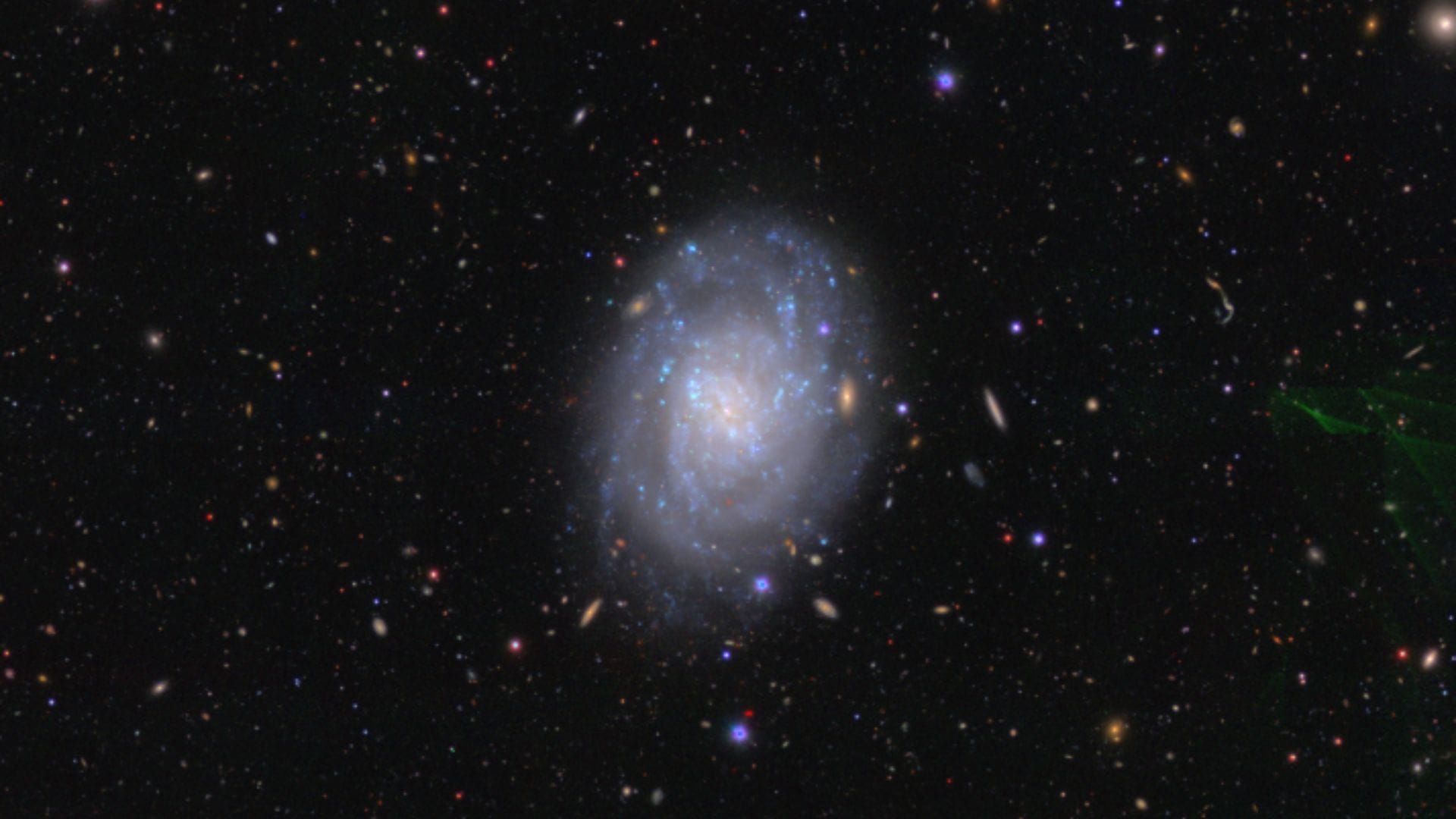
New Delhi: The Subaru Telescope, located on Mauna Kea in Hawaii, operated by the National Astronomical Observatory of Japan (NAOJ) has captured an image of an intermediate spiral galaxy designated as NGC 941, at a distance of 55 million lightyears from Earth in the constellation of Cetus. The faint galaxy exhibits characteristics between a barred spiral galaxy with a central bar that feeds gas and dust to the supermassive black hole occupying the galaxy core, and unbarred spiral galaxies. The galaxy has a bluish appearance overall, with dust lanes in the central regions indicating ongoing star formation. The galaxy is sitting in a field of distant galaxies of various sizes, shapes and colours.
The galaxy was discovered by the German-British astronomer William Herschel in January 1785. Intermediate spiral galaxies represent a transitional morphological type between classic barred spirals and unbarred spirals. They feature a weak lense-shape or partial central bar structure that is less pronounced than in fully barred galaxies. The intermediate bar can still channel gas and dust to the galaxy core, though less efficiently. The process fuels star formation as well as the central black hole. NGC 941 exemplifies this class with a bar-like elongation and loosely-would spiral arms.
How galaxies evolve
Astronomers believe such galaxies may evolve as bars form, strengthen or dissolve over cosmic time due to dynamical interactions, secular evolution or gravitational instabilities in the disk. NGC 941 spans about 55,000 lightyears in diameter and lies in a sparse region of space, allowing its delicate features to be pierced by light from far more distant background galaxies, visible as the tiny orange specks. Its bluish tint arises from young, hot stars in active-star forming regions, with the prominent dust lanes tracing where gas is compressed. The galaxy has hosted a number of supernovae. Such observations help scientists better understand how bars influence star formation.