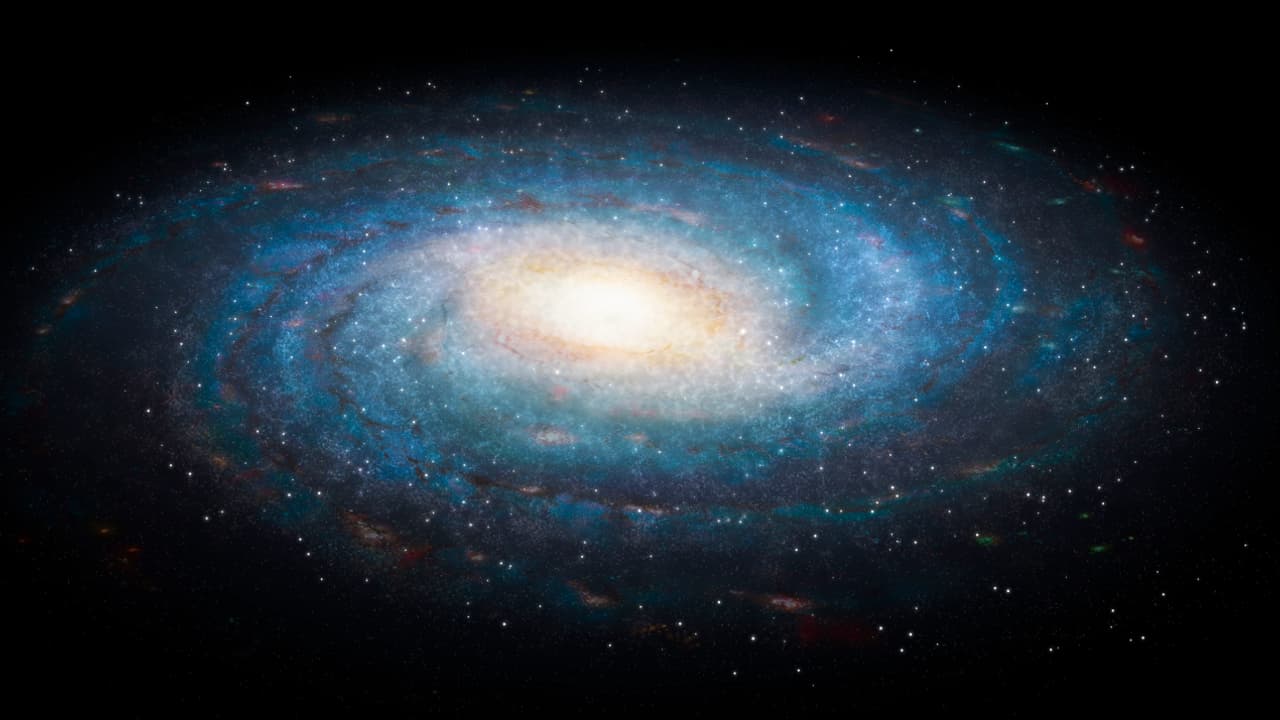
Uncover the secrets of Milky Way formation. New research uses simulations to explain the mysterious chemical divide in our stars, challenging old theories.
A recent scientific study provides new insights into how galaxies like the Milky Way form and develop across billions of years. It helps address a longstanding mystery regarding the unique chemical composition of many stars in our galaxy. The study was published in the Monthly Notices of the Royal Astronomical Society.
For a long time, astronomers studying stars close to the Sun have observed something unusual. These stars can be divided into two clear groups depending on the amounts of iron (Fe) and magnesium (Mg) they contain. When these elements are plotted on a graph, the stars form two separate lines, rather than a continuous pattern. This unusual division, known as chemical bimodality, has been hard to explain, especially because the two groups have similar levels of heavy elements, or metallicity.
Simulating the Birth of Galaxies
To investigate what might be responsible for this split, researchers from the Institute of Cosmos Sciences at the University of Barcelona and the French research organisation CNRS used advanced computer simulations called the Auriga simulations. These simulations enable scientists to create realistic “virtual” galaxies and observe their development over time, from the early Universe to the present day.
The team examined 30 simulated galaxies similar to the Milky Way. Their aim was to discover what kinds of events or processes could result in the two distinct groups of stars seen in real stars.
Understanding this chemical history is a key part of learning how the Milky Way formed. It also helps scientists compare our galaxy to others, such as Andromeda. Interestingly, Andromeda does not show the same chemical pattern, which suggests that galaxies can evolve in very different ways.
As lead author Matthew Orkney explains, the Milky Way’s chemical structure is not a “universal recipe”. Galaxies can grow along different paths and still end up looking broadly similar.
More Than One Way to Build a Galaxy
The simulations showed that there is no single explanation for the Milky Way’s chemical split. Instead, several different pathways can lead to two distinct groups of stars.
One possible cause is bursts of rapid star formation followed by calmer periods. Another involves changes in the flow of gas into the galaxy from its surrounding space. Gas is the raw material from which new stars are made, so the amount and composition of gas have a strong effect on how a galaxy develops.
The study also challenges an older idea that a major collision with a smaller galaxy, named Gaia-Sausage-Enceladus (GSE), was responsible for the chemical divide. Although this ancient collision did affect the Milky Way, the new simulations show that it is not necessary to create the two sequences.
Looking Ahead
Instead, the team found that fresh, metal-poor gas entering from the circumgalactic medium (a large cloud of gas surrounding a galaxy) plays a key role in forming the second branch of stars. In other words, the way a galaxy takes in new gas over time helps shape its chemical signature.
With powerful observatories such as the James Webb Space Telescope, and future missions like PLATO and Chronos, astronomers will soon have more detailed information about stars both inside and outside the Milky Way. These observations will help test the predictions made by the simulations and improve our understanding of how galaxies grow.
Source: Royal Astronomical Society. “This surprising discovery rewrites the Milky Way’s origin story.” ScienceDaily. ScienceDaily, 9 December 2025.